
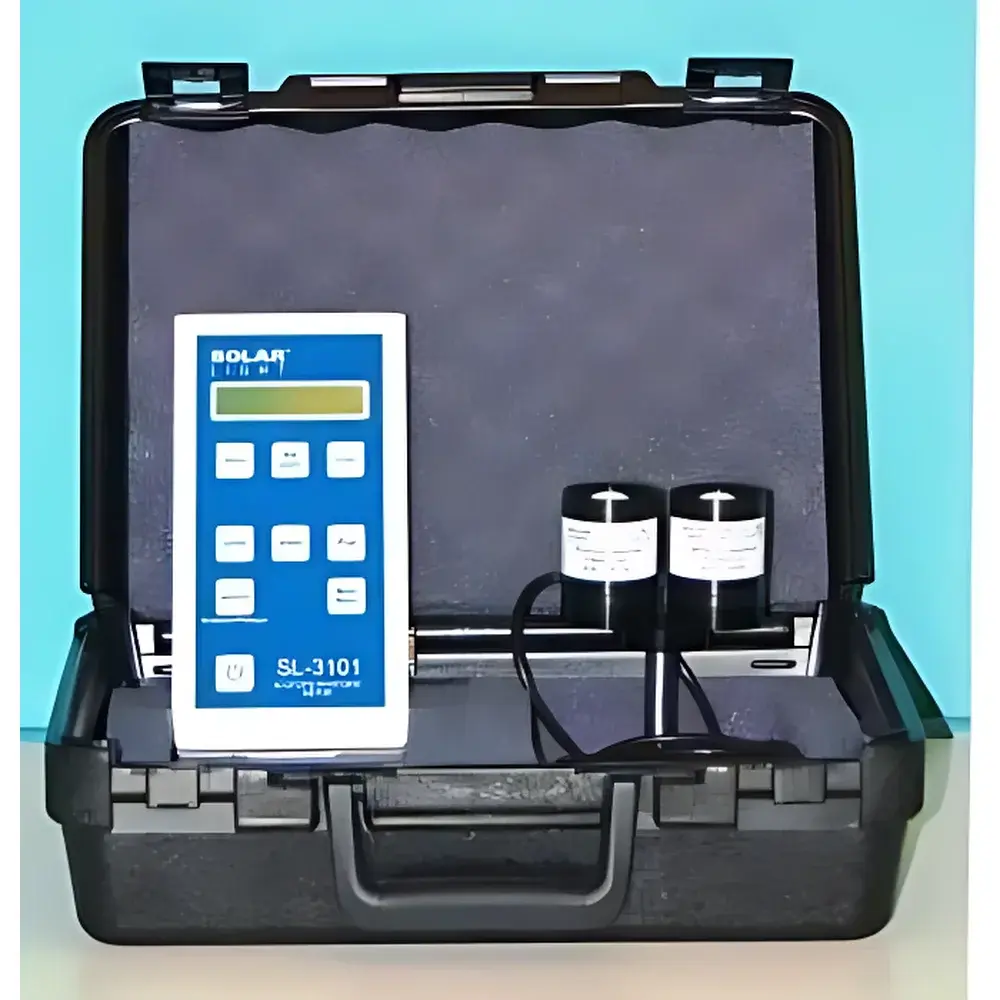
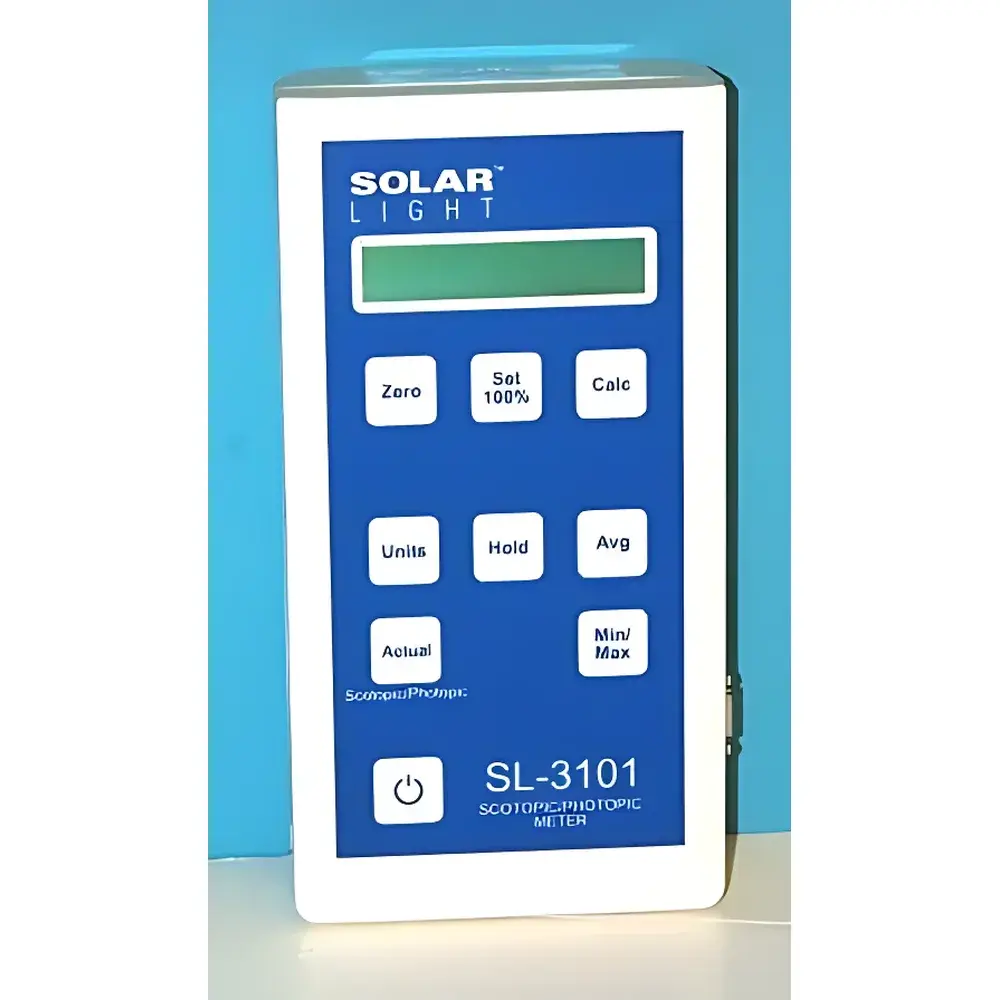
Solar Light SL-3101 Scotopic/Photopic Luminance Meter
| Brand | Solar Light |
|---|---|
| Origin | USA |
| Model | SL-3101 |
| Dynamic Range | 2.6 × 10⁶ (6.5 digits) |
| Accuracy | ±0.2% FS |
| Nonlinearity | ±0.003% |
| Temperature Coefficient | 50 ppm/°C |
| Max Sampling Rate | 3 Hz |
| Display Refresh Rate | 10 Hz |
| Operating Temperature | 0–50 °C |
| Power | 4 × AA alkaline batteries (≥40 h) or 9–12 V AC/DC adapter |
| Weight | 510 g |
| Dimensions | 10 × 4.35 × 19.3 cm |
| LCD Size | 6.4 × 1.3 cm |
| Photopic Detector (PMA2130) | Spectral Response CIE V(λ) (400–700 nm), Angular Response ≤5° (θ < 60°), Range: 0.01–150,000 lx, Resolution: 1 lx / 0.1 ft-cd |
| Scotopic Detector (PMA2131) | Spectral Response CIE V′(λ) (400–600 nm), Angular Response ≤5° (θ < 60°), Range: 0.01–150,000 lx, Resolution: 1 lx / 0.1 ft-cd |
Overview
The Solar Light SL-3101 Scotopic/Photopic Luminance Meter is a precision optical measurement instrument engineered for quantitative evaluation of spectral luminous efficiency in lighting environments. It implements dual-detector architecture calibrated to the CIE standard photopic luminosity function V(λ) (380–780 nm, peak at 555 nm) and scotopic luminosity function V′(λ) (380–650 nm, peak at 507 nm), enabling simultaneous measurement of photopic illuminance (Ev) and scotopic illuminance (Es). The instrument computes the critical S/P ratio—scotopic-to-photopic illuminance ratio—which serves as an objective metric for assessing mesopic visual performance under low-light conditions. Designed for metrological traceability, the SL-3101 supports spectral enhancement analysis in architectural lighting, roadway illumination, circadian lighting design, and energy-efficient retrofit validation. Its solid-state detector configuration, high dynamic range (2.6 × 10⁶), and temperature-stable analog front-end ensure reproducible measurements across ambient conditions from 0 to 50 °C.
Key Features
- Dual-channel detection system with independently calibrated photopic (PMA2130) and scotopic (PMA2131) sensors, each adhering to CIE 1924 and CIE 1951 reference curves
- Real-time S/P ratio calculation with auto-synchronized sampling at up to 3 Hz, supporting time-resolved mesopic assessment
- High-fidelity angular response (≤5% deviation at θ < 60°) compliant with IESNA LM-79 and CIE S 023/E:2012 requirements for cosine correction
- 6.5-digit dynamic range (2.6 × 10⁶) enables single-instrument operation across sub-lux ambient levels to direct sunlight intensities (up to 150,000 lx)
- Traceable calibration certificate included; sensor responsivity verified against NIST-traceable standards
- Integrated 2.5-inch monochrome LCD with 10 Hz refresh rate and user-configurable display units (lx, fc, cd/m², S/P)
- Rugged portable form factor (510 g, 10 × 4.35 × 19.3 cm) optimized for field deployment and lab-based spectral validation
Sample Compatibility & Compliance
The SL-3101 is compatible with all common light sources—including LED arrays, HID lamps, fluorescent tubes, OLED panels, and natural daylight—without requiring spectral pre-filtering or source-specific calibration. Its detector geometry satisfies the geometric conditions defined in CIE Publication 127:2007 for point-source and extended-source luminance measurement. The instrument complies with ISO/CIE 11664-1:2019 (colorimetry fundamentals), IEC 62471 (photobiological safety), and ANSI/IES RP-27.3-22 (photometric testing procedures). Data acquisition meets GLP audit requirements through deterministic timestamping, non-volatile memory storage, and full traceability of calibration coefficients embedded in firmware. While not FDA 21 CFR Part 11 certified out-of-box, raw data export (CSV/ASCII) supports integration into validated LIMS or QMS platforms for regulated environments.
Software & Data Management
The SL-3101 operates autonomously via its 9-key membrane keypad and onboard firmware; no host PC is required for routine measurements. For advanced analysis, optional Solar Light DataLink software (Windows-compatible) enables real-time telemetry streaming, batch logging, and S/P trend visualization over time. All stored datasets include metadata: date/time stamp, detector ID, ambient temperature, battery voltage, and operator-defined test labels. Exported files contain full-resolution sensor output (photopic and scotopic channels separately), computed S/P ratios, and uncertainty estimates derived from factory calibration matrices. Firmware updates are delivered via USB-mini interface and preserve user calibration offsets per detector module.
Applications
- Architectural lighting design validation for mesopic zones (e.g., corridors, stairwells, parking structures) per IES DG-22 and EN 12464-2
- Evaluation of circadian-effective lighting systems using melanopic EDI (Equivalent Daylight Illuminance) derived from S/P-weighted spectra
- Energy code compliance verification (ASHRAE 90.1, Title 24, LEED v4.1) where scotopic efficacy influences allowable lighting power density (LPD)
- Research on age-related photoreceptor sensitivity shifts, particularly in gerontological vision studies requiring V′(λ)-weighted metrics
- LED product development: quantifying blue-enriched spectrum impact on perceived brightness and visual acuity at low adaptation levels
- Transportation lighting audits, including tunnel portals and highway signage, where mesopic vision dominates driver perception
FAQ
Does the SL-3101 require periodic recalibration?
Yes. Solar Light recommends annual recalibration against NIST-traceable reference standards to maintain ±0.2% FS accuracy. Field verification using calibrated neutral-density filters is supported via internal diagnostic mode.
Can the instrument measure pulsed or modulated light sources?
It captures integrated values over each 333-ms sampling interval. For PWM-driven LEDs with frequencies >3 Hz, results represent time-averaged photopic/scotopic flux; high-frequency flicker analysis requires supplemental oscilloscopic instrumentation.
Is the detector cosine-corrected for off-axis incidence?
Yes. Both PMA2130 and PMA2131 detectors incorporate precision diffusers meeting CIE 127:2007 Type A angular response specifications (≤5% error at 60° incidence).
What is the measurement uncertainty budget?
Total expanded uncertainty (k=2) is ±0.4% for photopic mode and ±0.5% for scotopic mode, inclusive of nonlinearity, temperature drift (50 ppm/°C), and calibration residual errors.
Are replacement detectors field-swappable?
Yes. PMA2130 and PMA2131 modules are mechanically and electrically standardized; users may replace detectors in situ using supplied torque screwdriver and calibration ID transfer protocol.






