
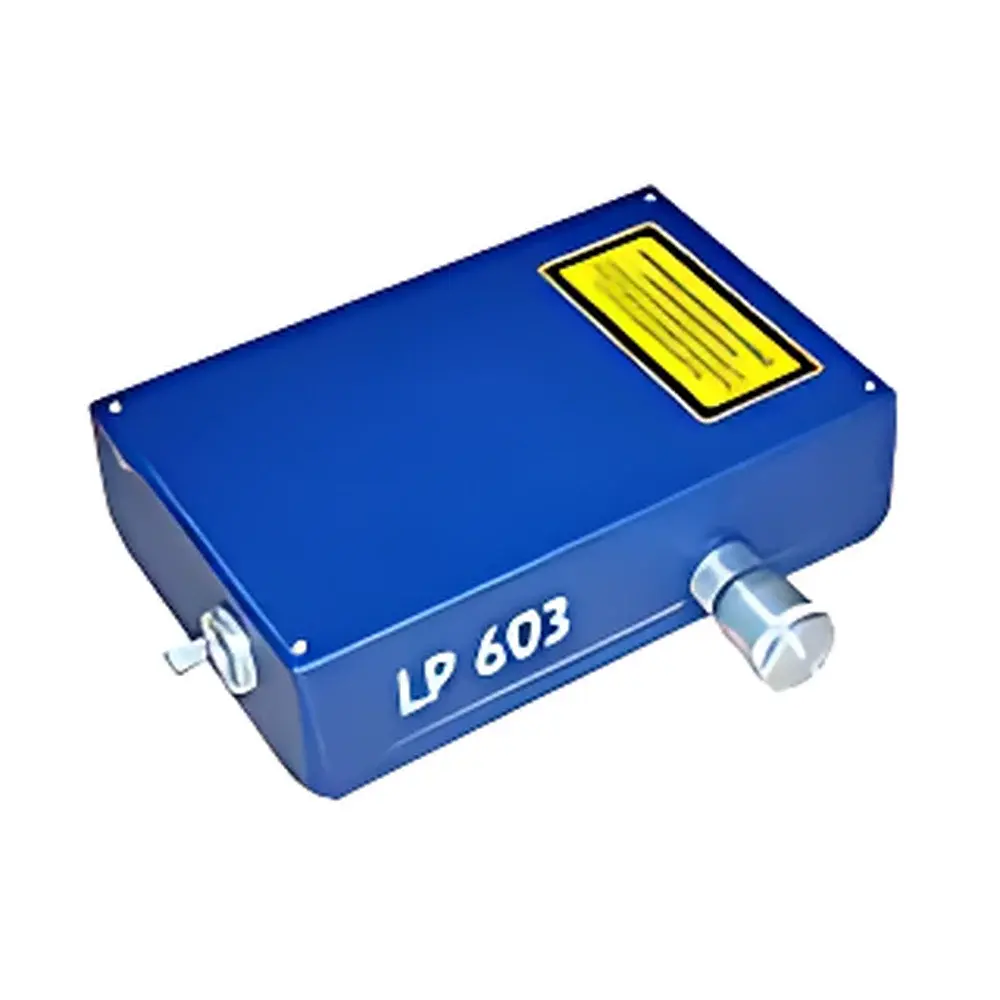
Solar LX329 Ti:Sapphire Tunable Laser System
| Brand | Solar |
|---|---|
| Origin | Belarus |
| Model | LX329 |
| Tuning Range (Fundamental) | 700–980 nm |
| SHG | 350–490 nm |
| THG | 235–320 nm |
| FHG | 210–240 nm |
| Linewidth (w/o etalon) | <0.05 nm |
| Linewidth (w/ etalon) | <0.005 nm |
| Repetition Rate | 10 Hz |
| Pulse Width | 7–30 ns |
| Beam Divergence | 1 mrad |
| Dimensions | 650 × 285 × 135 mm³ |
| Conversion Efficiency | Fundamental 25%, SHG 30%, THG/FHG 20% |
| Core Gain Medium | Ti:Sapphire Solid-State Crystal |
Overview
The Solar LX329 is a high-performance, solid-state tunable laser system based on titanium-doped sapphire (Ti:Sa) gain medium, engineered for precision wavelength agility across the visible and near-infrared spectrum. Operating on the principle of broadband gain amplification in a vibronically broadened crystal lattice, the LX329 delivers continuous, mode-locked or Q-switched pulsed output with exceptional spectral purity and spatial coherence. Its fundamental tuning range spans 700–980 nm, extendable to the deep UV (210–490 nm) via integrated harmonic generation stages—enabling direct access to biologically and spectroscopically critical bands without external optical parametric conversion. Designed for laboratory integration rather than turnkey operation, the LX329 emphasizes mechanical stability, thermal management, and alignment resilience—critical for long-duration experiments in ultrafast spectroscopy, quantum optics, and nonlinear frequency metrology.
Key Features
- High-fidelity Ti:Sapphire oscillator architecture with intracavity prism pair and birefringent filter for smooth, continuous wavelength scanning
- Dual-line etalon option for sub-5 pm linewidth narrowing (<0.005 nm), supporting high-resolution absorption and cavity ring-down spectroscopy
- Integrated harmonic generation module (SHG, THG, FHG) with optimized phase-matching geometry and automated crystal rotation control
- Robust thermal design featuring water-cooled crystal mount and low-drift cavity alignment—maintaining beam pointing stability <5 µrad over 8-hour operation
- Modular pump interface compatible with Q-switched Nd:YAG lasers (355 nm or 532 nm), enabling seamless synchronization with external timing systems
- Compliance-ready mechanical housing with CE marking, IEC 60825-1 Class 4 laser safety interlocks, and standardized SMA-905 fiber coupling ports (optional)
Sample Compatibility & Compliance
The LX329 is routinely deployed in environments requiring strict adherence to ISO/IEC 17025-accredited measurement practices and GLP-compliant photophysical characterization workflows. Its output stability (power drift <±1.5% over 4 h, wavelength repeatability ±0.1 nm) meets ASTM E275 and ISO 13694 requirements for reference-grade tunable sources. Harmonic generation efficiency data is traceable to NIST-calibrated power meters (Thorlabs S142C, calibrated at 266–1064 nm). The system conforms to EN 60825-1:2014 for laser product safety and incorporates redundant hardware shutter control, emission indicator LEDs, and key-switched enable circuitry—fully satisfying EU Machinery Directive 2006/42/EC and FDA 21 CFR Part 1040.10 laser safety regulations.
Software & Data Management
Control is executed via Solar’s proprietary LaserCommander v4.2 software suite, running on Windows 10/11 x64 platforms with native support for LabVIEW 2020+ (NI-VISA drivers included) and Python 3.8+ (PySolar API). All wavelength sweeps, harmonic selection, pulse energy monitoring, and etalon insertion states are logged with UTC timestamps and instrument metadata (serial number, firmware revision, ambient temperature/humidity from internal sensors). Audit trails comply with FDA 21 CFR Part 11 requirements—including electronic signatures, role-based user access levels (Operator, Technician, Administrator), and immutable event logs stored in encrypted SQLite3 databases. Raw spectral data exports support .csv, .h5 (HDF5), and .jdx (JCAMP-DX) formats for downstream analysis in Igor Pro, OriginLab, or MATLAB.
Applications
- Time-resolved fluorescence lifetime imaging (FLIM) in live-cell photobiology using tunable excitation between 700–950 nm for two-photon absorption minimization
- High-sensitivity cavity-enhanced absorption spectroscopy (CEAS) of transient radicals (e.g., OH, NO₂) in atmospheric simulation chambers
- Photoelectron spectroscopy (PES) source calibration across 210–490 nm UV ranges, leveraging FHG output with <0.005 nm linewidth
- Coherent anti-Stokes Raman scattering (CARS) microscopy with dual-beam synchronization (pump/probe) via external TTL triggering
- Quantum dot and perovskite photoluminescence excitation spectroscopy requiring <0.1 nm wavelength step resolution and <1% intensity variation
- Development and validation of optical frequency combs where absolute wavelength accuracy is referenced to iodine-stabilized HeNe lasers (633 nm)
FAQ
Is the LX329 compatible with external pulse pickers or regenerative amplifiers?
Yes—the system provides full TTL-compatible sync outputs (10 Hz master clock, pulse trigger, harmonic gate) and accepts external inhibit signals for pulse selection. Integration with standard regenerative amplifier chains (e.g., Spectra-Physics Spitfire) has been validated up to 1 kHz repetition rate via optional cavity dumping upgrade.
Can the harmonic generation modules be operated independently?
Each harmonic stage (SHG/THG/FHG) features independent motorized crystal translation and angle control; users may disable any stage while retaining fundamental output stability and beam collimation.
What maintenance intervals are recommended for optimal long-term performance?
Ti:Sapphire crystal inspection and cavity mirror cleaning are advised every 1,500 operating hours; harmonic crystal replacement is typically required after 5,000–7,000 hours depending on average fluence and environmental particulate load.
Does Solar provide factory calibration certificates with NIST-traceable wavelength verification?
Yes—each shipped LX329 includes a Certificate of Conformance with wavelength accuracy verified against a stabilized wavemeter (Bristol 621A, ±0.001 nm uncertainty) and power calibration referenced to a NIST-traceable thermopile sensor (Ophir 3A-FS).



