
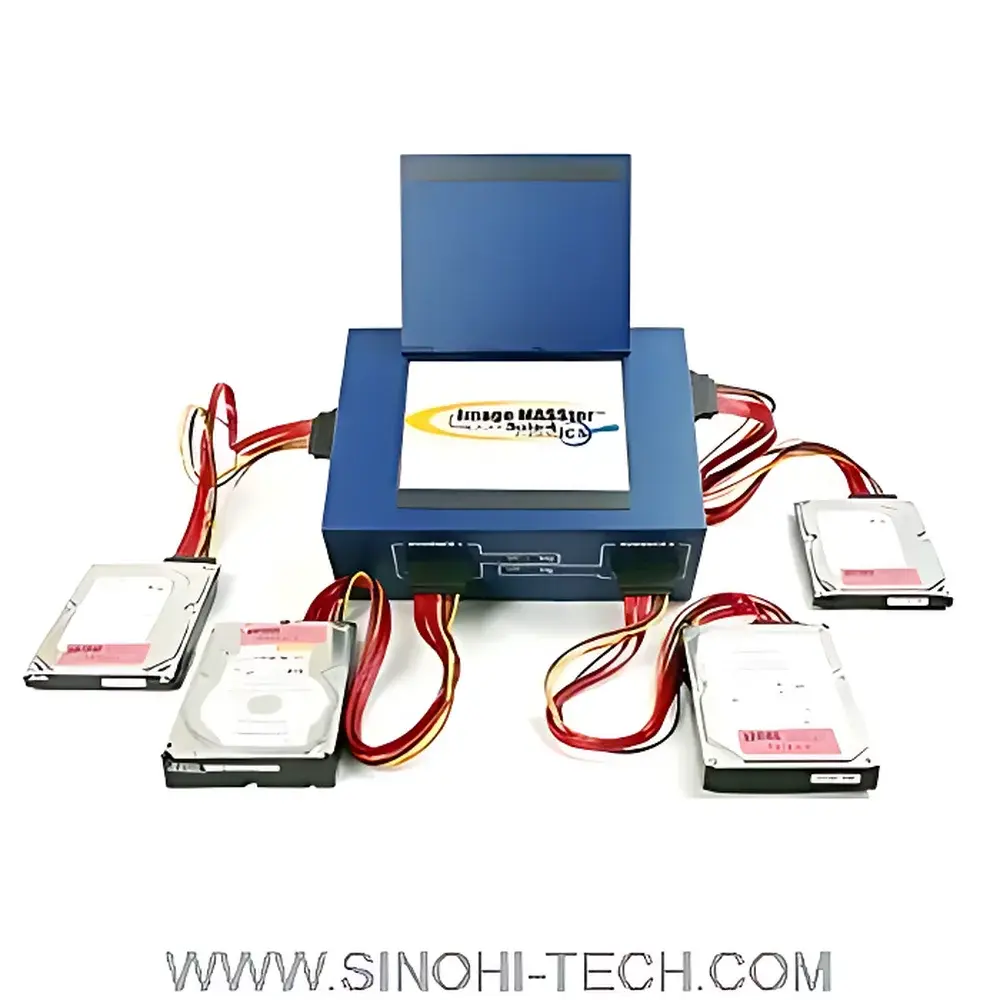
Solo4 Forensic Hard Drive Duplicator
| Origin | USA |
|---|---|
| Manufacturer Type | Authorized Distributor |
| Origin Category | Imported |
| Model | Solo4 |
| Pricing | Available Upon Request |
Overview
The Solo4 Forensic Hard Drive Duplicator is a purpose-built, standalone hardware imaging solution engineered for digital forensics laboratories, law enforcement agencies, and eDiscovery service providers requiring high-integrity, court-admissible disk duplication. Operating on a real-time Linux-based embedded platform, the Solo4 performs bit-for-bit cloning without host OS interference—ensuring forensic soundness per NIST SP 800-86 and ISO/IEC 27037 standards. Its architecture eliminates reliance on external workstations, reducing contamination vectors and eliminating software-layer vulnerabilities. The device implements full-disk imaging via raw sector-by-sector copying, preserving all user data, unallocated space, slack space, and firmware-reserved areas—including Host Protected Area (HPA) and Device Configuration Overlay (DCO)—without requiring prior BIOS or controller-level intervention.
Key Features
- Maximum cloning throughput of 18 GB/min (sustained), achieved through parallel SATA III (6 Gbps) and SAS 12 Gbps channel optimization, with hardware-accelerated hashing and AES encryption operating concurrently without performance penalty
- Native support for heterogeneous source/target interfaces: SATA I–III, SAS (6/12 Gbps), IDE (PATA), and USB 3.0 mass storage devices — enabling cross-interface cloning without protocol translation artifacts
- Tri-clone topology: simultaneous duplication from one source to up to three independent targets (“1-to-3” mode), or concurrent bidirectional cloning across three independent channels (“3-to-3” mode) for lab-scale evidence triage
- Forensic output formats include raw
.dd(Linux dd-compatible), Expert Witness Compression Format (.E01v1/v2/v3), with integrated compression, segmentation, and metadata logging (case number, examiner ID, timestamp, hash values) - Dedicated hardware write-blocker on all evidence drive ports, compliant with NIST SP 800-72 and DC3 guidelines, preventing any unintended writes to source media at the physical controller level
- Multi-algorithm integrity verification: MD5, CRC32, SHA-1, and SHA-2 (SHA-256) — all computed in real time using FIPS 140-2 validated cryptographic modules; SHA-1/SHA-256 acceleration offloaded to on-board ASICs
- On-the-fly AES-192 and AES-256 encryption of cloned images, configurable per job, with key management via secure USB token or PIN-authenticated internal keystore
- Two certified sanitization modes: DoD 5220.22-M 7-pass overwrite (NIST SP 800-88 Rev. 1 compliant) and fast zero-fill erasure, both verified with post-erase read-back validation
Sample Compatibility & Compliance
The Solo4 supports 2.5″ and 3.5″ SATA/SAS HDDs and SSDs (including NVMe via compatible U.2 adapters), IDE drives up to ATA-7, and USB-connected storage devices recognized as SCSI transparent command sets. It maintains compatibility with legacy forensic workflows involving EnCase, FTK Imager, and Autopsy by generating industry-standard hash-verified E01 and DD images with embedded case metadata. All cloning operations generate audit logs meeting GLP/GMP documentation requirements and are fully traceable under FDA 21 CFR Part 11-compliant environments when deployed with optional network logging and centralized log aggregation.
Software & Data Management
Although fully functional as a standalone appliance, the Solo4 integrates with enterprise forensic case management systems via its built-in Ethernet port (10/100/1000 Mbps) and RESTful API. Logs—including job start/end timestamps, source/target serial numbers, hash values, error codes, and operator credentials—are exportable in CSV or XML format. Firmware updates are delivered via signed packages over HTTPS, ensuring supply-chain integrity. The intuitive 7-inch capacitive touchscreen runs a hardened Linux UI localized in Simplified Chinese, English, Spanish, and Arabic—designed for glove-compatible operation in field labs and mobile response units.
Applications
- Law enforcement digital evidence acquisition in compliance with ACPO Good Practice Guide and ENFSI recommendations
- Corporate incident response teams performing rapid, defensible imaging of endpoint storage during breach investigations
- Government agencies conducting large-volume media processing for intelligence analysis or regulatory audits
- Third-party eDiscovery vendors fulfilling chain-of-custody requirements for litigation support
- Academic and training labs teaching forensic acquisition methodology with reproducible, auditable results
FAQ
Does the Solo4 require a host computer to operate?
No — it is a fully autonomous, self-contained duplicator with embedded Linux OS and no dependency on external PCs or drivers.
Can it clone NVMe drives directly?
NVMe support is available via optional U.2-to-SAS adapter kits; native PCIe/NVMe slot integration is not provided in the base Solo4 configuration.
Is HPA/DCO detection performed before or during cloning?
HPA and DCO detection occurs automatically during pre-cloning media analysis and is reported in the job log prior to initiation — no manual intervention is required.
How is cryptographic key security enforced during AES-encrypted cloning?
Keys are generated and stored exclusively within a tamper-resistant secure element; export outside the device requires multi-factor authentication and is logged in the immutable audit trail.
What environmental certifications does the Solo4 hold?
It meets UL/CSA 61010-1 (Safety Requirements for Electrical Equipment), FCC Part 15 Class B, and CE marking for EMC and RoHS compliance. Operating temperature and humidity specifications align with IPC-CC-830B Class 2 for industrial-grade reliability.





