
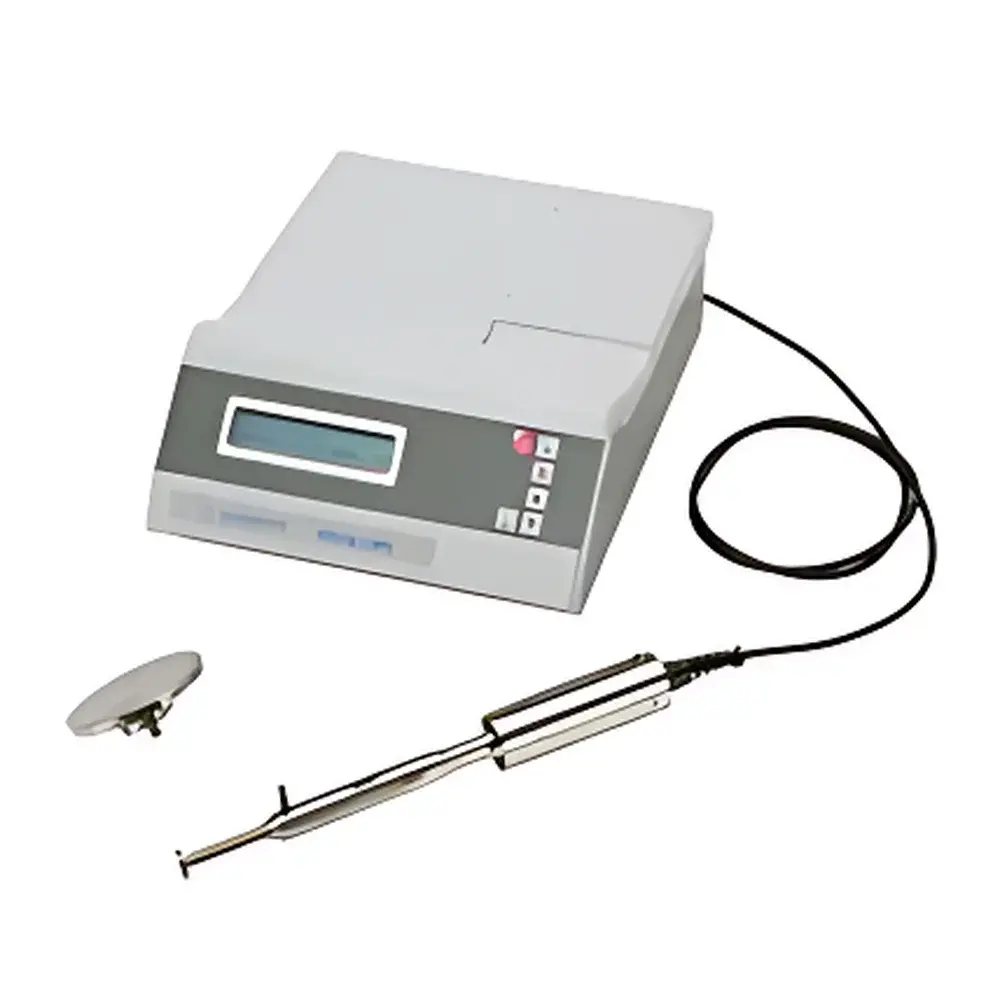
SONICS VCX130AT Ultrasonic Nebulizer
| Brand | Sonics |
|---|---|
| Origin | USA |
| Model | VCX130AT |
| Instrument Type | Ultrasonic Cell Disruptor |
| Power Output | 130 W |
| Operating Frequency | 20 kHz |
| Maximum Nebulization Rate | 16 L/hr |
| Droplet Size | 45 µm |
| Max. Fluid Viscosity | 60 cP |
| Nebulization Mode | Pressure-Free |
| Probe Replacement Cost | Low |
| Ambient Contamination | Minimal |
Overview
The SONICS VCX130AT Ultrasonic Nebulizer is a high-performance, benchtop ultrasonic dispersion system engineered for precise, pressure-free aerosol generation in life science and bioprocessing applications. Unlike conventional pneumatic or piezoelectric nebulizers, the VCX130AT employs high-intensity, low-frequency (20 kHz) ultrasonic energy transmitted via a titanium alloy probe to induce capillary wave formation at the liquid–air interface—resulting in controlled droplet ejection through the principle of ultrasonic cavitation-induced atomization. This mechanism enables consistent generation of monodisperse aerosols with a nominal median droplet diameter of 45 µm, making it suitable for inhalation toxicology studies, pulmonary drug delivery formulation development, bioaerosol generation for challenge testing, and continuous-feed sample introduction into mass spectrometry or optical particle counters. Its 130 W output power provides stable energy delivery across variable load conditions, supporting both continuous and duty-cycled operation without thermal runaway or probe erosion under validated protocols.
Key Features
- Stable 20 kHz ultrasonic frequency with digital generator feedback control for amplitude consistency and long-term reproducibility
- Pressure-free nebulization architecture eliminates compressed gas dependency, reducing infrastructure requirements and operational noise
- Titanium horn design optimized for chemical resistance and mechanical durability in aqueous, organic, and mildly corrosive media
- Scalable throughput up to 16 L/hr with flow-regulated peristaltic feed compatibility (external pump required)
- Low-viscosity tolerance extended to 60 cP—enabling processing of cell lysates, protein solutions, and polymer suspensions without pre-dilution
- Modular probe configuration allows rapid interchange of standard and custom-tip geometries; replacement probes are field-serviceable with minimal downtime and cost
- Integrated thermal cutoff and impedance monitoring prevent probe overload during extended runs or viscosity shifts
Sample Compatibility & Compliance
The VCX130AT accommodates a broad range of biological and synthetic samples, including mammalian and microbial cell suspensions, viral vectors, liposomal formulations, nanoparticle colloids, and viscous biopolymer solutions. It complies with general laboratory safety standards for Class II ultrasonic equipment (IEC 61000-6-3, IEC 61000-6-4) and supports Good Laboratory Practice (GLP) workflows through traceable operating parameters (amplitude, duration, cycle timing). While not certified for GMP manufacturing environments, its design aligns with FDA-recommended controls for aerosol-based analytical method development (e.g., USP on inhalation product characterization). All wetted surfaces are constructed from ASTM F136-grade titanium and PTFE—ensuring extractables compliance per USP Class VI and ISO 10993-5 cytotoxicity guidelines.
Software & Data Management
The VCX130AT operates via an embedded digital controller with front-panel LCD interface, supporting manual amplitude adjustment (0–100% in 1% increments), timer-based run cycles (1 s to 99 hr), and pulse-mode programming (on/off intervals from 0.1 to 99.9 s). Optional RS-232 or USB-to-serial interface enables integration with LabVIEW, MATLAB, or custom SCADA systems for automated logging of real-time amplitude, current draw, and runtime. Audit-trail functionality—including user ID stamping, parameter change history, and session timestamps—is available via third-party data acquisition software compliant with 21 CFR Part 11 when deployed with electronic signature modules.
Applications
- Inhalation toxicology exposure systems requiring calibrated, respirable-range aerosols (e.g., OECD TG 412, ISO 10871)
- Preclinical formulation screening for dry powder inhalers (DPIs) and pressurized metered-dose inhalers (pMDIs)
- Generation of standardized bioaerosols for HVAC filter challenge testing or biosafety cabinet validation
- Online coupling to ICP-MS or single-particle ICP-MS for elemental quantification of nanoparticles in suspension
- Cell disruption support in multi-step lysis workflows where gentle, non-thermal fragmentation preserves epitope integrity
- High-throughput sample nebulization for MALDI-TOF matrix application or electrospray ionization source conditioning
FAQ
Is the VCX130AT suitable for sterile aerosol generation in cleanroom environments?
Yes—when paired with sterilizable titanium probes and validated aseptic handling procedures, the VCX130AT can operate in ISO Class 5–7 environments. Sterilization via autoclaving (121°C, 20 min) or vaporized hydrogen peroxide (VHP) is compatible with all standard probe configurations.
Can the device be integrated into a closed-loop recirculation system?
Yes—the unit accepts gravity-fed or peristaltic inlet flow and features a bottom-drain port compatible with tubing connections. Closed-loop operation requires external temperature control and degassing to prevent cavitation instability.
What maintenance intervals are recommended for sustained performance?
Probe tip inspection every 200 hours of cumulative use; full generator calibration annually or after 1,000 hours—per manufacturer’s service bulletin VCX-SVC-2023-04.
Does SONICS provide application-specific validation protocols?
SONICS offers Application Notes (AN-VCX130AT-01 through AN-VCX130AT-07) covering aerosol D50 verification, viscosity compensation curves, and regulatory alignment guidance—but does not perform on-site IQ/OQ/PQ validation.




