
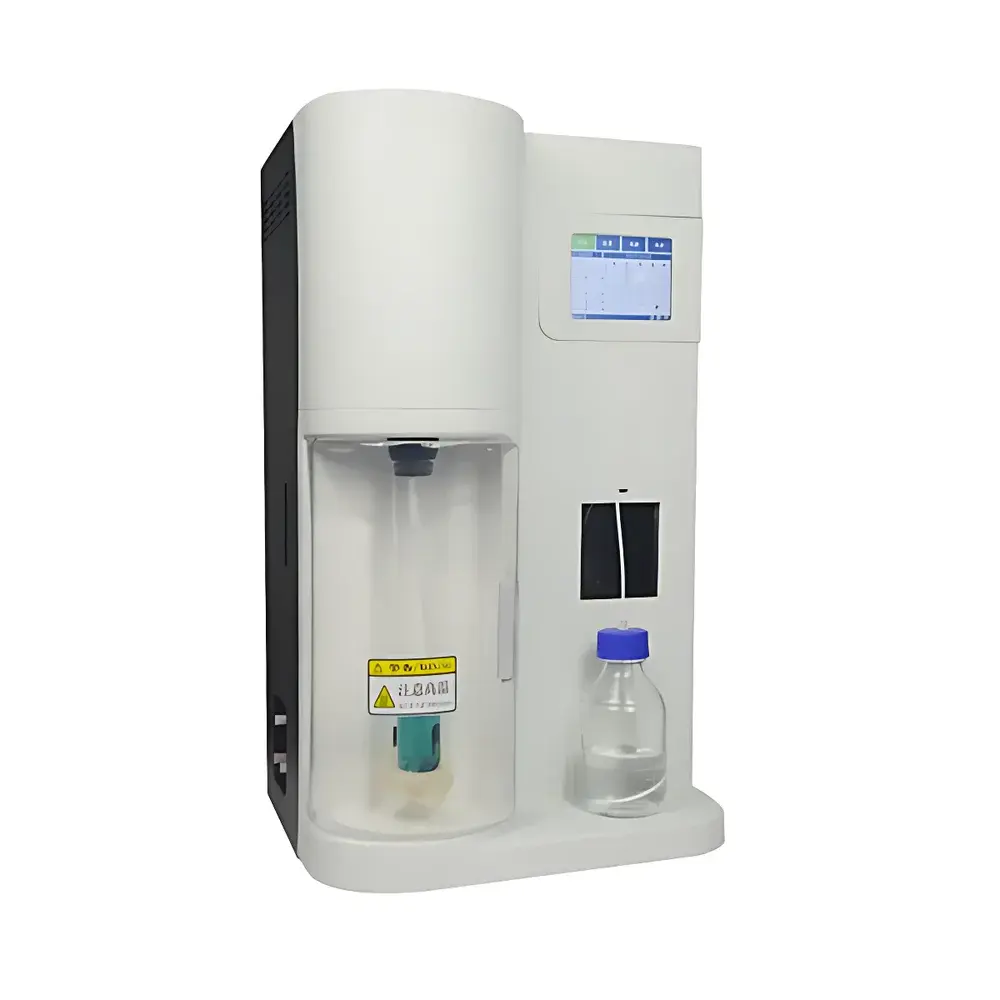
Sonnen K1306 Fully Automated Kjeldahl Nitrogen Determinator
| Brand | Sonnen |
|---|---|
| Origin | Shanghai, China |
| Model | K1306 |
| Instrument Type | Kjeldahl Nitrogen Determinator |
| Automation Level | Fully Automated |
| Nitrogen Determination Range | 0.1–240 mg N |
| 蒸馏时间 | 0–99 min (dynamically adjustable) |
| Repeatability | ±0.5% |
| Sample Weight Capacity | ≤6 g (solid), ≤25 mL (liquid) |
| Nitrogen Recovery Rate | ≥99.5% (at 100 ± 0.5 mg N) |
| Power Rating | 1800 W |
| Dimensions (L×W×H) | 420 × 365 × 710 mm |
| Linearity | RSD ≤1% within 1–3× nominal nitrogen content in digestion tube |
| Cooling Water Flow Rate | ≥1.5 L/min |
| Steam Flow Control | 0–100% |
| Distillation Delay | 0–999 min |
| Net Weight | 30 kg |
| Safety Certifications | ISO 9001, CE |
Overview
The Sonnen K1306 Fully Automated Kjeldahl Nitrogen Determinator is an engineered solution for precise, traceable, and regulatory-compliant total nitrogen quantification in routine and high-throughput laboratory environments. Based on the internationally standardized Kjeldahl method (ISO 8968-1, AOAC 984.13, ASTM D1142, USP & EP monographs), the system executes complete sample digestion, alkaline steam distillation, boric acid trapping, and potentiometric or colorimetric endpoint titration—fully unattended. Its architecture integrates process-critical safeguards—including dual-level water level monitoring, real-time steam pressure regulation, thermal cutoffs, and interlocked safety shielding—to ensure operational integrity during extended batch runs. Designed for laboratories subject to GLP, GMP, or ISO/IEC 17025 accreditation requirements, the K1306 supports full auditability through timestamped event logs, electronic signatures (via optional software modules), and 21 CFR Part 11–compliant data handling when integrated with validated LIMS or ELN platforms.
Key Features
- Fully automated reagent dispensing (H2SO4, NaOH, boric acid), distillation, titration, waste evacuation, and system rinsing—eliminating manual intervention across all analytical phases.
- High-fidelity colorimetric endpoint detection using a 16-bit trichromatic digital color sensor with user-adjustable calibration; supports both automatic and manual spectral reference alignment.
- Precision 2.0 µL per step titration system featuring a monolithic PTFE-coated plunger pump—engineered for long-term stability, minimal carryover, and resistance to particulate-induced clogging.
- Intelligent steam generator with integrated pressure transducer, dual temperature sensors, dry-run protection, auto-refill, and dynamic pressure modulation (0–100% range) to maintain optimal distillation kinetics without overpressure risk.
- Dual-mode operation: seamless switching between fully automated and manual override protocols for method development, troubleshooting, or validation exercises.
- Corrosion-resistant PTFE diaphragm alkaline dosing pump—specifically rated for aggressive caustic solutions and suspended solids commonly present in digested agricultural or environmental matrices.
- Water conservation architecture: cooling water activates only during distillation; flow rate (≥1.5 L/min) is continuously monitored, with low-pressure alarm and automatic shutdown upon interruption.
- Modular digestion station with transparent acrylic safety shield, position-sensing digestion tube detection, and thermal isolation—ensuring operator protection and consistent ammonia volatilization kinetics.
Sample Compatibility & Compliance
The K1306 accommodates diverse solid and liquid matrices within defined mass/volume limits (≤6 g solids or ≤25 mL liquids per digestion tube), making it suitable for foodstuffs (e.g., dairy, cereals, meat), pharmaceutical excipients, soil and fertilizer extracts, wastewater sludge, feedstuffs, and polymer additives. It complies with core regulatory frameworks including ISO 8968 (milk protein), ISO 1871 (foodstuffs), AOAC Official Methods 984.13 and 991.20, and EPA Method 350.1. All critical hardware components—including steam generator, titration manifold, and reagent delivery lines—are constructed from chemically inert materials (borosilicate glass, PTFE, 316 stainless steel) to prevent catalytic interference or leaching. The system meets CE Directive 2014/30/EU (EMC) and 2014/35/EU (LVD), and is certified under ISO 9001:2015 for design and manufacturing quality management.
Software & Data Management
The embedded 7-inch capacitive touchscreen interface provides bilingual (English/Chinese) navigation, real-time graphical monitoring of steam pressure, temperature, titration curve progression, and reagent levels. Method parameters—including digestion time presets, alkali volume, condensate flow duration, and distillation delay—are stored as editable templates. Up to 1,000 complete test records—including raw titration curves, calculated %N, %protein (using standard conversion factors), RSD values, and operator ID—are retained internally with UTC timestamps. Data export is supported via USB 2.0 to CSV or PDF formats. When connected to enterprise-grade laboratory informatics systems, the K1306 supports HL7 and ASTM E1384 messaging protocols for automated result transfer and metadata synchronization.
Applications
The K1306 delivers robust performance across regulated and research-driven use cases: determination of crude protein in animal feed and infant formula (per AOAC 984.13); total nitrogen in soil and compost (ISO 11261); ammoniacal nitrogen in wastewater effluents (EPA 350.1); nitrogen content in pharmaceutical active ingredients and excipients (USP ); and cation exchange capacity (CEC) assessment in clay-rich geological samples via ammonium acetate displacement. Its high recovery rate (≥99.5%) and repeatability (±0.5%) enable reliable compliance testing for ISO/IEC 17025-accredited laboratories performing proficiency testing or participating in interlaboratory comparison schemes.
FAQ
What digestion methods are compatible with the K1306?
The instrument is designed exclusively for classical Kjeldahl digestion using concentrated sulfuric acid and catalysts (e.g., CuSO4/K2SO4). Microwave or block-digestion units are external accessories and not integrated into the K1306 platform.
Does the system support USP or Ph. Eur. 2.5.20 compliance?
Yes—the K1306 implements the core procedural requirements of both monographs, including controlled alkaline distillation, boric acid absorption, and endpoint titration. Full compliance requires documented IQ/OQ/PQ, method validation per ICH Q2(R2), and integration with 21 CFR Part 11–enabled software.
Can the K1306 be used for non-protein nitrogen (NPN) analysis?
Yes—by coupling with appropriate sample pre-treatment (e.g., TCA precipitation), the system enables selective quantification of NPN in dairy or biological matrices, provided the residual filtrate falls within the 0.1–240 mg N linear range.
Is remote diagnostics or firmware update capability available?
Firmware updates are performed locally via USB; remote diagnostic access is not natively supported but may be enabled through third-party secure VPN configurations in enterprise deployments.
What maintenance intervals are recommended for the PTFE diaphragm pump?
Under typical usage (≤20 samples/day), the alkaline dosing pump requires inspection every 6 months and replacement of the diaphragm assembly every 12–18 months, as verified by flow calibration checks per JJF 109–2012 guidelines.




