
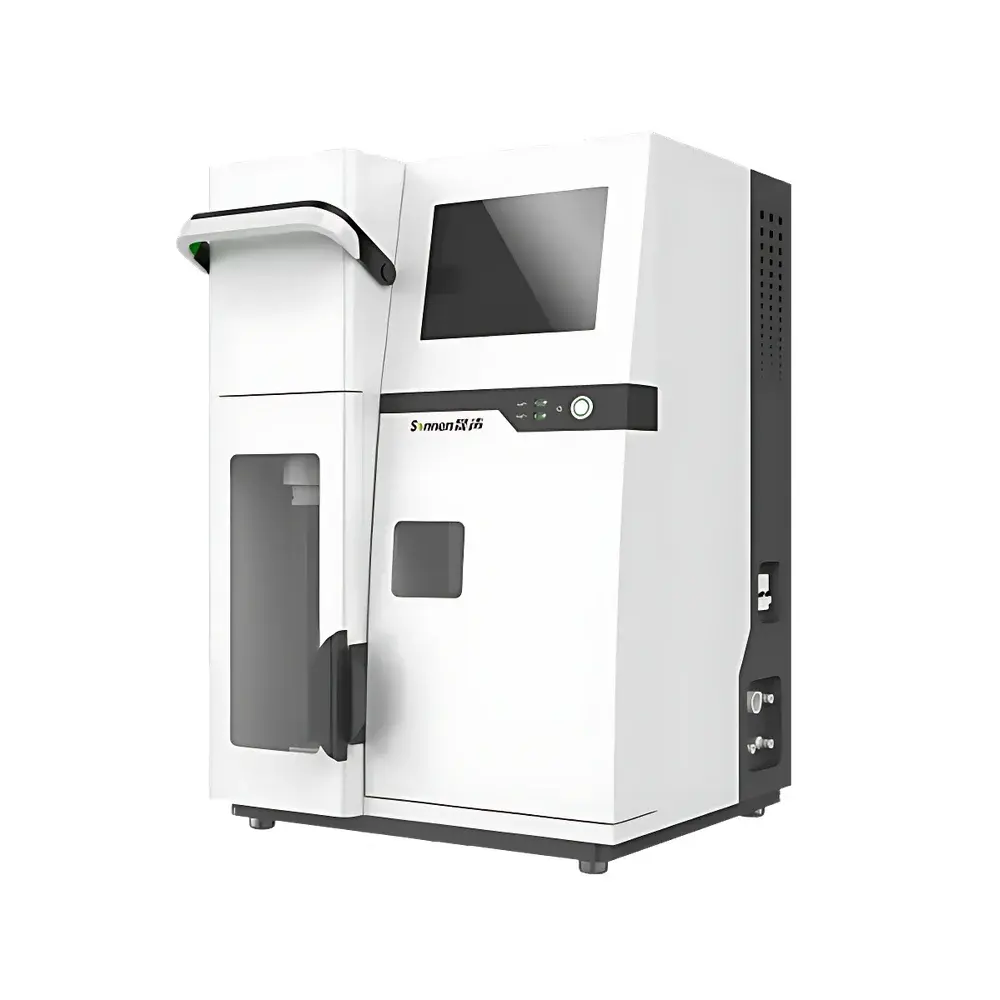
Sonnen K18 Fully Automated Kjeldahl Nitrogen Determinator
| Brand | Sonnen |
|---|---|
| Origin | Shanghai, China |
| Model | K18 |
| Instrument Type | Fully Automated Kjeldahl Nitrogen Determinator |
| Nitrogen Range | 0.1–240 mg N |
| Distillation Time (Ammonium Nitrogen) | 3–7 min/sample |
| Repeatability | ≤0.2% RSD |
| Sample Weight | ≤5 g (solid) or ≤25 mL (liquid) |
| Recovery Rate | ≥99.8% |
| Power Consumption | 1800 W |
| Dimensions (L×W×H) | 460 × 450 × 720 mm |
| Linearity | RSD ≤1% within 1–3× nitrogen concentration in digestion tube |
| Titration Resolution | 0.1 µL/step |
| Internal Data Storage | 1,000,000 test records |
| User-Defined Methods | 500 |
| Cooling Water Flow | 0.5 L/min (at 15 °C), 1.5 L/min (at 25 °C) |
| Compliance | ISO 9001, CE Marked |
| Automation Level | Fully Automated (reagent dosing, steam distillation, boric acid absorption, potentiometric/colorimetric titration, waste discharge, calibration, reporting) |
Overview
The Sonnen K18 Fully Automated Kjeldahl Nitrogen Determinator is an integrated, regulatory-compliant analytical platform engineered for precise, trace-level nitrogen quantification via the classical Kjeldahl method—comprising acid digestion, alkaline steam distillation, boric acid trapping, and endpoint-determined titration. Designed for laboratories requiring high-throughput, auditable, and GLP/GMP-aligned elemental nitrogen analysis, the K18 implements a validated physicochemical workflow aligned with international standards including ISO 8968 (milk protein), ISO 5983 (feed), AOAC 981.10 and 984.27 (food), and Chinese national standards GB/T 22923–2008 and JJF 109–2012. Its measurement principle relies on quantitative ammonia liberation under controlled steam distillation conditions, followed by stoichiometric acid–base titration with real-time colorimetric endpoint detection using a 16-bit trichromatic digital sensor. The system delivers trace sensitivity down to 10 ppm nitrogen while maintaining metrological integrity across heterogeneous matrices—from viscous dairy slurries and high-fat animal feeds to environmental soil extracts and pharmaceutical excipients.
Key Features
- Fully automated end-to-end operation: reagent dispensing (H2SO4, NaOH, boric acid), digestion tube handling, steam distillation, condensate collection, colorimetric titration, waste evacuation, and report generation—all without manual intervention.
- Dual-mode steam generation: adjustable steam flow (0–100%) enables method optimization for volatile nitrogen species (e.g., ammonium) and robust recovery for complex matrices such as nitrate-rich fertilizers or high-protein cereals.
- Dynamic synchronous titration: titration initiates during distillation; the system autonomously modulates titrant delivery rate based on real-time color gradient kinetics, reducing total assay time by up to 40% versus sequential protocols.
- Multi-layer safety architecture: pressure-sensor-monitored steam generator, dual water-level detection (float + electrode), overtemperature cutoffs, door-interlocked operation, condensate temperature monitoring (to ensure complete ammonia condensation), and low-flow cooling water alarm with automatic shutdown.
- ARM-based embedded OS with 10-inch HD capacitive touchscreen: supports bilingual (English/Chinese) UI, real-time process visualization, and contextual operation assistant prompts.
- Four-tier user permission model (Program Administrator → Master Administrator → Assistant Administrator → Operator) with time-stamped audit trails, data locking, and role-specific access control—fully compliant with FDA 21 CFR Part 11 and EU Annex 11 requirements for electronic records and signatures.
Sample Compatibility & Compliance
The K18 accommodates solid samples up to 5 g and liquid samples up to 25 mL per digestion tube, supporting routine analysis of foodstuffs (dairy, meat, grains), feedstuffs (soybean meal, fishmeal), agricultural soils, wastewater sludge, pharmaceutical intermediates, and tobacco products. Its corrosion-resistant 304 stainless steel distillation chamber and PTFE-coated safety door withstand prolonged exposure to concentrated sulfuric acid and caustic alkali. All fluid-handling components—including diaphragm reagent pumps and high-molecular-weight splash traps—are chemically inert to strong acids and bases, and engineered to resist particulate clogging. The instrument carries CE marking and ISO 9001 certification, and its software architecture supports full traceability per GLP and GMP guidelines, including electronic signature workflows, version-controlled method storage, and immutable audit logs covering all user actions, calibration events, and result modifications.
Software & Data Management
The K18 operates with a native embedded Linux-based firmware and integrates seamlessly with Windows-based PC software for advanced data interrogation. The desktop application provides statistical analysis (recovery rate calculation, RSD, linear regression), customizable report templates (exportable in Word, Excel, PDF, CSV, XML, and 9 additional formats), and full traceability mapping from raw signal to final nitrogen value. Data management includes five-tier administrative roles (Operator, Reviewer, Approver, Manager, Maintainer), configurable retention policies, and optional cloud synchronization via built-in Wi-Fi or USB 2.0 mass storage export. Internal non-volatile memory retains 1 million test records with timestamps, operator IDs, method parameters, raw titration curves, and color sensor output values—enabling full forensic reconstruction of every determination. All data exports include digital signatures and checksum verification to satisfy regulatory submission requirements.
Applications
The K18 serves as a primary nitrogen quantification tool in accredited food safety labs (ISO/IEC 17025), QC departments of feed mills and dairy processors, environmental testing facilities performing soil fertility assessments (e.g., CEC, ammonium-N), and academic research groups studying nitrogen cycling in agroecosystems. It is routinely deployed for protein content estimation (using standard nitrogen-to-protein conversion factors), validation of rapid NIR or Dumas methods, and compliance testing against Codex Alimentarius, USDA FSIS, and EU Regulation (EC) No 152/2009. Optional modules extend functionality to nitrate/nitrite interference correction and high-nitrogen sample dilution automation—making it adaptable to evolving regulatory scopes without hardware modification.
FAQ
What regulatory standards does the K18 comply with?
The instrument conforms to ISO 8968, ISO 5983, AOAC Official Methods, GB/T 22923–2008, and JJF 109–2012. Its software architecture satisfies FDA 21 CFR Part 11 and EU Annex 11 for electronic records and signatures.
Can the K18 analyze nitrate-containing samples without interference?
Yes—optional nitrate reduction module integrates cadmium column reduction prior to distillation, enabling accurate total Kjeldahl nitrogen (TKN) measurement in fertilizers and wastewater.
How is data integrity ensured during long-term unattended operation?
All measurements are timestamped, digitally signed, and stored with full audit trail metadata; internal memory uses wear-levelled NAND flash with ECC protection; cloud sync employs TLS 1.2 encryption.
What maintenance intervals are recommended for routine operation?
Daily: cleaning of drip tray and condenser outlet; weekly: inspection of reagent tubing and splash trap integrity; quarterly: calibration of color sensor and titration syringe; annually: full steam generator performance verification per JJF 109–2012.
Is remote diagnostics supported?
Yes—the embedded web server allows secure HTTPS-based remote monitoring and firmware updates; diagnostic logs can be exported for technical support review without exposing raw sample data.
Related Products




