
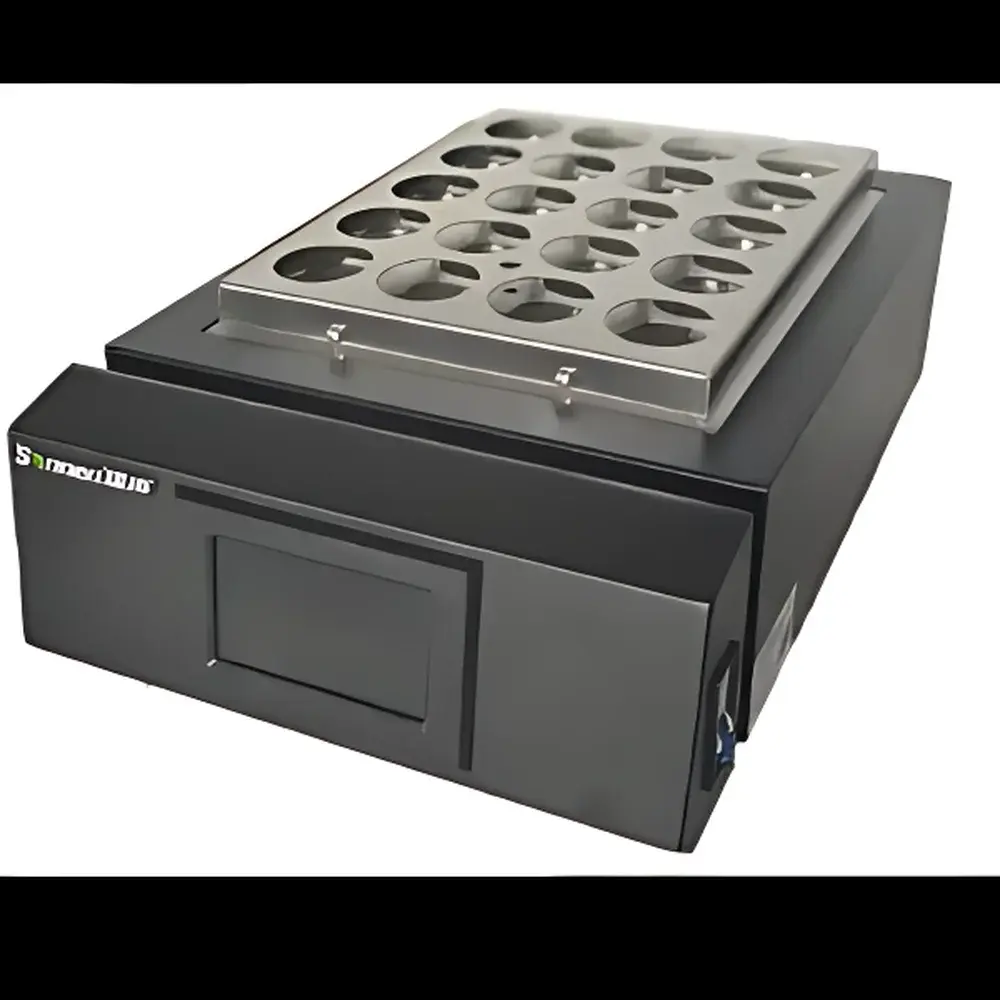
Sonnen S-Series Graphite Block Automatic Digestion System
| Brand | Sonnen |
|---|---|
| Origin | Shanghai, China |
| Model | S08 / S20 / S36 |
| Digestion Positions | 8 / 20 / 36 |
| Temperature Range | Ambient to 450 °C |
| Temperature Accuracy | ±1 °C |
| Heating Principle | Infrared Radiation + High-Purity Graphite Conduction |
| Automation Level | Fully Automatic |
| Digestion Vessel Capacity | 300 mL |
| Max Sample Mass | 6 g (solid) / 25 mL (liquid) |
| Power Supply | AC 220 V ±10%, 50 Hz |
| Rated Power | 3000 W |
| Dimensions (W×D×H) | 455 × 310 × 180 mm |
| Net Weight | 25 kg |
| Compliance | ISO 9001 Certified |
Overview
The Sonnen S-Series Graphite Block Automatic Digestion System is a precision-engineered sample preparation instrument designed for high-throughput, reproducible acid digestion of solid and liquid matrices in environmental, food, agricultural, clinical, and metallurgical laboratories. It employs a dual-heating architecture—combining focused infrared radiation with uniform thermal conduction through high-purity, isotropic graphite blocks—to achieve rapid, homogeneous temperature distribution across all digestion positions. Unlike conventional hotplate or block heaters, the S-Series integrates closed-loop PID temperature control with real-time sensor feedback, enabling programmable multi-stage ramp-and-hold thermal profiles (CA and CK timing modes) essential for method-compliant digestion per ASTM D3682, ISO 11047, EPA Method 3050B, and USP . The system operates within a rigorously engineered thermal envelope—ceramic fiber insulation combined with active airflow channeling—to minimize external heat dissipation and maintain stable ambient laboratory conditions.
Key Features
- Fully automated operation with intuitive 7-inch color TFT touchscreen interface supporting multilingual UI (English default), graphical temperature curve visualization, and password-protected method storage.
- Dual-mode thermal programming: CA mode initiates timer at heating start; CK mode triggers timing only upon reaching target setpoint—enabling precise alignment with standardized digestion protocols requiring dwell time at final temperature.
- Corrosion-resistant construction: Electrophoretic-coated steel chassis with PTFE (Teflon®)-sprayed exterior surfaces; integrated acid-resistant drip tray with directional flow channels to divert condensate and splashes away from electronics and heating elements.
- Comprehensive safety architecture: Triple-redundant thermal protection (over-temperature, over-current, over-pressure), real-time ambient temperature monitoring, fault diagnostics with audible alarm and on-screen Chinese/English bilingual alert messages, and automatic shutdown upon sensor failure or abnormal thermal gradient detection.
- Optimized thermal isolation: Dual-layer ceramic fiber insulation plus engineered air-channel heat shielding reduces surface temperature to <45 °C at 450 °C operating condition—meeting IEC 61010-1 Class II safety requirements for laboratory equipment.
Sample Compatibility & Compliance
The S-Series accommodates standard 300 mL borosilicate glass or quartz digestion tubes (included), compatible with HNO₃, HCl, HF, H₂O₂, and mixed-acid systems used in total elemental recovery. It supports digestion of diverse matrices including soil, sludge, plant tissue, animal feed, dairy products, and metal alloys—validated for nitrogen/protein Kjeldahl digestion (AOAC 984.13), COD determination (ISO 6060), total phosphorus (EPA 365.4), arsenic speciation prep (USP ), and heavy metal analysis (Pb, Cu, Zn, Sn) per ISO 17294-2 and EN 13346. All units are manufactured under ISO 9001:2015 quality management system certification, with full traceability documentation provided—including factory calibration records, material declarations, and CE-marked electrical safety compliance (where applicable per EU export configuration).
Software & Data Management
While the embedded controller operates standalone, optional RS-232/USB connectivity enables integration with LIMS or laboratory informatics platforms. Method parameters—including ramp rates, hold times, temperature setpoints, and user ID—are logged with timestamped audit trails compliant with GLP and FDA 21 CFR Part 11 requirements when paired with validated third-party data acquisition software. Each instrument ships with digital copies of electronic manuals, SOP templates aligned with ISO/IEC 17025 clause 7.2.2, and firmware update utilities accessible via secure manufacturer portal.
Applications
- Preparation of samples for ICP-OES, ICP-MS, AAS, and HG-AFS analysis requiring complete matrix decomposition and analyte stabilization.
- Routine digestions for regulatory compliance testing—e.g., RoHS restricted substances screening, fertilizer nutrient content verification, and wastewater metal discharge monitoring.
- High-volume QC workflows in contract testing labs where throughput, inter-operator reproducibility, and method transferability are critical performance metrics.
- Research applications demanding controlled thermal history—such as leaching behavior studies, mineralogical dissolution kinetics, and speciation-preserving extractions.
FAQ
What digestion tube types and sizes are supported?
Standard 300 mL borosilicate glass tubes (included); quartz tubes available as optional accessories for HF-based protocols.
Is remote monitoring or network integration possible?
Yes—via optional serial-to-Ethernet converter or USB-hosted data logging; requires configuration with certified lab IT infrastructure per institutional cybersecurity policy.
How is temperature uniformity verified across the graphite block?
Each unit undergoes factory validation using NIST-traceable thermocouples at ≥9 representative positions; certificate of conformance includes max deviation (<±1.2 °C at 400 °C) and spatial homogeneity map.
Does the system meet GMP/GLP documentation requirements?
Yes—audit trail functionality, electronic signature support, and full method version control are enabled when used with validated third-party software meeting Annex 11 and ALCOA+ principles.
What maintenance is required for long-term reliability?
Annual inspection of graphite block integrity, IR emitter output calibration, and thermal sensor drift verification—service kits and certified technician dispatch available globally through authorized Sonnen partners.



