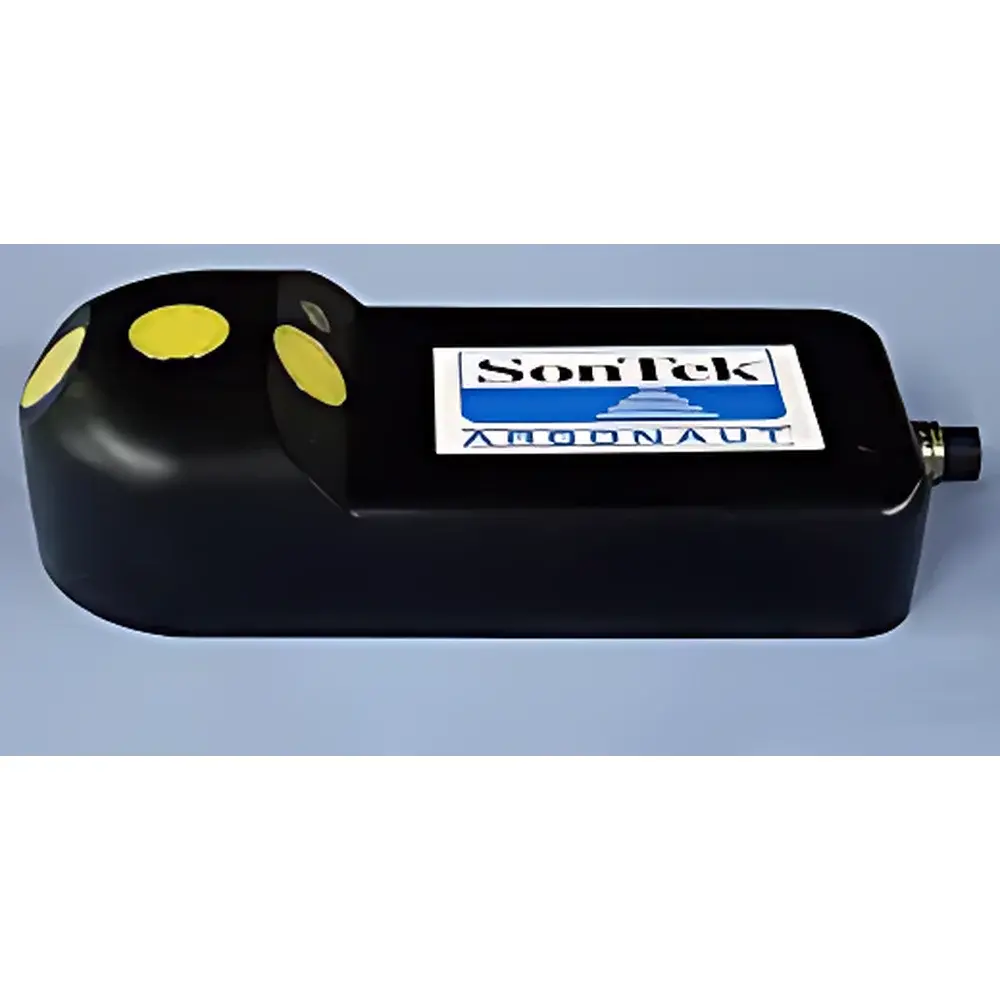
SonTek Argonaut-SW Shallow-Water Acoustic Doppler Flowmeter
| Brand | SonTek |
|---|---|
| Origin | USA |
| Model | Argonaut-SW |
| Measurement Principle | Acoustic Doppler Velocimetry (ADV) with Three-Beam Configuration |
| Velocity Range | ±5 m/s |
| Velocity Accuracy | ±1% of measured value or ±0.5 cm/s |
| Velocity Resolution | 0.1 cm/s |
| Depth Range | 0.2–5.0 m |
| Water Level Accuracy | ±0.1% of measured level or ±0.3 cm |
| Minimum Measurable Depth | 0.2 m total depth (0.1 m above transducer) |
| Operating Temperature | −5°C to +60°C |
| Pressure Rating | 25 m submersion |
| Power Input | 5–15 VDC |
| Power Consumption | 500–700 mW |
| Communication Protocols | RS-232, SDI-12 |
| Onboard Memory | 4 MB (≥50,000 samples) |
| Dimensions | 24.5 × 10.0 × 6.3 cm |
| Weight | 1.2 kg (air), 0.15 kg (water buoyant) |
| Integrated Temperature Sensor | ±0.5°C accuracy, ±0.1°C resolution |
| Flow Calculation | Real-time based on user-defined channel geometry |
Overview
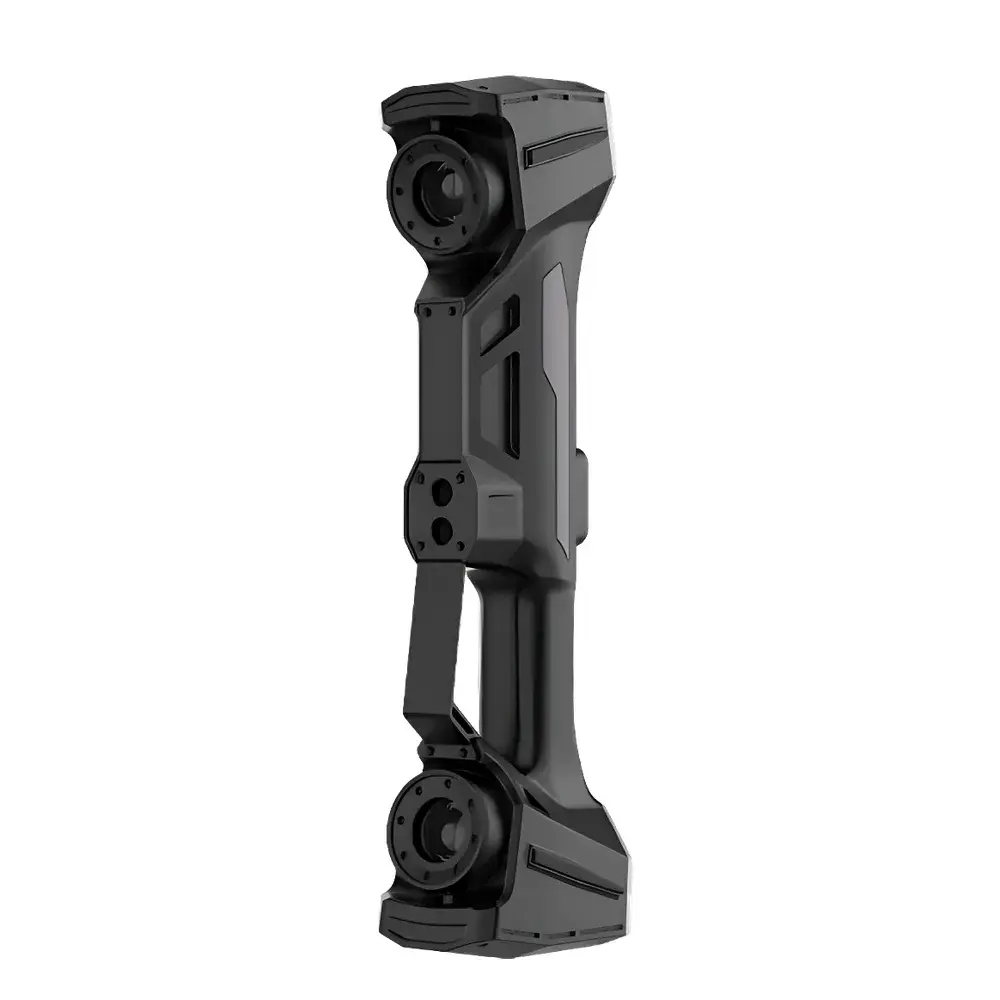
The SonTek Argonaut-SW is a compact, bottom-mounted acoustic Doppler flowmeter engineered for high-fidelity velocity profiling, water level monitoring, and real-time discharge computation in shallow open-channel environments. Operating on the principle of coherent pulsed acoustic Doppler velocimetry, the instrument employs a three-beam transducer array: two oblique beams (±25° from vertical) resolve orthogonal components of horizontal flow velocity (u and v), while the central vertical beam simultaneously measures water surface elevation via time-of-flight echometry. This integrated architecture eliminates the need for external level sensors and enables synchronized, co-located measurement of hydrodynamic state variables—critical for accurate stage-discharge relationships in dynamic, low-flow conditions. Designed specifically for deployment in natural streams, irrigation canals, wastewater channels, and stormwater conveyances where water depth ranges from 0.2 m to 5.0 m, the Argonaut-SW delivers robust performance under variable sediment load, aquatic vegetation, and turbulent boundary layer conditions.
Key Features
- Triple-beam acoustic Doppler configuration optimized for shallow-water hydraulics, with automatic adaptive sampling cell sizing based on real-time water level feedback
- Integrated water level measurement using vertical beam echometry—no separate pressure transducer or bubbler system required
- Self-calibrating velocity profiling across up to 32 user-configurable depth cells, with dynamic range adjustment to maintain signal-to-noise ratio at low depths
- Ruggedized polycarbonate housing rated for continuous submersion to 25 m, with operational stability from −5°C to +60°C ambient temperature
- Low-power design (500–700 mW) compatible with solar-battery telemetry systems and long-term unattended operation
- Onboard 4 MB non-volatile memory supporting ≥50,000 timestamped records—including u/v velocity components, water level, temperature, signal strength, and computed instantaneous flow
- Built-in high-stability thermistor (±0.5°C accuracy) for temperature compensation of sound speed and density-dependent flow calculations
Sample Compatibility & Compliance
The Argonaut-SW is validated for use in natural and engineered open channels with hydraulic depths ≥0.2 m and Froude numbers < 0.8. It complies with standard practices for acoustic velocity measurement as referenced in ASTM D5941 (Standard Test Method for Determining Discharge Using Acoustic Doppler Current Profilers) and ISO 748:2022 (Liquid flow measurement in open channels — Velocity-area method). Its firmware supports configurable data logging intervals (1 second to 24 hours), audit-trail-enabled configuration changes, and metadata tagging per USGS NWIS requirements. While not certified for Class I Div 1 hazardous locations, the unit meets IP68 ingress protection and conforms to FCC Part 15 Subpart B for unintentional radiators. Data outputs are traceable to NIST-traceable calibration protocols performed at SonTek’s ISO/IEC 17025-accredited facility.
Software & Data Management
- ViewArgonaut desktop software (Windows-compatible) provides full instrument setup, real-time telemetry visualization, and post-processing tools including velocity vector rotation, discharge integration, and stage-discharge curve generation
- SonUtils PDA application enables field configuration and rapid survey mode operation via Bluetooth or serial connection
- SDI-12 and RS-232 interfaces support integration into existing SCADA, PLC, or datalogger networks (e.g., Campbell Scientific CR1000X, Onset HOBO UX120)
- Optional analog outputs (4–20 mA or 0–5 V DC) configurable for any primary or derived parameter: u-velocity, v-velocity, water level, temperature, signal amplitude, or computed flow rate
- All stored data include embedded timestamps (RTC accuracy ±2 ppm/month), sensor health diagnostics, and configurable alarm thresholds for out-of-range conditions
Applications
The Argonaut-SW serves as a foundational tool in environmental monitoring, water resource management, and regulatory compliance programs. Typical deployments include continuous flow monitoring at irrigation diversion structures, effluent discharge points, and municipal combined sewer overflows (CSOs); real-time flood forecasting in low-gradient tributaries; sediment transport studies requiring precise near-bed velocity gradients; and validation of hydraulic models (e.g., HEC-RAS, MIKE 11) where traditional flumes or weirs are impractical. Its shallow-depth capability makes it especially valuable for ecological flow assessments in riffle-run habitats, wetland hydrology studies, and climate-resilient infrastructure monitoring where minimum detectable depth is a limiting factor for conventional ADCPs.
FAQ
Can the Argonaut-SW operate reliably in highly turbid or aerated water?
Yes—the instrument uses 2 MHz acoustic frequency and pulse-coherent processing to maintain signal integrity in suspended solids concentrations up to 10 g/L and moderate air entrainment. Performance degradation begins only under extreme cavitation or dense macrophyte obstruction.
Is firmware update supported in the field?
Yes—firmware upgrades are delivered via ViewArgonaut or SonUtils and require no hardware modification. Version history and rollback capability are retained in device logs.
How is discharge calculated internally?
Discharge is computed in real time using the velocity-area method: ∑(vi × Ai), where vi is the mean velocity in each depth cell and Ai is the corresponding cross-sectional area derived from user-input channel geometry (width, side slope, bed elevation).
Does the device meet FDA 21 CFR Part 11 or GMP data integrity requirements?
While not marketed for pharmaceutical process control, its audit-trail logging, electronic signature support (via ViewArgonaut), and immutable data storage align with ALCOA+ principles. Full Part 11 compliance requires site-specific validation of the complete data lifecycle.
What mounting options are available for permanent installation?
Standard includes a corrosion-resistant polycarbonate mounting plate with adjustable tilt compensation. Optional stainless-steel frames, pile mounts, and retractable housings are available for tidal or debris-prone sites.