
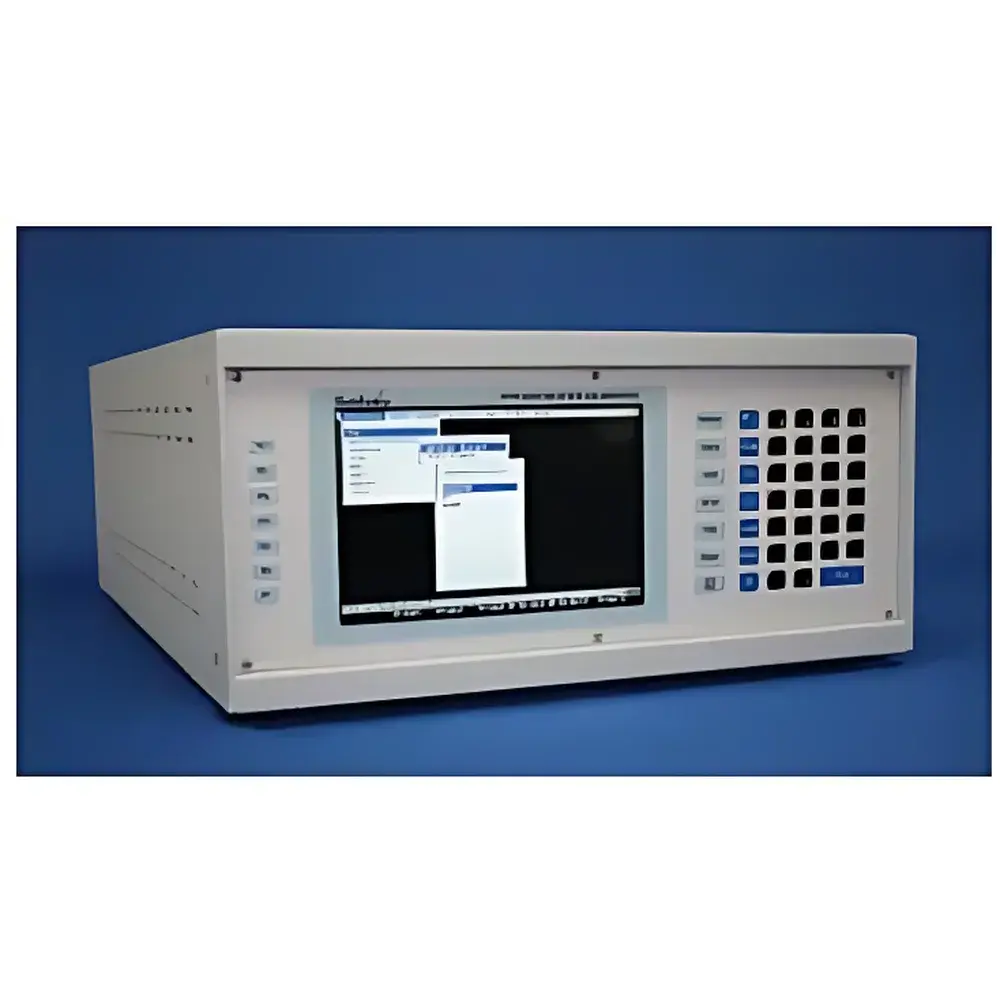
Sabio 4010L Gas Dilution Calibrator
| Brand | Sabio |
|---|---|
| Origin | Beijing, China |
| Model | 4010L |
| Diluent Flow Range | 0–10 SLM (optional up to 20 SLM) |
| Source Gas Flow Range | 0–100 SCCM / 0–10,000 SCCM |
| Flow Accuracy | ≤ ±1% FS |
| Flow Repeatability | ≤ ±0.15% FS |
| Linearity | ≤ ±0.5% FS |
| Inlet Pressure | 20–35 PSIG |
| Ozone Generator Output | 0.05–1.5 ppm at 5 SLPM |
| Ozone Generator Accuracy | ±1% of setpoint or ±2 ppb at 5 SLPM |
| UV Absorption Photometer Range | 0–0.5 / 1.0 / 2.0 ppm |
| Photometer Zero Drift | < ±1 ppb per 24 h (or 30 days) |
| Photometer Flow Rate | 1.0 LPM |
| Dilution Furnace Temperature Range | Ambient +5 °C to 65 °C |
| Temperature Stability | < ±0.1 °C |
| Calibration Programs | 20 user-configurable, time- and event-driven (7-day cycle support) |
| Input/Output | 24-bit digital I/O, 2× serial ports (RS232 standard), parallel printer port, external keyboard interface, air source control port |
| Display | High-brightness color LCD |
| Keypad | 55-key membrane panel |
| Gas Ports | 4 source gas inlets, 1 purge inlet, 1 diluent inlet, 5 calibrated outputs, 1 exhaust port |
Overview
The Sabio 4010L Gas Dilution Calibrator is a fully integrated, laboratory-grade calibration platform engineered for trace-level gas standard generation and dynamic dilution of reference gases in environmental monitoring, ambient air quality laboratories, and regulatory compliance facilities. It operates on the principle of precision mass flow-controlled mixing—utilizing high-stability thermal mass flow controllers (MFCs) to blend certified source gases with ultra-pure diluent gas (e.g., zero air or nitrogen) at precisely defined volumetric ratios. This enables accurate, repeatable preparation of calibration standards across concentration ranges from sub-ppb to low ppm levels—critical for calibrating ozone analyzers, NOx, SO2, CO, VOC monitors, and other EPA-compliant continuous emission monitoring systems (CEMS). The system integrates three core analytical modules—gas dilution, ozone generation, and UV absorption photometry—within a single chassis, supporting closed-loop verification and automated calibration sequence execution without external instrumentation.
Key Features
- Precision dual-MFC architecture: Independent control of diluent flow (0–10 SLM, optional 20 SLM) and source gas flow (0–100 SCCM standard; 0–10,000 SCCM high-range option), both with ≤ ±1% full-scale accuracy and ≤ ±0.15% repeatability.
- Modular gas routing: Four standardized source gas inlets, one purge line, one diluent inlet, five independently calibrated output ports, and one dedicated exhaust port—enabling multi-analyzer calibration campaigns without manual reconfiguration.
- Onboard ozone generation: Integrated UV-based ozone generator delivering 0.05–1.5 ppm at 5 SLPM, with temperature-stabilized lamp (50 ± 0.1 °C) and flow-controlled output (100 ± 1 SCCM), traceable to NIST-traceable ozone transfer standards.
- Integrated UV absorption photometer: Built-in dual-range (0–0.5 ppm / 0–2.0 ppm) ozone analyzer with ±1 ppb absolute accuracy, < ±1 ppb/24 h zero drift, and analog voltage outputs (0–0.1 V / 0–1 V / 0–5 V) for real-time validation and feedback control.
- Programmable dilution furnace: Single-tube heated dilution path constructed from borosilicate glass or PTFE, adjustable from ambient +5 °C to 65 °C with < ±0.1 °C thermal stability—minimizing adsorption losses and condensation for reactive or polar species.
- Industrial-grade HMI: 55-key membrane keypad, high-luminance color LCD display, RS232 serial interface, 24-bit digital I/O for external device synchronization, parallel printer port, and external USB keyboard support for efficient lab integration.
Sample Compatibility & Compliance
The 4010L supports calibration of gaseous standards compliant with U.S. EPA Methods 214, 215, and EQOA-0010; ISO 12039 (ambient air—determination of ozone); and ASTM D6887 (ozone calibration using UV photometry). Its flow control architecture meets ISO 6145-4 requirements for dynamic gas mixing. All internal wetted surfaces are chemically inert (glass/PTFE), ensuring compatibility with ozone, NO2, Cl2, H2S, formaldehyde, and other reactive compounds. The system supports GLP/GMP-aligned operation through audit-trail-capable calibration logging, user-access-level controls, and timestamped event records—fully compatible with FDA 21 CFR Part 11 when deployed with validated third-party data acquisition software.
Software & Data Management
While the 4010L operates autonomously via front-panel programming, it supports bidirectional communication via RS232 for remote configuration, real-time parameter readout, and scheduled calibration log export. Up to 20 factory-defined or user-customized calibration protocols can be stored—including gas identity, flow setpoints, dwell times, temperature profiles, and pass/fail thresholds. Each protocol supports time-triggered execution (e.g., daily 8:00 AM ozone calibration) or event-driven initiation (e.g., post-maintenance verification). Calibration reports include MFC readings, photometer verification values, temperature logs, and pass/fail status—all exportable as CSV or ASCII text for LIMS integration. Optional firmware upgrades enable enhanced data encryption and extended audit trail retention.
Applications
- Primary and secondary calibration of ambient ozone analyzers (UV photometric, chemiluminescent) per U.S. EPA PS-2 and EN 14625.
- Dynamic preparation of multi-point calibration curves for regulatory-grade CEMS and AQMS networks.
- Verification and adjustment of field-deployed gas sensors requiring traceable low-concentration standards.
- Method validation studies for new gas-phase analytical techniques requiring precise gas mixture reproducibility.
- Research applications involving reactive gas kinetics, where controlled dilution and thermal stabilization minimize wall effects and decomposition.
- Quality assurance workflows in certified environmental testing laboratories accredited to ISO/IEC 17025.
FAQ
What calibration standards does the 4010L support?
The system supports certified gas mixtures traceable to NIST SRMs or equivalent national metrology institutes—including ozone, NO, NO2, CO, SO2, and hydrocarbon standards in air or nitrogen matrices.
Can the 4010L perform automatic zero/span checks?
Yes—via programmable sequences that route zero air through the photometer or dilution path, followed by span gas delivery and real-time absorbance comparison against stored reference values.
Is the built-in photometer suitable for routine ozone calibration verification?
Yes—the photometer meets EPA performance specifications for ozone transfer standards and is designed for daily verification prior to analyzer calibration.
How is temperature control implemented in the dilution furnace?
A PID-regulated heating element maintains setpoint temperature within ±0.1 °C using a calibrated platinum RTD sensor embedded in the dilution tube housing.
Does the 4010L comply with ISO/IEC 17025 documentation requirements?
When operated with configured audit logging and timestamped calibration records, the system provides foundational data integrity elements required for ISO/IEC 17025 clause 7.7 (result reporting) and clause 8.9 (nonconforming work tracking).
Related Products







