
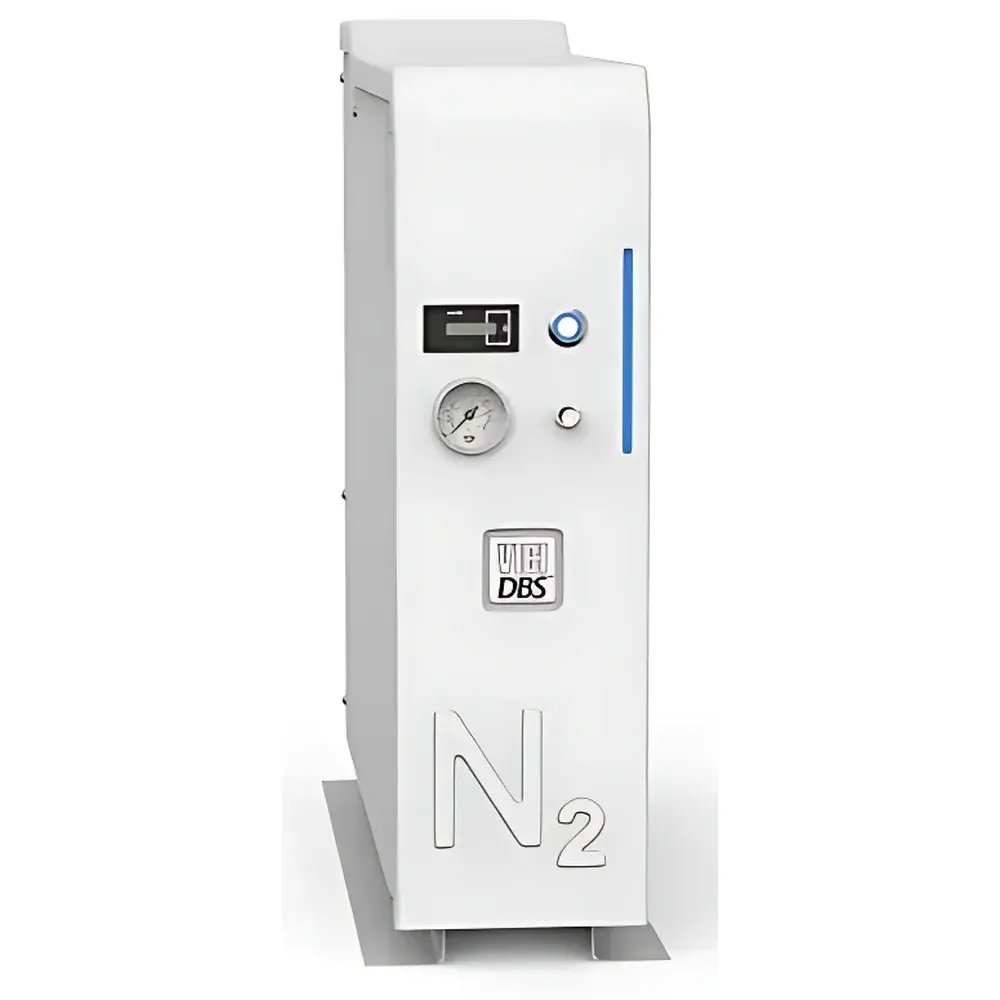
VICI HP Plus Tower PSA Nitrogen Generator
| Brand | VICI |
|---|---|
| Origin | USA |
| Manufacturer Type | Authorized Distributor |
| Origin Category | Imported |
| Model | HP Plus Tower |
| Nitrogen Generation Principle | Pressure Swing Adsorption (PSA) |
| Output Flow Rate | 0.5–4 L/min |
| Output Pressure | 5 bar (75 psig) |
| Nitrogen Purity | 99.999% (≤10 ppm O₂, ≤0.1 ppm total hydrocarbons with optional HC module) |
| Dew Point | −50 °C |
| Inlet Air Pressure | 7–10 bar (100–160 psi) |
| Interface | LED display with power switch, system status, and error indicators |
| Connection | Inlet – 1/4" NPT, Outlet – 1/8" NPT |
| Noise Level | Low (external air compressor design) |
Overview
The VICI HP Plus Tower PSA Nitrogen Generator is an engineered solution for laboratories requiring a continuous, on-demand supply of high-purity nitrogen gas (99.999%) without reliance on high-pressure cylinders or liquid nitrogen dewars. Based on pressure swing adsorption (PSA) technology, the system separates nitrogen from compressed ambient air by selectively retaining oxygen, carbon dioxide, moisture, and trace hydrocarbons on specialized carbon molecular sieve (CMS) beds. The dual-bed architecture enables alternating adsorption and regeneration cycles—ensuring uninterrupted nitrogen delivery at stable flow and pressure. Designed specifically for analytical instrumentation support, the HP Plus Tower delivers nitrogen meeting stringent purity requirements for sensitive detection methods where background interference must be minimized. Its modular configuration supports optional hydrocarbon removal (<0.1 ppm total HC), making it suitable for applications demanding ultra-low carbon contamination, such as electron capture detection or trace-level volatile organic compound analysis.
Key Features
- Stable output flow range of 0.5–4 L/min at regulated pressure up to 5 bar (75 psig), compatible with multi-instrument deployment via manifold distribution.
- Consistent nitrogen purity of 99.999% (≤10 ppm O₂), validated per ISO 8573-1 Class 2:2:2 for particulates, water, and oil content.
- Dew point control to −50 °C, ensuring minimal moisture carryover critical for thermal desorption, GC column conditioning, and hygroscopic sample handling.
- External air compressor integration eliminates internal compression noise and heat generation—reducing vibration coupling and improving long-term stability of connected analytical systems.
- Intuitive LED interface provides real-time monitoring of power status, operational mode, and fault diagnostics—including CMS saturation alerts, pressure deviation warnings, and filter maintenance prompts.
- Standardized mechanical connections: 1/4″ NPT inlet for clean, oil-free compressed air; 1/8″ NPT outlet for direct instrument coupling or integration into centralized lab gas networks.
Sample Compatibility & Compliance
The HP Plus Tower is fully compatible with gas chromatography (GC) systems requiring carrier and make-up gases, including flame ionization (FID), thermal conductivity (TCD), and electron capture (ECD) detectors. It also supports evaporative light scattering detection (ELSD), thermogravimetric analysis (TGA), differential scanning calorimetry (DSC), and purge-and-trap concentrators. The generator complies with ISO 8573-1:2010 for compressed air quality and meets ASTM D6349 specifications for nitrogen used in instrumental analysis. When equipped with the optional hydrocarbon removal module, it satisfies USP and EP 2.5.27 requirements for nitrogen used in pharmaceutical residual solvent testing. System logs retain timestamped operational data for GLP/GMP audit readiness, and firmware supports configurable event logging aligned with FDA 21 CFR Part 11 principles for electronic records.
Software & Data Management
While the HP Plus Tower operates as a standalone hardware unit with no embedded PC or proprietary software stack, its LED-based HMI provides deterministic state feedback suitable for integration into facility-wide monitoring platforms via dry-contact relay outputs (optional). Users may log operational parameters—including runtime hours, pressure deviations, and alarm history—using external SCADA or LIMS interfaces. All firmware updates are performed via secure USB-based field programming, with version control and checksum verification. Audit trails for maintenance events (e.g., CMS replacement, coalescing filter change) can be manually recorded in laboratory notebooks or digital logbooks compliant with ISO/IEC 17025 documentation standards.
Applications
- GC carrier gas for capillary column operation across volatile and semi-volatile compound analysis.
- Make-up gas for ECD and ELSD, where baseline stability and detector sensitivity depend on ultra-low oxygen and hydrocarbon content.
- Purge gas in TGA-DSC hybrid systems to maintain inert thermal environments during oxidative decomposition studies.
- Blank gas for headspace sampling, dynamic dilution calibrators, and zero-air generation systems.
- Instrument purging during standby or shutdown to prevent moisture ingress into optical cells and detector housings.
FAQ
What compressed air quality is required for optimal HP Plus Tower performance?
Clean, oil-free, refrigerated-dried air at 7–10 bar and ≤−20 °C dew point is recommended. A coalescing pre-filter (0.01 µm) and activated carbon polishing stage are advised upstream of the generator inlet.
Can the HP Plus Tower supply multiple GC instruments simultaneously?
Yes—when configured with appropriate flow-balancing manifolds and pressure-regulated outlets, the system supports concurrent operation of up to three mid-flow GCs (e.g., two FIDs + one ECD) within its 4 L/min maximum output capacity.
How often does the carbon molecular sieve require replacement?
Under typical lab conditions (8 h/day, 5 days/week), CMS life expectancy exceeds 20,000 operating hours. Replacement intervals are indicated by sustained O₂ breakthrough (>15 ppm) or failure to achieve target dew point after regeneration.
Is the system compatible with existing lab gas management infrastructure?
Yes—the 1/8″ NPT outlet conforms to standard analytical gas fittings. Integration with central gas panels, pressure-reducing stations, and leak-tested stainless-steel distribution lines is fully supported.
Does the HP Plus Tower meet regulatory requirements for pharmaceutical QC labs?
When operated with the optional hydrocarbon removal module and maintained per VICI’s scheduled service protocol, it fulfills nitrogen purity criteria outlined in USP , EP 2.5.27, and ICH Q5C for biopharmaceutical process validation and stability testing environments.



