SonTek FlowTracker2 Laboratory Acoustic Doppler Velocimeter (ADV®)
| Brand | SonTek |
|---|---|
| Origin | USA |
| Model | FlowTracker2 |
| Technology | Acoustic Doppler Velocimetry |
| Probe Configurations | 2-beam or 3-beam |
| Output Data Format | CSV |
| Temperature Compensation | Yes |
| Velocity Components | U, V, W (X, Y, Z) |
| Real-time Visualization | Yes |
| Compliance | Designed for ASTM D5118, ISO 748, and GLP-aligned data acquisition workflows |
| Software | FlowTracker2 PC Software (Windows), Firmware-upgradable |
| Power | USB-powered or external 12 V DC |
Overview
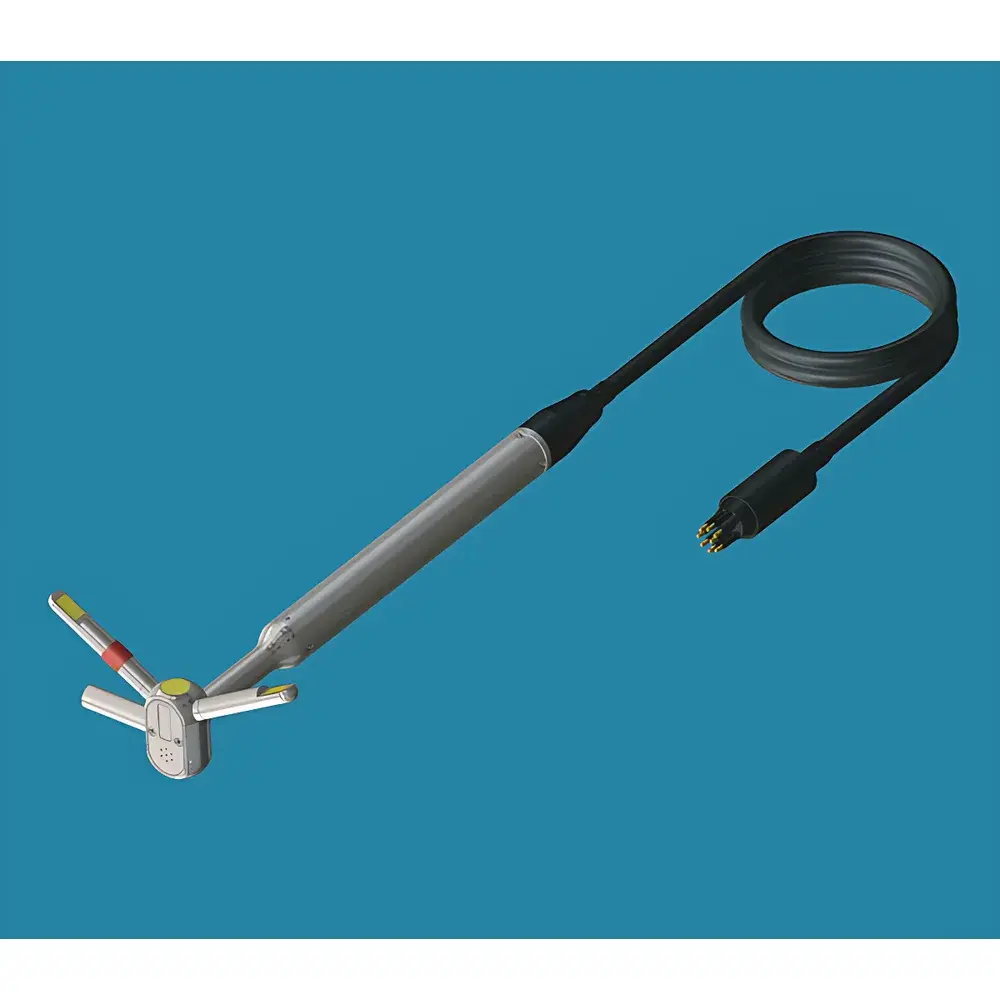
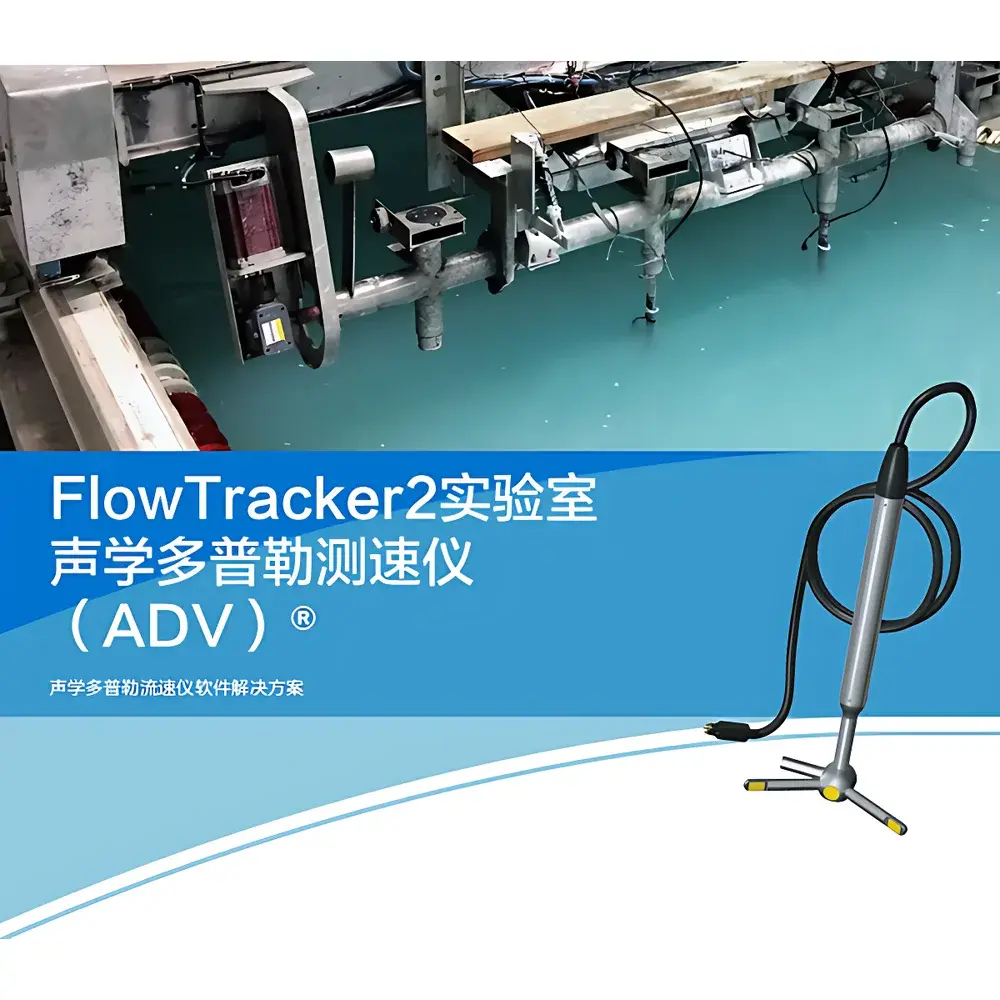
The SonTek FlowTracker2 Laboratory Acoustic Doppler Velocimeter (ADV®) is an engineered solution for high-fidelity, non-intrusive, three-component velocity measurement in controlled hydrodynamic environments. Leveraging the physical principle of acoustic Doppler shift—where ultrasonic pulses transmitted into fluid are scattered by suspended particles and return with frequency shifts proportional to local flow velocity—the FlowTracker2 ADV delivers sub-millimeter spatial resolution and millisecond-scale temporal sampling. Unlike optical methods, ADV operates effectively in turbid, aerated, or low-light conditions common in physical modeling tanks, flumes, aquaria, and sedimentation basins. Its compact, single-unit architecture integrates transducer array, signal processing electronics, and optional pressure transduction within a lightweight, lab-portable housing—eliminating the need for external signal conditioners or rack-mounted controllers. The system is calibrated traceably to NIST standards and designed for repeatable deployment across benchtop-scale experiments requiring adherence to ISO/IEC 17025-compliant measurement practices.
Key Features
- Compact monolithic design: All electronics, transducers, and optional pressure sensor housed in one sealed, corrosion-resistant unit (IP67-rated)
- Configurable probe geometry: Selectable 2-beam or 3-beam transducer arrays supporting both 2D and 3D velocity vector reconstruction
- Real-time velocity output: Simultaneous acquisition of U, V, W components at user-defined sampling rates up to 200 Hz
- Integrated environmental sensing: Onboard temperature measurement and optional pressure sensor enable dynamic depth correction via SonTek’s patented Bernoulli-based compensation algorithm
- USB-powered operation: Eliminates need for external power supplies; compatible with standard laboratory laptops running Windows 10/11
- Robust data integrity: Timestamped, metadata-embedded CSV export with built-in checksum validation and audit-ready file naming conventions
- Firmware-upgradable architecture: Field updates ensure long-term compatibility with evolving data management and compliance requirements (e.g., FDA 21 CFR Part 11–ready logging options available)
Sample Compatibility & Compliance
The FlowTracker2 Laboratory ADV is validated for use in Newtonian and weakly non-Newtonian aqueous media containing naturally occurring or seeded scatterers (e.g., clay, silt, microspheres ≥ 5 µm). It performs reliably across Reynolds numbers typical of laminar-to-turbulent transitional flows (Re = 10²–10⁵) in flumes, wave tanks, and recirculating channels. The system conforms to measurement uncertainty frameworks outlined in ASTM D5118 (Standard Practice for Measurement of Velocity in Open Channels Using Acoustic Doppler Techniques) and ISO 748 (Liquid flow measurement in open channels — Velocity-area method). When configured with timestamped, user-identified operator logs and immutable data export, it supports GLP and GMP-aligned experimental documentation protocols. No calibration drift is observed over 12-month intervals under stable thermal conditions (±2 °C), per SonTek’s factory calibration certificate (NIST-traceable reference standards applied).
Software & Data Management
FlowTracker2 PC Software provides a deterministic, GUI-driven interface for probe configuration, sampling parameter definition (burst duration, averaging window, trigger logic), and real-time visualization of velocity time series and correlation metrics. All raw outputs—including velocity components, beam-wise correlation coefficients, signal-to-noise ratio (SNR), amplitude, ambient noise floor, temperature, sound speed, raw and corrected pressure, depth, accelerometer readings, and supply voltage—are written directly to human-readable, tab-delimited CSV files without proprietary binary encoding. Each file includes embedded header metadata (instrument ID, firmware version, UTC timestamp, coordinate frame orientation, sensor calibration dates). Batch export and scriptable API access (via COM interface) enable integration with MATLAB, Python (pandas), or LabVIEW-based post-processing pipelines. Audit trails—including parameter change history and user login events—are retained locally and exportable for regulatory review.
Applications
- Civil and environmental hydraulics: Boundary layer profiling in scaled physical models of spillways, culverts, and fish passage structures
- Aquaculture system optimization: Quantifying flow homogeneity, dead zones, and shear stress distribution in raceways and recirculating aquaculture systems (RAS)
- Sediment transport research: Measuring settling velocities of cohesive and non-cohesive particles under controlled turbulence intensities
- Biological flow ecology: Characterizing near-field hydrodynamics around fish guidance structures (e.g., fish screens, bypass weirs)
- Fluid-structure interaction studies: Capturing unsteady velocity fields adjacent to submerged geometries in wave and current tanks
- Validation of CFD simulations: Providing high-resolution, phase-averaged benchmark data for LES and RANS model verification
FAQ
What velocity accuracy can be expected in laboratory water tanks?
Typical velocity uncertainty is ±0.5% of reading ± 0.1 mm/s (k=2), referenced to calibrated flow loops per ISO/IEC 17025-accredited procedures.
Is the pressure sensor optional—and how does depth correction work?
Yes; the integrated pressure sensor is field-installable. Depth correction applies a physics-based model accounting for dynamic pressure effects (Bernoulli term) and local atmospheric pressure, referenced to a user-defined datum plane.
Can the system operate without a connected PC?
With the optional handheld controller, yes—enabling standalone triggering, real-time display, and SD-card-based data logging independent of laptop connectivity.
Are firmware updates provided post-purchase?
Yes; SonTek delivers free, version-controlled firmware releases through its secure customer portal, including enhancements to noise rejection algorithms and metadata tagging capabilities.
Does the software support automated batch processing of multiple CSV files?
Native batch import is not included, but the documented CSV structure and COM interface allow seamless scripting in Python or MATLAB for high-throughput analysis workflows.