
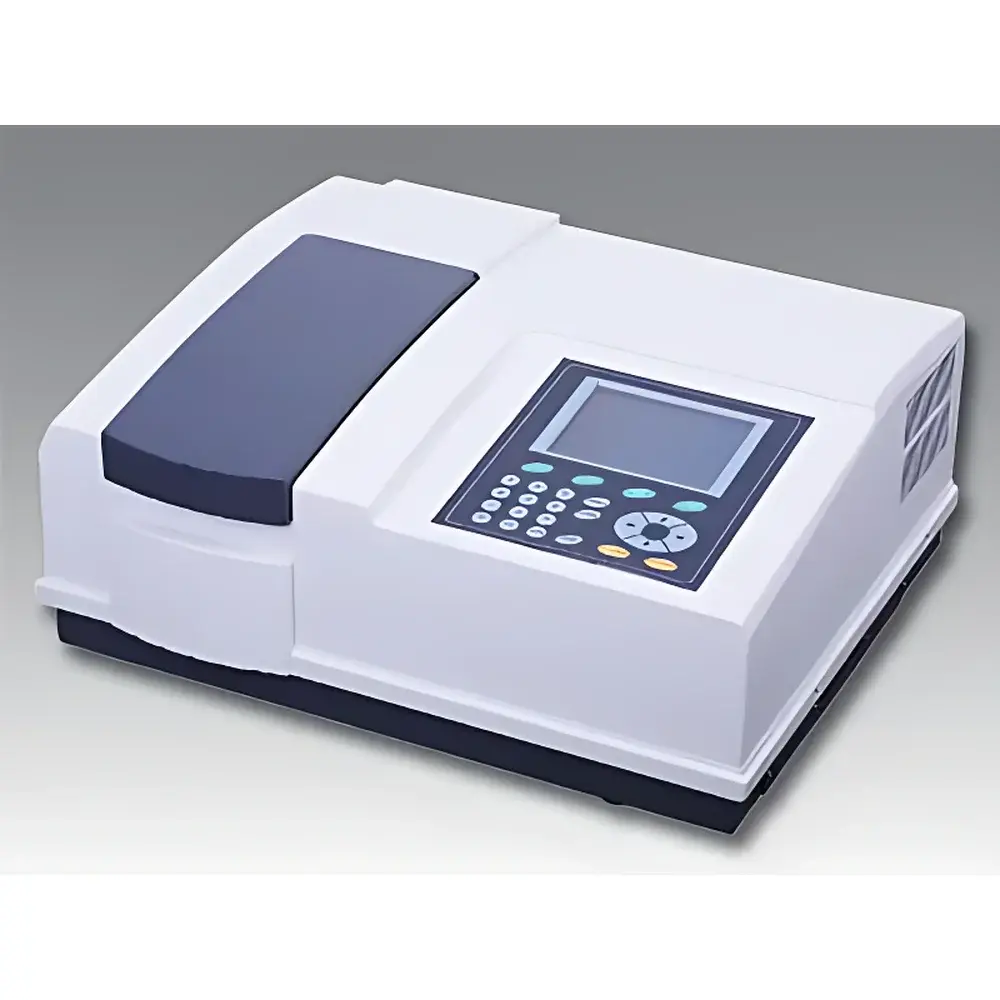
SOPTOP UV2800PC Dual-Beam Ultraviolet-Visible Spectrophotometer
| Brand | SOPTOP |
|---|---|
| Origin | Shanghai, China |
| Model | UV2800PC |
| Optical System | Dual-beam |
| Detector | Photomultiplier Tube (PMT) |
| Wavelength Range | 190–1100 nm |
| Wavelength Accuracy | ±0.3 nm |
| Spectral Bandwidth | 1.8 nm |
| Stray Light | ≤0.05%T at 220 nm and 360 nm |
| Display | 320×240 LCD (6-inch) |
| Software | UV-Solution 3.0 |
| Compliance | ASTM E275, ISO 6223, USP <857>, GLP-ready audit trail support |
Overview
The SOPTOP UV2800PC is a dual-beam ultraviolet-visible (UV-Vis) spectrophotometer engineered for precision quantitative and qualitative analysis across research laboratories, quality control environments, and educational institutions. Based on the fundamental principle of Beer-Lambert law absorption spectroscopy, the instrument measures sample absorbance, transmittance, and concentration by comparing light intensity through a reference and sample path simultaneously—minimizing errors from source drift or detector instability. Its optimized optical architecture integrates a high-stability deuterium lamp (UV) and tungsten-halogen lamp (visible), coupled with a Czerny-Turner monochromator and photomultiplier tube (PMT) detection system. This configuration delivers high photon sensitivity, low electronic noise, and exceptional signal-to-noise ratio—critical for trace-level quantitation and kinetic studies. The 190–1100 nm spectral coverage enables analysis of organic chromophores, transition metal complexes, nucleic acids, proteins, and nanomaterials, while the 1.8 nm fixed spectral bandwidth ensures resolution sufficient for most routine pharmaceutical, environmental, and biochemical applications.
Key Features
- Dual-beam optical design with real-time reference compensation for enhanced baseline stability and long-term measurement reproducibility
- Photomultiplier tube (PMT) detector offering superior sensitivity in the UV region (190–350 nm) compared to silicon photodiodes
- Low-stray-light optical path (<0.05%T at 220 nm and 360 nm), enabling accurate measurements of highly absorbing samples and extending dynamic range
- High-resolution 320×240 graphic LCD (6-inch display) supporting full-spectrum visualization, peak/valley annotation, and real-time zoom
- Tool-free, flange-mounted deuterium lamp module—eliminates optical alignment after lamp replacement and reduces maintenance downtime
- Comprehensive wavelength calibration and photometric validation routines compliant with ASTM E275 and ISO 6223 verification protocols
Sample Compatibility & Compliance
The UV2800PC accommodates standard 10 mm pathlength quartz, glass, or plastic cuvettes (including matched pairs for high-precision work), and supports optional accessories such as automatic 8-cell or 16-cell sample changers, temperature-controlled holders (±0.1 °C), and solid-sample reflectance modules. All hardware and firmware are designed to meet international regulatory expectations for analytical instrumentation: data integrity safeguards include user-accessible audit trails, electronic signatures, and password-protected method locking—fully aligned with FDA 21 CFR Part 11 readiness and GLP/GMP documentation requirements. Routine performance qualification (PQ) can be executed using NIST-traceable holmium oxide and potassium dichromate reference standards.
Software & Data Management
UV-Solution 3.0 workstation software provides a validated, Windows-based interface supporting method development, instrument control, and report generation. Core capabilities include: photometric mode (A/T/C), spectrum scanning (scan speeds adjustable from 100–2400 nm/min; data interval options: 0.1, 0.5, 1, 2, or 5 nm), quantitative analysis (single-point, multi-point linear calibration with up to 9 standard points), and time-based kinetic assays (up to 1800 data points stored per run). Raw spectral data are exported in ASCII or CSV format; reports include instrument parameters, calibration history, operator ID, timestamp, and digital signature fields. Software validation documentation (IQ/OQ/PQ templates) is provided for laboratory compliance workflows.
Applications
- Pharmaceutical QC: Assay of active pharmaceutical ingredients (APIs), dissolution testing, and excipient compatibility screening per USP
- Environmental monitoring: Nitrate, phosphate, and heavy metal ion quantification in water per EPA Method 365.3 and ISO 15681-1
- Life sciences: Protein concentration (Bradford/Lowry), DNA/RNA purity (A260/A280), enzyme kinetics (e.g., LDH, ALP), and cell culture density estimation
- Materials science: Bandgap determination of semiconducting nanoparticles and thin-film optical characterization
- Academic teaching: Hands-on instruction in spectroscopic theory, calibration curve construction, and error propagation analysis
FAQ
What is the difference between UV2800 and UV2800PC models?
The UV2800PC includes full PC connectivity via USB and bundled UV-Solution 3.0 software, whereas the base UV2800 operates standalone with internal LCD control only.
Is the instrument compliant with 21 CFR Part 11?
Yes—the UV-Solution 3.0 software supports electronic signatures, audit trails, and role-based access control required for regulated environments.
Can I perform kinetic measurements over extended time periods?
Yes—time-scan mode supports up to 1800 sequential data points with user-defined intervals ranging from 0.1 seconds to 60 minutes.
What validation materials are recommended for routine performance checks?
NIST SRM 930e (neutral density filters), holmium oxide solution (for wavelength accuracy), and potassium dichromate in 0.005 M H₂SO₄ (for photometric accuracy and linearity).
Does the system support third-party LIMS integration?
Raw data export in ASCII/CSV format enables seamless import into common LIMS platforms; custom API integration is available upon request through SOPTOP’s OEM support channel.
Related Products



