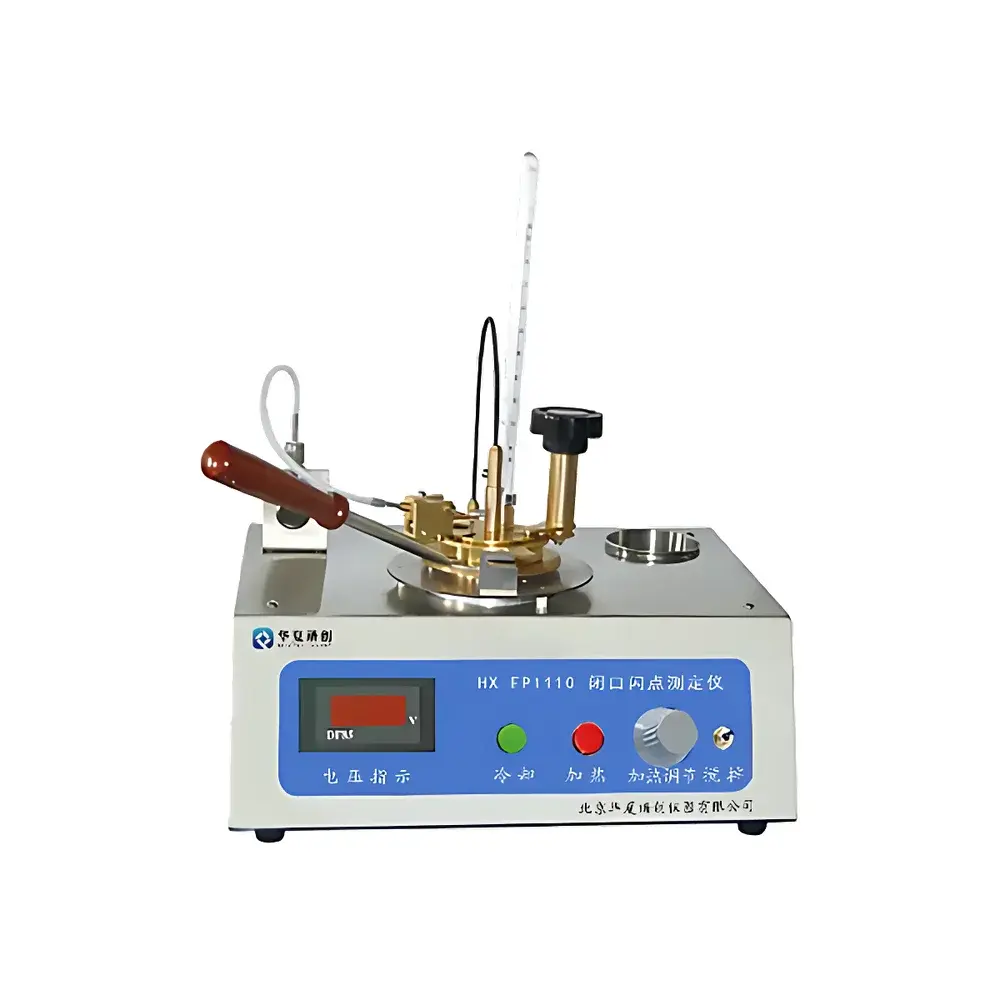
Spectra Invent HX-FP1110 Closed Cup Flash Point Tester
| Brand | Spectra Invent |
|---|---|
| Origin | Beijing, China |
| Manufacturer Type | Authorized Distributor |
| Product Category | Domestic (PRC-manufactured) |
| Model | HX-FP1110 |
| Detection Method | Closed Cup (Pensky-Martens Principle) |
| Operation Mode | Manual |
| Ignition Source | Pressurized Gas Flame (Propane/Butane) |
| Compliant Standards | GB/T 261–2021, ASTM D93–22 |
Overview
The Spectra Invent HX-FP1110 Closed Cup Flash Point Tester is a manually operated, benchtop analytical instrument engineered for precise determination of the closed cup flash point of petroleum products—including gasoline, diesel, lubricating oils, and solvents—according to internationally recognized standardized test methods. It operates on the Pensky-Martens closed cup principle, where a sample is heated under controlled conditions in a sealed test cup, and an externally supplied gas flame is periodically introduced into the vapor space above the liquid surface to detect the lowest temperature at which ignition occurs. This method ensures high reproducibility and regulatory alignment with GB/T 261–2021 (equivalent to ISO 2719) and ASTM D93–22 (Standard Test Method for Flash Point by Pensky-Martens Closed Cup Tester). Designed for routine quality control laboratories in rail transport, aviation fuel handling, power generation, petrochemical refining, and R&D institutions, the HX-FP1110 delivers traceable, operator-controlled flash point measurements without reliance on automated thermal ramping or digital ignition triggering.
Key Features
- Manual heating rate adjustment via calibrated rotary control, enabling fine-tuned thermal profiling aligned with standard-specified ramp rates (e.g., 5–6 °C/min during final approach to flash point).
- Dual-speed mechanical stirrer (120 rpm / 240 rpm) ensures homogeneous temperature distribution throughout the sample volume, critical for compliance with stirring requirements in both GB/T 261 and ASTM D93.
- Stainless steel work surface and compact footprint (310 × 250 × 220 mm) support durability, chemical resistance, and space-efficient integration into QC labs with limited benchtop real estate.
- Dedicated gas flame ignition system using regulated propane or butane—no electric spark generator—eliminates electromagnetic interference concerns and aligns with traditional Pensky-Martens methodology.
- Integrated LED-digit voltage indicator provides real-time verification of input power stability (AC 220 V ±10%, 50 Hz), supporting GLP-compliant instrument performance monitoring.
- Engineered cup cover holder and ergonomic oil-change port facilitate rapid sample exchange and cleaning between tests, minimizing cross-contamination risk and downtime.
Sample Compatibility & Compliance
The HX-FP1110 is validated for use with transparent and opaque petroleum distillates, residual fuels, and hydrocarbon-based solvents having initial boiling points above 40 °C and flash points ranging from 20 °C to 300 °C. It conforms strictly to the apparatus specifications outlined in Clause 6 of ASTM D93–22 and Section 5 of GB/T 261–2021, including cup geometry, thermometer placement, flame diameter (3–4 mm), and sweep timing intervals. While not equipped with electronic audit trail or user authentication, its manual operation supports full procedural traceability when used within documented laboratory workflows compliant with ISO/IEC 17025:2017 general requirements for competence of testing and calibration laboratories.
Software & Data Management
The HX-FP1110 operates without embedded firmware or proprietary software. All operational parameters—including observed flash point temperature, ambient conditions (5–40 °C, ≤85% RH), and heating duration—are recorded manually in laboratory notebooks or LIMS-integrated paperless systems. Temperature readings are obtained directly from a calibrated ASTM-certified mercury-in-glass or digital thermometer (not included), ensuring metrological traceability to national standards. The absence of digital data output simplifies validation in environments where electronic records are not required, while maintaining full compatibility with GLP documentation practices and internal QA review protocols.
Applications
- Routine flash point verification of aviation turbine fuel (Jet A-1) prior to dispatch per IATA and DEF STAN 91-91 specifications.
- Quality assurance testing of diesel fuel batches against EN 590 and GB 19147 flash point limits (≥55 °C).
- Refinery intermediate product screening to prevent unsafe storage or transport of low-flash fractions.
- Academic research on thermal stability and volatility behavior of bio-derived fuel blends under standardized closed-cup conditions.
- Third-party inspection agencies performing statutory testing for customs clearance and import compliance in APAC and EMEA markets.
FAQ
Does the HX-FP1110 comply with ASTM D93 and GB/T 261?
Yes—the instrument’s cup design, stirrer configuration, flame delivery mechanism, and thermal control range meet all physical and procedural requirements specified in both standards.
Is a thermometer included with the unit?
No—a calibrated ASTM IP or equivalent thermometer must be supplied separately and verified per laboratory SOP before use.
What gas type is recommended for ignition?
Propane or butane with regulated pressure (typically 10–30 kPa) is required; cylinder regulators and tubing must be compatible with hydrocarbon gases.
Can the HX-FP1110 be used for open cup testing?
No—it is strictly configured for closed cup (Pensky-Martens) methodology; open cup testing requires a separate Cleveland Open Cup apparatus.
What maintenance is required for long-term reliability?
Regular cleaning of the test cup, lid aperture, and flame nozzle with solvent-resistant lint-free wipes; periodic verification of stirrer motor torque and voltage regulation accuracy.
Related Products