
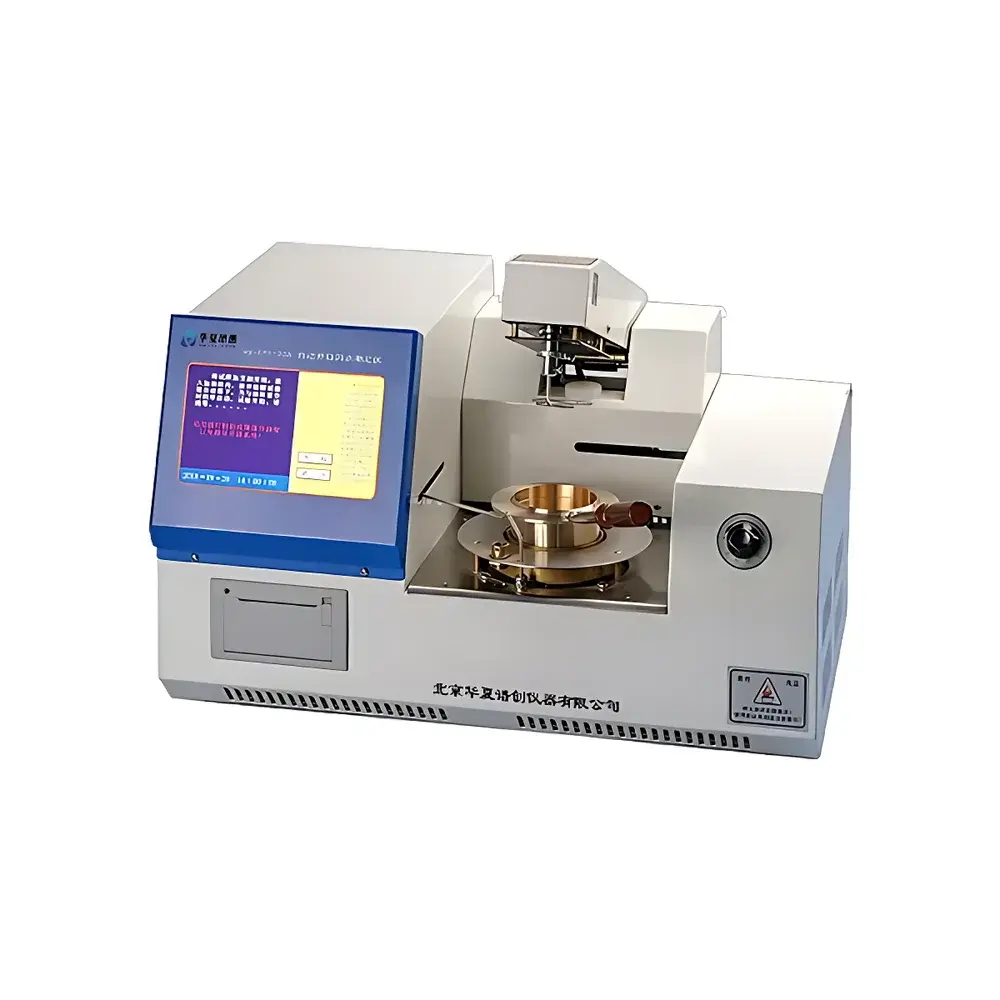
SPECTRA INVENT HX-FP1120A Automatic Cleveland Open-Cup Flash Point Tester
| Brand | SPECTRA INVENT |
|---|---|
| Origin | Beijing, China |
| Manufacturer Type | Authorized Distributor |
| Country of Manufacture | China |
| Model | HX-FP1120A |
| Detection Method | Cleveland Open-Cup (COC) |
| Operation Mode | Fully Automatic |
| Temperature Range | Ambient to 400 °C |
| Ignition Method | Electronic Spark Ignition |
| Repeatability | ≤4 °C |
| Applicable Standards | ASTM D92, GB/T 3536 |
Overview
The SPECTRA INVENT HX-FP1120A Automatic Cleveland Open-Cup Flash Point Tester is a precision-engineered instrument designed for the standardized determination of flash point and fire point of petroleum products, lubricants, biodiesel blends, and other combustible liquids using the Cleveland Open-Cup (COC) method. Based on the fundamental principle of thermal equilibrium and controlled vapor-air mixture ignition, the HX-FP1120A heats the sample in an open crucible at a regulated rate while periodically introducing an electronic spark source across the vapor space. The lowest temperature at which the vapor ignites momentarily upon application of the ignition source defines the flash point; sustained combustion for at least 5 seconds indicates the fire point. This gravimetric-thermal methodology ensures compliance with internationally recognized test protocols essential for safety classification, transportation regulation, and quality assurance in refining and distribution workflows.
Key Features
- Fully automated operation sequence: sample heating, vapor scanning, electronic spark ignition, flame detection, and result recording — all executed without manual intervention.
- High-resolution 7-inch color LCD touchscreen interface with full Chinese-language menu navigation, supporting intuitive input of test parameters including ambient pressure, sample ID, calibration offset, and test date.
- Real-time graphical display of temperature versus time profile, dynamically updated during testing to verify conformance with ASTM D92 and GB/T 3536 prescribed heating rates (e.g., 14–17 °C/min prior to expected flash point).
- Integrated atmospheric pressure correction algorithm: automatically computes and applies correction factors per ASTM D92 Annex A1 and GB/T 3536 Clause 8.2, enhancing inter-laboratory reproducibility.
- Dual functionality: measures both flash point and fire point in a single run, reducing turnaround time and sample consumption.
- Electronic spark ignition system eliminates reliance on pilot flames or butane gas sources, improving operational safety and eliminating consumable dependencies.
- Forced-air cooling module enables rapid post-test cooldown, minimizing downtime between consecutive analyses.
- Onboard non-volatile memory stores up to 120 test records with timestamp, sample ID, raw temperature data, and pass/fail status — accessible via RS-232 serial interface.
Sample Compatibility & Compliance
The HX-FP1120A is validated for use with residual fuels (e.g., No. 6 fuel oil), new and used lubricating oils, bituminous materials, transformer oils, and bio-derived hydrocarbon mixtures. It strictly adheres to the geometric specifications, crucible dimensions, thermometer calibration requirements, and procedural controls defined in ASTM D92 (Standard Test Method for Flash and Fire Points by Cleveland Open Cup Tester) and GB/T 3536 (Petroleum Products — Determination of Flash Point — Cleveland Open Cup Method). Instrument design incorporates mechanical stability features to minimize vibration-induced false ignition events, and thermal shielding ensures uniform heat distribution across the test cup. All firmware logic and measurement algorithms are traceable to NIST-traceable reference standards and support GLP-compliant audit trails when integrated into validated laboratory information management systems (LIMS).
Software & Data Management
The embedded control software implements fuzzy logic-based temperature ramp regulation to maintain precise adherence to standard-specified heating profiles under variable ambient conditions. Data export is supported via RS-232 to external PCs running Windows-compatible terminal emulation or custom LIMS clients. Raw datasets include time-stamped temperature readings (0.1 °C resolution), ignition event timestamps, atmospheric pressure inputs, and operator-defined metadata. Exported CSV files contain structured columns compatible with statistical process control (SPC) platforms and regulatory reporting tools. Firmware supports remote parameter updates and includes built-in diagnostics for heater resistance, thermocouple continuity, and spark generator output verification — critical for FDA 21 CFR Part 11–aligned environments requiring electronic record integrity.
Applications
This instrument serves as a primary safety assessment tool across upstream, midstream, and downstream petroleum operations. In refinery QC labs, it verifies flash point compliance for finished diesel, jet fuel (Jet A/A-1), and marine distillates against ISO 8217 and DEF STAN 91-87 specifications. Power generation facilities deploy the HX-FP1120A for routine monitoring of turbine and insulating oils per IEC 60296 and ASTM D3487. Aviation maintenance organizations use it to screen hydraulic fluids and de-icing agents per SAE AS5780. Research institutions apply it in formulation studies involving alternative fuels, nano-additized lubricants, and pyrolysis oils where thermal stability thresholds must be quantified under standardized open-cup conditions.
FAQ
What standards does the HX-FP1120A fully comply with?
It is engineered and verified to meet all procedural, dimensional, and performance criteria specified in ASTM D92 and GB/T 3536, including cup geometry, thermometer placement, heating rate tolerances, and ignition source positioning.
Can the instrument correct for barometric pressure variations?
Yes — it calculates real-time correction values using the user-entered local atmospheric pressure and applies them automatically to final reported flash point results per ASTM D92 Section 11 and GB/T 3536 Clause 8.2.
Is fire point measurement included in the same test cycle?
Yes — after flash point detection, the instrument continues heating at the same rate and initiates additional ignition attempts until sustained combustion (>5 s) is observed, thereby determining fire point without reconfiguration.
What is the minimum sample volume required?
The standard Cleveland open cup requires 70 mL of homogeneous liquid sample, pre-conditioned to room temperature and free of suspended water or particulates.
Does the system support networked data archiving?
While native Ethernet or Wi-Fi is not integrated, RS-232 connectivity enables integration with serial-to-Ethernet converters or legacy lab networks for centralized data aggregation and long-term storage in compliant repositories.




