
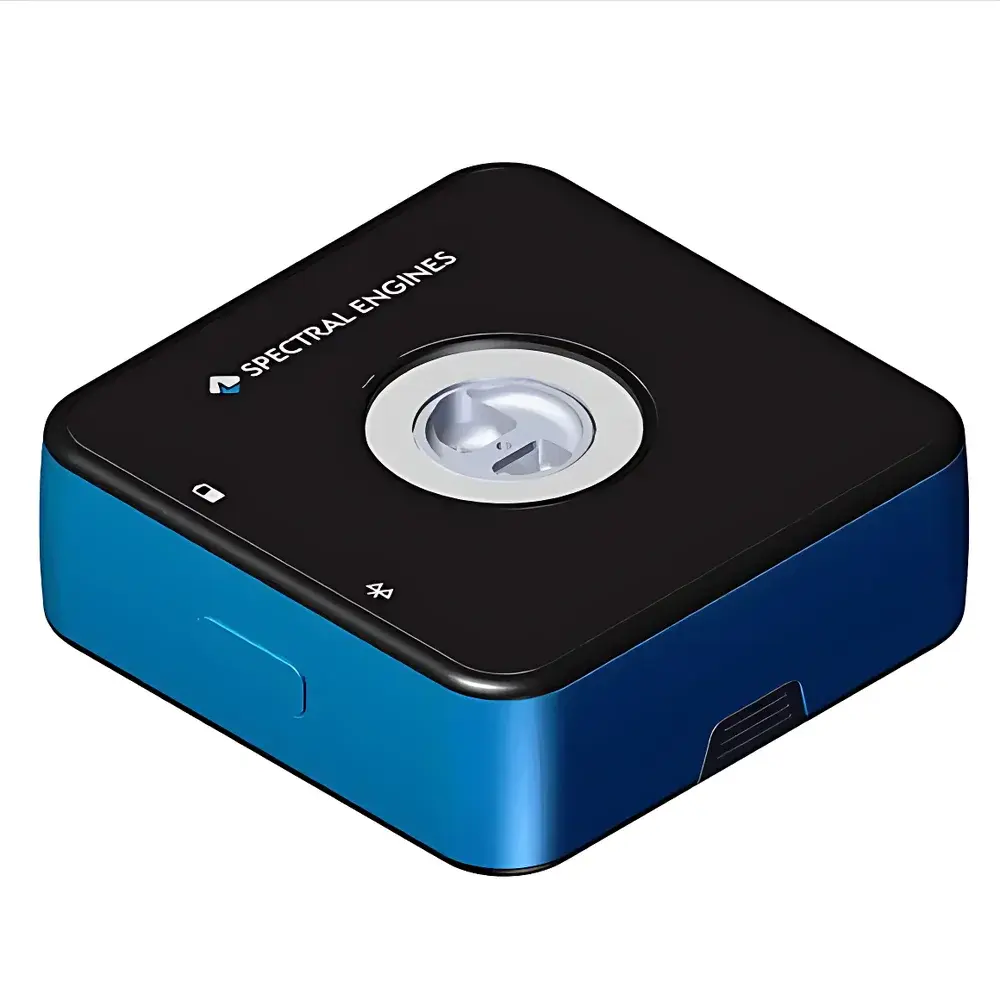
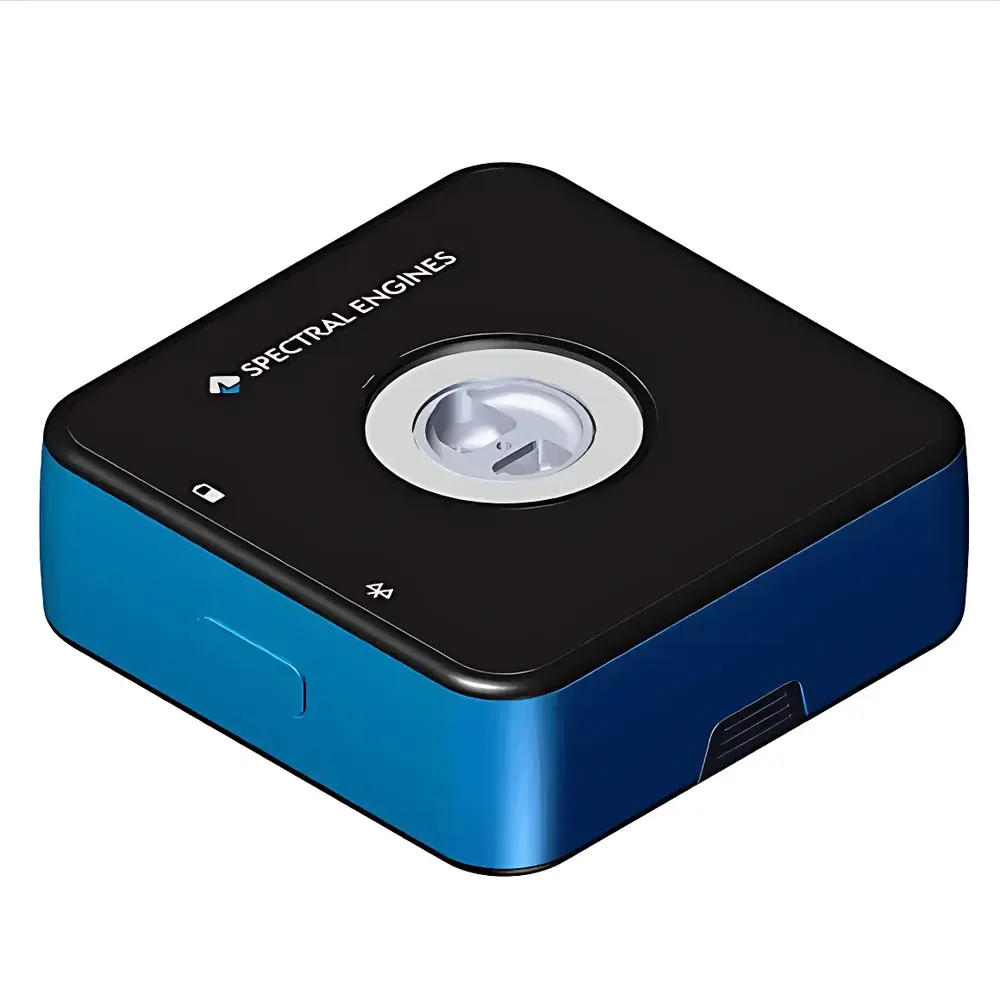
Spectral Engines NIRONE DEVICE Miniature Smart Near-Infrared Spectral Sensor
| Brand | Spectral Engines |
|---|---|
| Origin | Finland |
| Model | NIRONE DEVICE |
| Instrument Type | Portable NIR Spectrometer |
| Operating Principle | Micro-Electro-Mechanical Systems (MEMS)-Based Fabry–Pérot Interferometer |
| Wavelength Range | 1150–1950 nm (standard configuration) |
| Spectral Acquisition Time | <50 ms per spectrum |
| Spectral Sampling Interval | Adjustable from 1 to 10 nm |
| Optical Measurement Modes | Diffuse Reflectance and Transmission |
| Detector | Single-pixel InGaAs photodiode with integrated thermoelectric stabilization |
| Spectral Resolution (FWHM) | 15–25 nm |
| Wavelength Tuning Speed | <1 ms per step |
| Tuning Step Size | 0.1 nm (up to 512 discrete wavelengths) |
| Data Interfaces | Bluetooth 5.0 + USB 2.0 (micro-USB) |
| Onboard Power | Rechargeable Li-ion battery (≥8 h typical operation) |
| Software Suite | NIRSA Chemometrics Platform + SensorControl PC/Android/iOS Application |
| Compliance | CE, RoHS, FCC Part 15 Class B |
| Firmware Architecture | Field-upgradable via OTA or USB |
Overview
The Spectral Engines NIRONE DEVICE is a fully integrated, portable near-infrared (NIR) spectral sensing platform engineered for high-fidelity field-deployable analysis. At its core lies the NIRONE Sensor—a MEMS-based Fabry–Pérot interferometric spectrometer module that replaces traditional grating- or prism-based optical architectures with a solid-state, no-moving-parts design. This architecture enables robust spectral acquisition under mechanical stress, temperature fluctuation, and variable orientation—critical for industrial process monitoring, agricultural scouting, pharmaceutical raw material verification, and point-of-care diagnostics. Unlike scanning monochromators or linear-variable filter (LVF) systems, the NIRONE DEVICE leverages voltage-tuned Fabry–Pérot etalons to achieve continuous, programmable wavelength selection across the short-wave NIR range (1150–1950 nm), delivering laboratory-grade spectral fidelity in a 42 × 32 × 18 mm sensor footprint. Its embedded signal chain includes analog front-end amplification, 16-bit ADC conversion, on-chip temperature compensation, and real-time dark-current subtraction—ensuring baseline stability and measurement reproducibility across ambient conditions.
Key Features
- MEMS Fabry–Pérot interferometer with no mechanical actuators—enabling shock resistance (>50 g) and long-term calibration stability
- Programmable spectral acquisition: user-selectable sampling intervals (1–10 nm), up to 512 discrete wavelengths per scan
- Sub-50 ms full-spectrum capture time—optimized for dynamic process monitoring and high-throughput screening
- Dual communication interface: Bluetooth 5.0 for mobile device pairing and micro-USB for firmware updates, bulk data transfer, and charging
- Integrated rechargeable Li-ion battery supporting ≥8 hours of continuous operation at 1 Hz acquisition rate
- Onboard LED status indicators for power, Bluetooth link, and measurement activity—enabling intuitive operational feedback without host software
- Standardized I²C and UART digital interfaces for OEM integration into custom enclosures, robotic arms, or inline conveyor systems
- Hermetically sealed optical path with anti-reflective coated sapphire window—suitable for humid, dusty, or mildly corrosive environments
Sample Compatibility & Compliance
The NIRONE DEVICE supports both diffuse reflectance and transmission measurement geometries via interchangeable optical probes (sold separately), enabling compatibility with solids (e.g., tablets, grains, polymers), semi-solids (e.g., creams, pastes), and liquids (e.g., fuels, solvents, aqueous solutions). Its spectral response conforms to ISO 12099:2017 (Animal feeding stuffs — General guidelines for near-infrared spectroscopic analysis) and ASTM E1655-22 (Standard Practices for Infrared Multivariate Quantitative Analysis). When deployed with validated chemometric models in NIRSA software, the system meets GLP-aligned data integrity requirements—including audit-trail-enabled method versioning, user authentication, and electronic signature support per FDA 21 CFR Part 11 Annex 11 guidelines. All firmware and sensor calibration files are digitally signed and cryptographically verified during OTA updates to ensure traceability and regulatory defensibility.
Software & Data Management
The NIRONE DEVICE operates natively with two complementary software environments: SensorControl (cross-platform desktop and mobile app) and NIRSA (Windows-based chemometrics suite). SensorControl provides real-time spectral visualization, hardware configuration (integration time, averaging, ROI definition), and Bluetooth/USB session management—ideal for rapid prototyping and field validation. NIRSA delivers full-featured multivariate modeling capabilities including PLS regression, PCA, SVM classification, outlier detection, and model transfer optimization. All raw spectra are stored in vendor-agnostic, HDF5-compliant format with embedded metadata (timestamp, GPS coordinates if enabled, sensor temperature, battery level). Cloud synchronization via secure HTTPS endpoints enables centralized library management, collaborative model development, and remote algorithm updates—eliminating manual firmware or calibration file distribution.
Applications
- Pharmaceutical: Real-time identification of active pharmaceutical ingredients (APIs) and excipients in blend uniformity testing and tablet coating thickness assessment
- Agriculture: On-site grain moisture, protein, and oil content quantification; fruit sugar maturity grading using handheld probes
- Food & Beverage: Fat content in dairy products; adulteration detection in honey and olive oil; authenticity verification of coffee and spices
- Recycling & Plastics: Polymer type identification (PET, PP, PE, ABS) for automated sorting lines
- Materials Science: In-line monitoring of solvent evaporation kinetics in coating processes and crosslinking degree in thermosets
- Research Education: Teaching platform for spectroscopy fundamentals, chemometrics, and embedded systems integration in undergraduate and graduate labs
FAQ
What spectral range does the standard NIRONE DEVICE cover?
The base configuration operates from 1150 nm to 1950 nm with 15–25 nm FWHM resolution. Custom configurations extending to 2200 nm are available upon request.
Can the NIRONE DEVICE be used in GMP-regulated environments?
Yes—when paired with NIRSA software configured for 21 CFR Part 11 compliance (audit trail, role-based access, electronic signatures), it supports validated workflows in pharmaceutical and medical device manufacturing.
Is external illumination required for reflectance measurements?
No—the NIRONE DEVICE integrates a calibrated tungsten-halogen broadband source optimized for 1150–1950 nm output, eliminating dependency on ambient light or third-party lamps.
How is wavelength calibration maintained over time and temperature?
Each unit undergoes factory calibration against NIST-traceable standards; onboard thermistor feedback and polynomial correction algorithms compensate for thermal drift, ensuring ±0.5 nm wavelength accuracy over −10 °C to +50 °C.
Does the device support third-party chemometric libraries or model import?
Yes—NIRSA accepts PLS models exported from Unscrambler, MATLAB, Python (scikit-learn), and other platforms in .nirs or .csv formats with defined preprocessing steps and validation metrics.



