
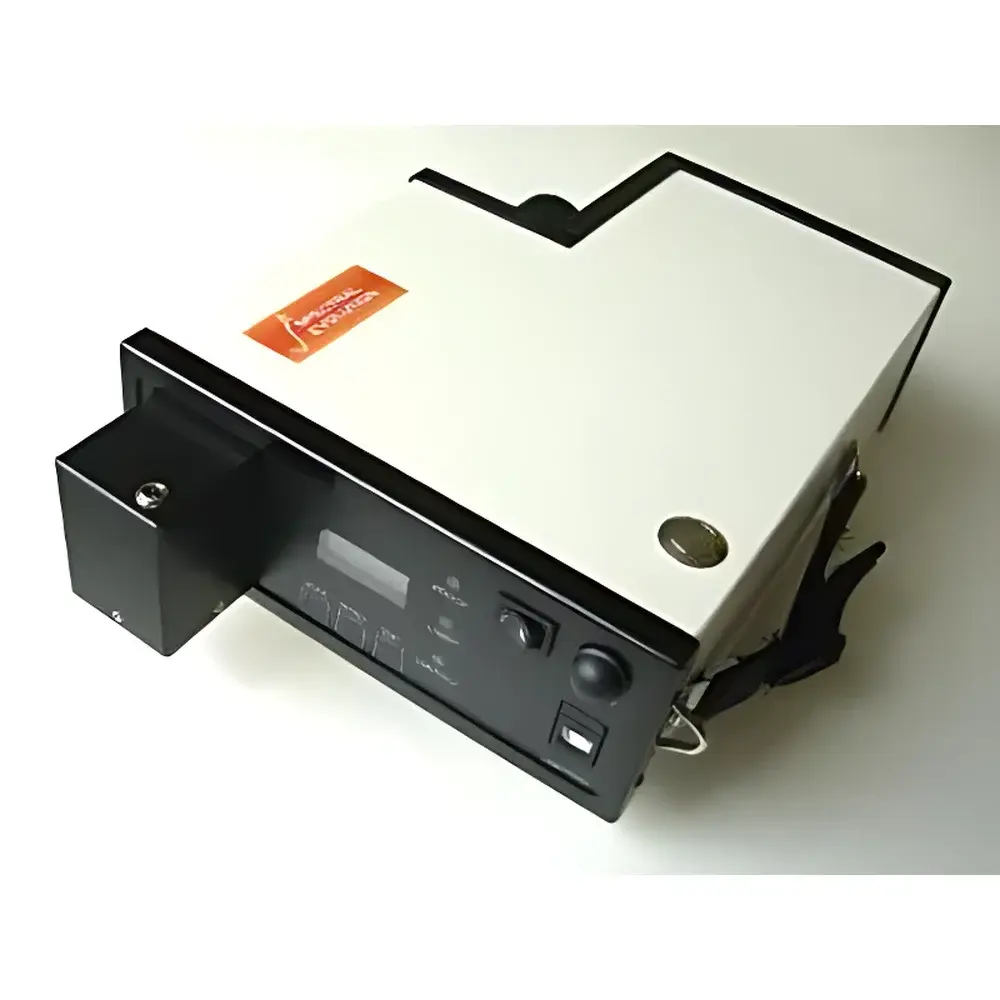
Spectral Evolution PSR-3500 Portable Field Spectroradiometer
| Brand | Spectral Evolution |
|---|---|
| Origin | USA |
| Model | PSR-3500 |
| Spectral Range | 350–2500 nm |
| Spectral Resolution | 3.5 nm (350–1000 nm), 10 nm @ 1500 nm, 7 nm @ 2100 nm |
| Spectral Bandwidth | 1.5 nm (350–1000 nm), 3.8 nm @ 1500 nm, 2.5 nm @ 2100 nm |
| Detector | 512-pixel Si array (350–1000 nm) + dual-stage thermoelectrically cooled 256-pixel InGaAs array (970–2500 nm) |
| FOV Options | 4°, 8°, or 14° fore-optics |
| Integration Time | Adjustable from 1 ms to 60 s |
| Scan Speed | Full-spectrum acquisition in ≤100 ms (up to 10 Hz) |
| Wavelength Accuracy | ±0.5 × spectral bandwidth |
| Wavelength Repeatability | ±0.1 nm |
| Radiometric Noise (4° lens, 0.5 s integration) | 1.0×10⁻⁹ W/cm²/nm/sr @ 400 nm, 1.5×10⁻⁹ W/cm²/nm/sr @ 1500 nm, 2.0×10⁻⁹ W/cm²/nm/sr @ 2100 nm |
| Calibration Uncertainty | ±5% @ 400 nm, ±4% @ 700 nm, ±7% @ 2200 nm (NIST-traceable) |
| Interface | USB 2.0 and Bluetooth 4.2 |
| Dimensions | 21.6 × 29.2 × 8.3 cm |
| Weight | 3.3 kg (7.3 lbs) |
| Power | Dual removable Li-ion batteries (7.4 V, ≥2 h operation) |
| Onboard Memory | 500 spectra |
| Tripod Mount | Dual ¼-20 threaded ports |
Overview
The Spectral Evolution PSR-3500 Portable Field Spectroradiometer is a high-performance, NIST-traceably calibrated instrument engineered for precise, rapid, and field-deployable spectral measurements across the ultraviolet, visible, and shortwave infrared (UV-VIS-SWIR) spectrum (350–2500 nm). Utilizing a fixed-holographic grating optical design with dual linear array detectors—silicon (Si) for 350–1000 nm and thermoelectrically cooled indium gallium arsenide (InGaAs) for 970–2500 nm—the PSR-3500 eliminates moving parts, ensuring long-term radiometric stability and calibration integrity. Its all-solid-state architecture avoids the spectral drift and alignment sensitivity inherent in scanning monochromators or fiber-coupled systems with narrow slits. Designed for rigorous environmental and geospatial applications, the PSR-3500 delivers full-spectrum radiance, reflectance, transmittance, and irradiance data with ≤100 ms acquisition time and up to 10 spectra per second—enabling dynamic scene capture under variable illumination conditions. The instrument’s ruggedized aluminum housing provides thermal stability across operational temperature ranges (−10 °C to +50 °C), while its ergonomic form factor and integrated carrying system support extended handheld or tripod-mounted field deployment.
Key Features
- Fixed holographic grating and linear array detector architecture—no moving optics, eliminating mechanical wear and wavelength calibration drift
- Dual-detector configuration: 512-pixel Si CCD (350–1000 nm) and two-stage TE-cooled 256-pixel InGaAs arrays (970–2500 nm) for optimized SNR across SWIR bands
- NIST-traceable factory calibration with documented uncertainty: ±5% @ 400 nm, ±4% @ 700 nm, ±7% @ 2200 nm
- Integrated shutter and drift-lock auto-calibration routine for real-time dark current and reference correction
- Bluetooth 4.2 and USB 2.0 connectivity for wireless remote control and wired data transfer
- Onboard memory stores up to 500 full-spectrum scans; no external computer required for basic operation
- Field-replaceable lithium-ion battery pack supporting ≥2 hours of continuous operation
- Laser targeting module for precise spatial registration of measurement location
- Ergonomic nylon shoulder strap, tripod mounting interface (dual ¼-20 threads), and optional field backpack or wheeled transport case
Sample Compatibility & Compliance
The PSR-3500 supports versatile sampling geometries via interchangeable fore-optics (4°, 8°, or 14° field-of-view lenses), detachable fiber optic probes (25° acceptance), cosine correctors, and optional integrating spheres (e.g., Labsphere IS-1000). This flexibility enables compliance with standard measurement protocols including ASTM E275, ISO 9050, and USP for reflectance and transmittance characterization. When paired with calibrated reference panels (e.g., Spectralon®), the system meets requirements for field validation under NASA ARSET, ESA FLEX, and USDA-ARS protocols. All calibration certificates are issued with full traceability documentation satisfying ISO/IEC 17025 and GLP audit requirements. Instrument firmware and DARWin SP software support FDA 21 CFR Part 11-compliant electronic signatures and audit trails when configured for regulated environments.
Software & Data Management
Data acquisition and post-processing are enabled by Spectral Evolution’s DARWin SP software suite—available for Windows desktop and CE-compatible mobile platforms (e.g., Getac PS236 PDA with integrated GPS, digital camera, and electronic compass). DARWin SP provides real-time spectral visualization, automated exposure control, batch processing, spectral math (e.g., NDVI, PRI, REIP), and export to ENVI, MATLAB, Python (via .csv or .spc), and ArcGIS-compatible formats. The software includes built-in atmospheric correction modules (e.g., MODTRAN-based quicklook), spectral library matching, and statistical outlier detection. LabVIEW drivers are available upon request for custom automation integration. All raw and processed datasets retain embedded metadata—including GPS coordinates, UTC timestamps, integration time, FOV configuration, and calibration ID—ensuring FAIR (Findable, Accessible, Interoperable, Reusable) data management principles.
Applications
- Remote sensing validation and vicarious calibration of airborne/satellite sensors (e.g., Landsat, Sentinel-2, PRISMA)
- Crop phenotyping and precision agriculture: chlorophyll content estimation, water stress index mapping, yield prediction modeling
- Mineral identification and lithological mapping via diagnostic absorption features (e.g., Al-OH, Fe-OH, carbonate bands)
- Forest canopy structure analysis and biodiversity assessment using spectral unmixing and vegetation indices
- Inland and coastal water quality monitoring: CDOM, chlorophyll-a, suspended sediment concentration retrieval
- Solar energy research: PV panel spectral responsivity testing, albedo quantification for solar farm site assessment
- Pharmaceutical and food product authentication via spectral fingerprinting in VIS-NIR-SWIR
- Material science: thin-film interference characterization, pigment dispersion analysis, coating thickness estimation
FAQ
Is the PSR-3500 suitable for quantitative reflectance measurements under natural sunlight?
Yes—the instrument includes an integrated shutter and drift-lock algorithm that performs automatic dark and reference corrections prior to each measurement sequence, enabling robust bidirectional reflectance distribution function (BRDF)-aware field reflectance acquisition against calibrated Spectralon panels.
Can the PSR-3500 be operated without a connected computer?
Yes—it features a backlit membrane keypad, onboard display, and internal storage for up to 500 spectra, allowing fully autonomous field operation.
What spectral calibration standards does Spectral Evolution use?
All PSR-series instruments are calibrated using NIST-traceable sources at Spectral Evolution’s ISO 17025-accredited laboratory; calibration reports include uncertainty budgets and spectral deviation maps.
Is the PSR-3500 compatible with third-party GIS or remote sensing platforms?
Yes—DARWin SP exports geotagged spectral data in GeoTIFF, ASCII, and ENVI header formats, and supports direct ingestion into QGIS, ERDAS IMAGINE, and Google Earth Engine pipelines.
Does the system support automated spectral averaging or ensemble measurements?
Yes—DARWin SP allows programmable multi-scan averaging (up to 100 repetitions), weighted noise reduction, and statistical confidence interval calculation per wavelength bin.





