
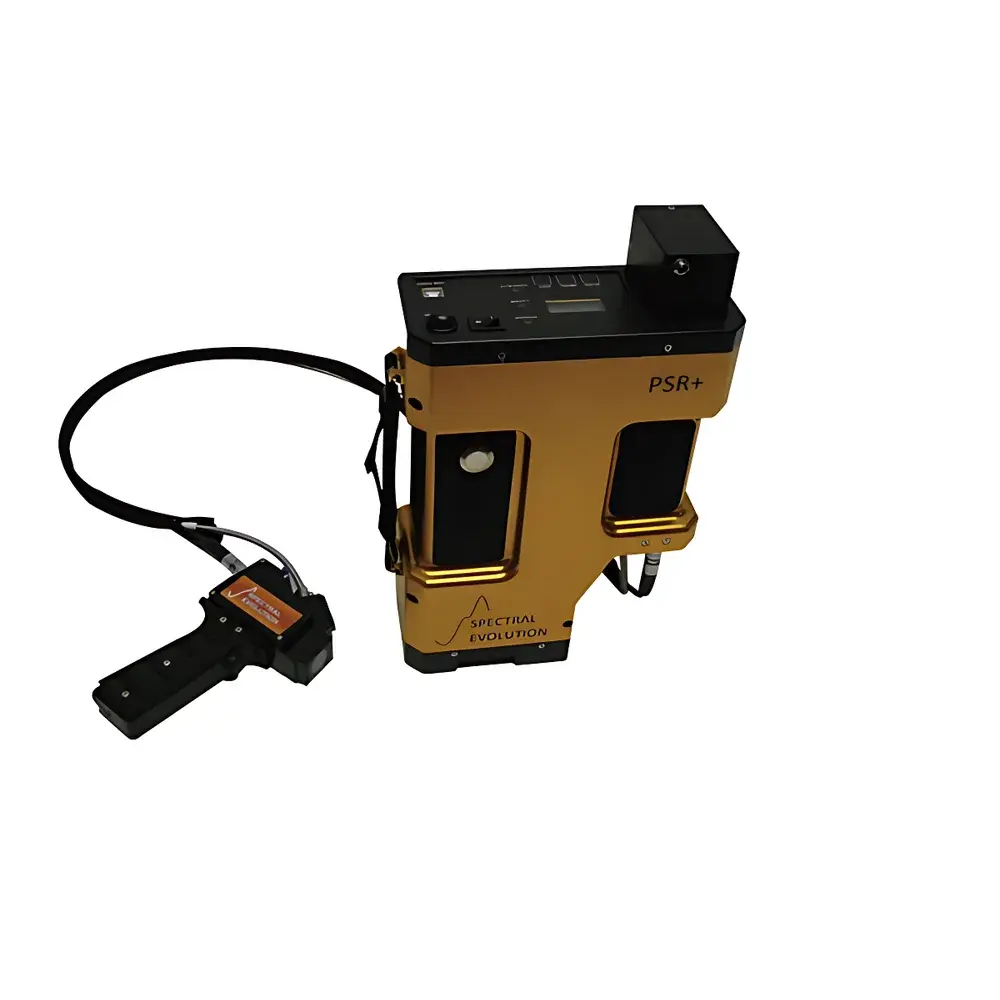
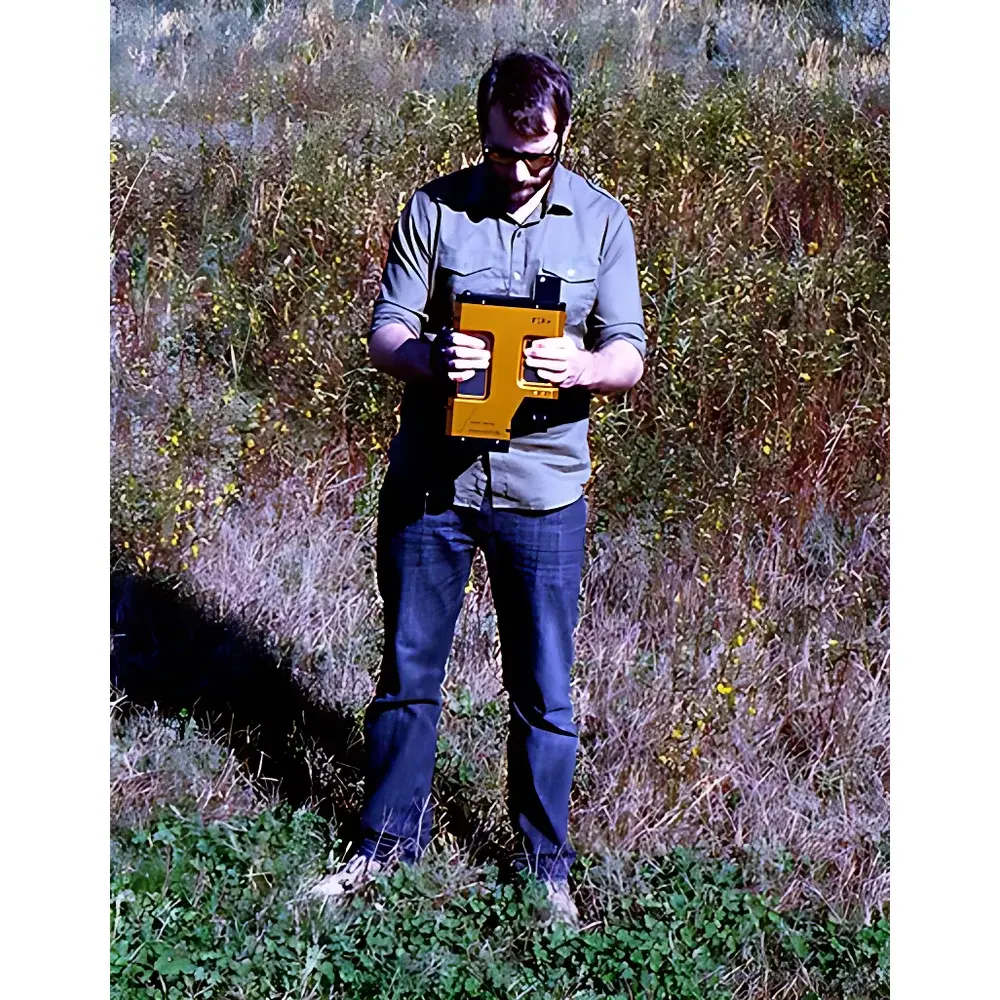
Spectral Evolution PSR+ Portable Field Spectroradiometer
| Brand | Spectral Evolution |
|---|---|
| Model | PSR+ |
| Origin | USA |
| Spectral Range | 350–2500 nm |
| Spectral Resolution | 3 nm @ 700 nm, 8 nm @ 1500 nm, 6 nm @ 2100 nm |
| Detector Configuration | 512-pixel Si (350–1000 nm), 256-pixel TE-cooled extended InGaAs (970–1910 nm and 1900–2500 nm) |
| Total Spectral Channels | 2151 (1-nm output interval) |
| NEDL | ≤0.5×10⁻⁹ W/cm²/nm/sr @ 400 nm, ≤0.8×10⁻⁹ W/cm²/nm/sr @ 1400 nm, ≤1.0×10⁻⁹ W/cm²/nm/sr @ 2100 nm |
| Radiometric Calibration Accuracy | ±1% @ 450 nm, ±1% @ 900 nm, ±1% @ 2300 nm |
| Wavelength Repeatability/Precision | 0.1 nm / ±0.5 nm FWHM |
| Scan Speed | 100 ms per spectrum |
| Weight | 3.3 kg (7.3 lbs) |
| Battery Life | ≥4 hours (7.4 V Li-ion, internal) |
| Data Storage | Onboard memory for 1000 spectra |
| PDA storage capacity | 100,000 spectra with embedded GPS geotagging |
| Communication | USB 2.0, Bluetooth 4.0 |
| Operating Modes | Standalone (LCD + laser pointer + one-button measurement), PDA-controlled (touchscreen, integrated GPS), laptop/tablet remote operation |
| Compatible Platforms | Ground-based field surveys, airborne mounts, UAV-integrated hyperspectral mapping |
Overview
The Spectral Evolution PSR+ Portable Field Spectroradiometer is a high-performance, push-broom–compatible, interferometrically stabilized spectroradiometer engineered for rigorous field-deployable spectral measurements across the full solar-reflective range (350–2500 nm). Designed around a fixed-optics architecture—featuring no moving parts, holographic gratings, and linear array detectors—the PSR+ delivers laboratory-grade radiometric stability in a rugged, handheld form factor. Its core measurement principle combines calibrated spectral radiance capture with real-time dark-current compensation, drift-lock auto-calibration, and shutterless integration control. Unlike scanning or filter-wheel systems, the PSR+ employs simultaneous full-spectrum acquisition via three co-aligned detector arrays (Si + dual TE-cooled extended InGaAs), enabling high-fidelity, reproducible spectral sampling under variable illumination and thermal conditions. The instrument meets foundational requirements for traceable field spectroscopy, supporting compliance with ASTM E275, ISO 13406-2 (for detector uniformity), and NASA/USGS field validation protocols used in vicarious calibration of satellite sensors (e.g., Landsat, Sentinel-2, MODIS).
Key Features
- Triple-detector architecture: 512-pixel silicon CCD (350–1000 nm), two 256-pixel TE-cooled extended InGaAs arrays (970–1910 nm and 1900–2500 nm) for seamless spectral coverage without gaps or interpolation artifacts.
- Fixed-grating, all-reflective optical path eliminates mechanical wear, thermal hysteresis, and wavelength registration drift—critical for long-duration field campaigns and UAV-mounted operations.
- Integrated Class II laser targeting system and ergonomic one-button measurement interface enable rapid, operator-independent spectral acquisition with spatial referencing accuracy <±0.5°.
- Onboard 7.4 V lithium-ion battery (0.3 kg) supports ≥4 hours of continuous operation; dual-battery option extends deployment time without external power sources.
- Bluetooth 4.0 and USB 2.0 connectivity allow flexible control from Windows-based PDAs, tablets, or laptops—no driver installation required.
- Real-time drift-lock calibration and automatic dark-current subtraction ensure radiometric consistency across temperature gradients (−10 °C to +50 °C operational range).
- Aluminum alloy chassis provides EMI shielding, thermal mass buffering, and MIL-STD-810G-compliant mechanical robustness for transport and field handling.
Sample Compatibility & Compliance
The PSR+ is optimized for non-contact reflectance, radiance, irradiance, transmittance, and CIE colorimetric measurements of natural and engineered surfaces—including vegetation canopies, soil profiles, mineral outcrops, water bodies, photovoltaic materials, and painted or coated substrates. Its modular fore-optics system accepts interchangeable FOV lenses (1°–10°), contact probes, cosine correctors, and fiber-coupled accessories, ensuring adaptability across ISO 9050 (glass transmittance), ASTM E308 (colorimetry), and USGS spectral library matching workflows. All factory calibrations are NIST-traceable and documented per ISO/IEC 17025:2017 requirements. The instrument’s radiometric uncertainty budget conforms to USP guidelines for analytical instrument qualification (AIQ) in regulated environmental monitoring applications.
Software & Data Management
Data acquisition is managed via Spectral Evolution’s proprietary WinSpec Pro software suite, compatible with Windows 10/11 and Windows Mobile on ruggedized PDAs. The software implements FDA 21 CFR Part 11–compliant audit trails, electronic signatures, and secure data encryption for GLP/GMP-aligned deployments. Key capabilities include: automated NDVI, GRVI, SR, EVI, and PRI index computation; spectral angle mapper (SAM) analysis against the USGS Digital Spectral Library v7; cross-platform spectral resampling to match AVHRR, SPOT, Sentinel-2 MSI, and PlanetScope bandpasses; CIE 1931 xy chromaticity and correlated color temperature (CCT) derivation; and solar simulator spectral mismatch correction per IEC 60904-9. Optional EZ-ID mineral identification module integrates with the ASTER and ECOSTRESS spectral libraries for geological surveying.
Applications
- Earth observation calibration: Vicarious validation of multispectral/hyperspectral satellite and airborne sensors (e.g., PRISMA, EnMAP, AVIRIS-NG).
- Environmental remote sensing: Canopy biochemical parameter retrieval (chlorophyll-a, leaf water content, lignin/cellulose ratios) using PROSAIL inversion frameworks.
- Geological exploration: Identification of hydroxyl-, carbonate-, and sulfate-bearing minerals via diagnostic absorption feature detection at 1400, 1900, and 2200 nm.
- Aquatic optics: Inherent optical property (IOP) modeling of CDOM, chlorophyll-a, and suspended sediment from above-water radiance measurements.
- Renewable energy: Spectral responsivity characterization of PV modules under natural illumination, including spectral mismatch factor (MMF) calculation per IEC 61215-2.
- Food and pharma QA: Non-destructive assessment of surface composition, moisture content, and adulterant detection via spectral fingerprinting in the SWIR region.
- Material science: Reflectance anisotropy studies, thin-film thickness estimation, and pigment dispersion analysis in coatings and composites.
FAQ
Is the PSR+ suitable for UAV-integrated hyperspectral mapping?
Yes—the PSR+’s weight (3.3 kg), low power draw (<8 W), and vibration-resistant optical design make it compatible with medium-class UAV platforms. Integration requires third-party gimbal stabilization and synchronization with GNSS/IMU telemetry via TTL trigger signals.
Does the instrument support real-time GPS geotagging during acquisition?
Yes—when operated with the optional Windows Mobile PDA, each spectrum is automatically tagged with latitude, longitude, altitude, UTC timestamp, and heading from the embedded GPS receiver (WAAS-enabled, <3 m CEP accuracy).
Can raw data be exported in ENVI, HDF5, or ASCII formats for third-party processing?
Yes—WinSpec Pro exports calibrated radiance/reflectance spectra in BSQ, BIL, and BIP formats compliant with ENVI 5.6+, as well as CSV and HDF5 (v1.10.7) for MATLAB, Python (h5py), and R interoperability.
What is the recommended recalibration interval for field-deployed units?
Spectral Evolution recommends annual radiometric recalibration against NIST-traceable standards; however, onboard drift-lock functionality and user-performed dark/reference checks extend calibration validity to 12–18 months under controlled storage and moderate field use.
Are spectral libraries and vegetation index algorithms preloaded in the firmware?
No—the spectral libraries (USGS, ASTER) and index algorithms reside in the WinSpec Pro software environment. Firmware contains only core acquisition logic, calibration coefficients, and real-time signal processing kernels.



