
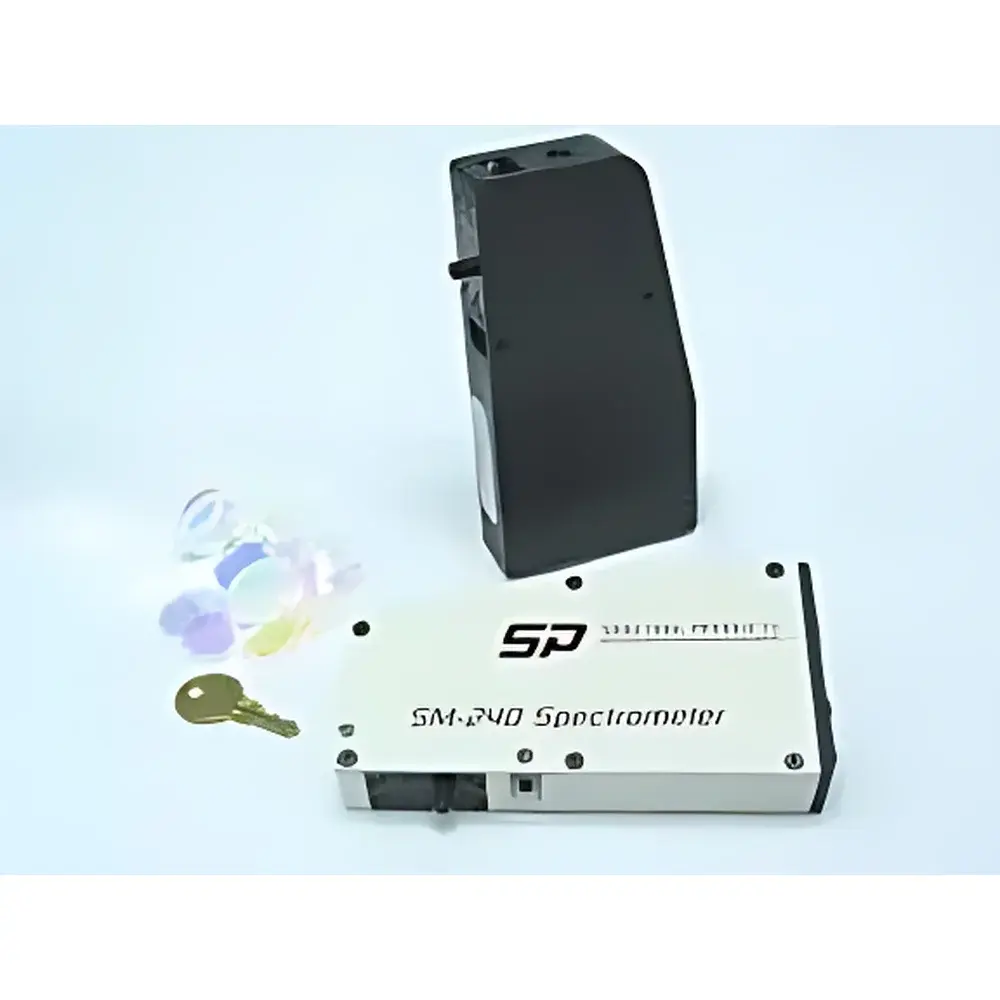
Spectral Products SM240 Compact CCD Fiber-Optic Spectrometer
| Brand | Spectral Products |
|---|---|
| Origin | USA |
| Model | SM240 |
| Detector | Sony ILX511 (2048-pixel linear CCD) |
| Spectral Range | 200–1050 nm |
| Optical Resolution | 0.15–10 nm (slit- and grating-dependent) |
| Slit Options | 5, 10, 25, 50, 100, 200, 400 µm |
| Input Interface | SMA905 or FC fiber connector |
| f/# | 2.7 |
| Dynamic Range | 16-bit (65,536 counts) |
| Data Acquisition Rate | Up to 500 kHz via USB 2.0 |
| Multi-channel Support | Up to 8 spectrometers synchronized via USB hub |
| UV-enhanced coating | Yes (enhances QE <450 nm by ~20–50% vs. standard coatings) |
| Temperature Sensitivity | 0.01 nm/°C |
| Housing | Anodized aluminum, ruggedized for field and lab use |
| Software | SM32Pro (Windows® 98/2000/XP/7, 32-/64-bit), SDK & DLL included for custom integration |
| Compliance | USB 2.0 Class-compliant |
Overview
The Spectral Products SM240 is a compact, fiber-coupled CCD spectrometer engineered for high-fidelity spectral acquisition across the ultraviolet–visible–near-infrared (UV-VIS-NIR) range (200–1050 nm). Based on the proven optical bench architecture of the SM200 series, it employs a fixed-grating Czerny–Turner configuration with optimized f/2.7 optics and thermally stable aluminum housing—ensuring mechanical rigidity and wavelength stability (0.01 nm/°C) over ambient temperature fluctuations. Its core measurement principle relies on dispersive spectroscopy: incident light—delivered via SMA905 or FC-terminated optical fiber—is collimated, diffracted by a ruled or holographic grating, and focused onto a linear CCD array (Sony ILX511, 2048 pixels × 14 µm × 200 µm). The 16-bit analog-to-digital conversion enables high dynamic range (65,536 intensity levels), critical for applications requiring simultaneous detection of weak and strong spectral features. Unlike scanning monochromators, the SM240 captures full spectra in a single exposure, supporting rapid kinetics, real-time process monitoring, and multichannel comparative analysis.
Key Features
- Compact, handheld-ready design (5.6″ H × 2.75″ W × 0.87″ D; 0.5 lb) with machined anodized aluminum enclosure for thermal and mechanical stability
- UV-enhanced anti-reflection coating on CCD window, improving quantum efficiency by 20–50% below 450 nm relative to conventional coatings
- Interchangeable slit options (5–400 µm) and selectable diffraction gratings enable resolution tuning from 0.15 nm to 10 nm (FWHM)
- USB 2.0 interface (500 kHz max readout) with native 16-bit digitization and support for up to eight synchronized spectrometers via hub-based multi-channel configuration
- Integrated order-sorting filters or long-pass blocking filters prevent second-order spectral overlap, ensuring spectral fidelity across the full 200–1050 nm range
- Low-noise array driver electronics optimized for stability and sensitivity, achieving typical dark current <10 e⁻/pixel/s at 25°C
Sample Compatibility & Compliance
The SM240 accepts light input either directly through its precision-machined entrance slit or via standardized optical fiber (SMA905 or FC termination), enabling seamless integration into diverse optical setups—including cuvette holders, integrating spheres, plasma probes, LED/Laser characterization rigs, and remote sensing configurations. Its spectral response is calibrated traceably to NIST-traceable standards, and raw data output conforms to ASTM E308 (computing tristimulus values) and ISO/CIE colorimetry protocols. While not certified as a medical device, the instrument meets electromagnetic compatibility (EMC) requirements per FCC Part 15 Class B and CE directives. Its firmware and SM32Pro software architecture support audit-ready operation under GLP/GMP environments when configured with user-access logging and timestamped metadata capture—though formal 21 CFR Part 11 compliance requires supplemental validation by the end user.
Software & Data Management
SM32Pro is a native Windows® application (32-/64-bit compatible, Windows 98 through Windows 7) providing complete control over integration time (1 ms–65 s), signal averaging, dark subtraction, baseline correction, and spectral math operations (e.g., transmission = I_sample/I_reference, absorbance = –log₁₀(transmission)). It supports real-time overlay of multiple spectra, color space conversion (CIE XYZ, LAB, LCH), peak identification with centroid fitting, and export to CSV, TXT, or binary formats. For embedded or automated systems, Spectral Products supplies a comprehensive Windows DLL library and C/C++/LabVIEW/Python SDKs—enabling deterministic trigger synchronization, hardware-timed acquisitions, and integration into SCADA, PLC, or custom QC/QA workflows. All spectral data includes embedded metadata: wavelength calibration coefficients, slit width, grating ID, integration time, temperature reading, and firmware version.
Applications
- UV-VIS absorption and transmission spectroscopy of liquid and solid samples in chemistry and pharmaceutical QA/QC labs
- Laser-induced fluorescence (LIF) and Raman excitation profiling in material science and life sciences
- LED and OLED spectral power distribution (SPD) and chromaticity coordinate (x,y) measurement per CIE 15:2018
- In-line process monitoring in semiconductor manufacturing (plasma emission, thin-film thickness via reflectance)
- Environmental sensing: water quality (COD, nitrate, chlorophyll-a), gas-phase absorption (NO₂, SO₂) using differential optical absorption spectroscopy (DOAS) principles
- Educational labs: hands-on instruction in optical physics, spectroscopic instrumentation, and digital signal processing fundamentals
FAQ
What is the maximum optical resolution achievable with the SM240?
Resolution depends on slit width and grating line density; with a 5 µm slit and 2400 l/mm grating, typical FWHM resolution is ≤0.15 nm in the UV region.
Can the SM240 operate without a computer?
No—the SM240 is a USB-powered, host-dependent device requiring a Windows PC running SM32Pro or custom software built upon the provided SDK/DLL.
Is calibration data provided with each unit?
Yes—each SM240 ships with a factory-applied wavelength calibration file (.cal) and radiometric responsivity curve (if ordered with NIST-traceable irradiance calibration option).
How does the UV-enhanced coating improve performance?
It increases quantum efficiency in the 200–450 nm band by reducing reflection losses and enhancing photon absorption in the silicon depletion layer—yielding 20–50% higher signal-to-noise ratio compared to uncoated or standard AR-coated CCDs.
Does the SM240 support external triggering?
Yes—via TTL-compatible input on the USB board, enabling precise synchronization with pulsed lasers, shutter controllers, or motion stages.



