
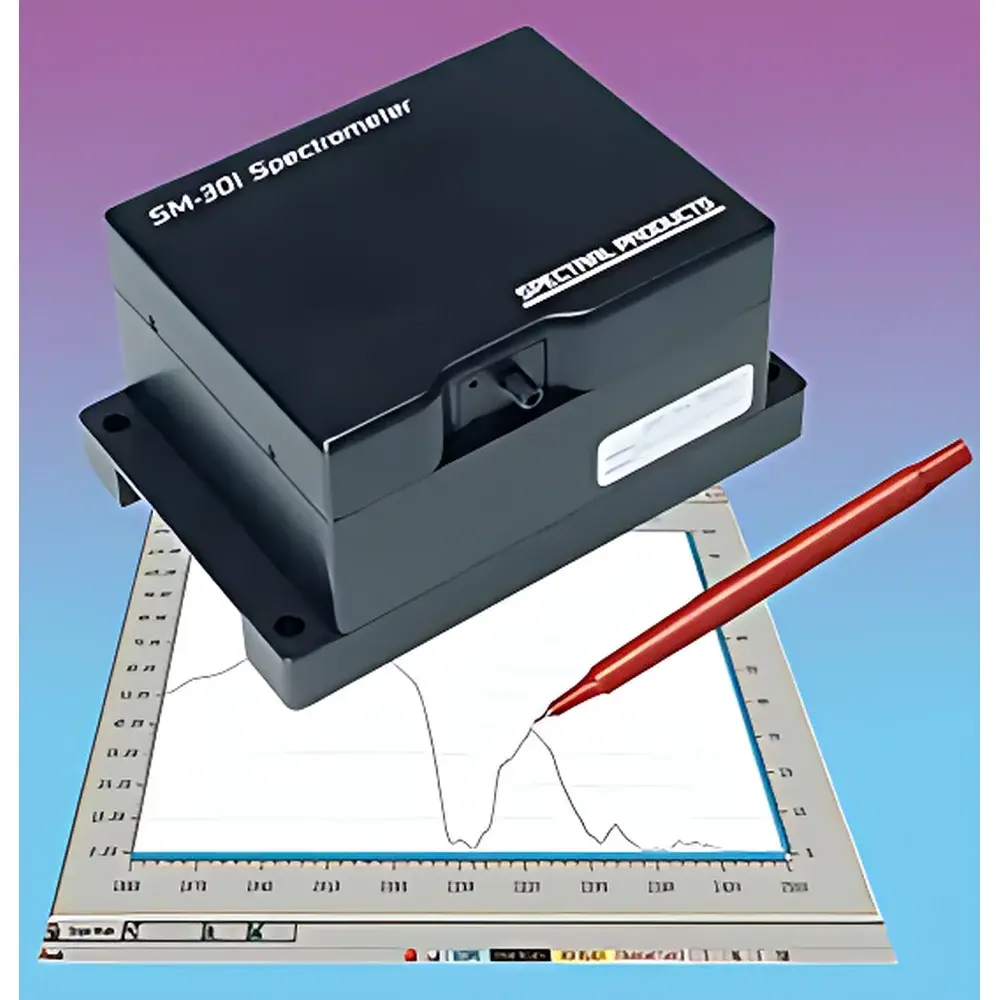
Spectral Products SM301-EX PbS/PbSe Array-Based Mid-Infrared Spectrometer
| Brand | Spectral Products |
|---|---|
| Origin | USA |
| Manufacturer Type | Authorized Distributor |
| Import Status | Imported |
| Model | SM301-EX |
| Spectral Range | 1.0–5.0 µm |
| Detector Type | Thermoelectrically Cooled PbS/PbSe Linear Array (256 elements) |
| Optical Resolution | 10–30 nm (FWHM, dependent on slit width and grating configuration) |
| Sensitivity | High (typical detectivity D* > 1×10¹⁰ cm·√Hz/W for PbSe at 4.0 µm) |
| Signal-to-Noise Ratio | > 5,000:1 (RMS, 1 s integration, full well) |
| Dynamic Range | > 70 dB (linear response over 4 decades of irradiance) |
| Stray Light | < 0.1% (measured at 2.5 µm with 500 nm bandwidth rejection filter) |
Overview
The Spectral Products SM301-EX is a thermoelectrically cooled, array-based mid-infrared (MIR) spectrometer engineered for high-stability spectral acquisition in the 1.0–5.0 µm range. Unlike scanning monochromators or Fourier-transform instruments, the SM301-EX employs a fixed-grating optical design coupled with a 256-element linear PbS (for 1.0–3.0 µm) or PbSe (for 1.5–5.0 µm) photodetector array, enabling true multichannel detection. This architecture eliminates mechanical moving parts, delivering superior measurement reproducibility, reduced acquisition time, and enhanced signal-to-noise performance through simultaneous wavelength sampling. The detector array is actively stabilized at –4 °C via integrated Peltier cooling, minimizing dark current drift and enabling long-duration measurements under ambient laboratory conditions without liquid nitrogen. Its optical input accepts either free-space illumination via a precision 25 µm entrance slit or fiber-coupled light using standard SMA-905 connectors—supporting both benchtop reflectance/absorption setups and process-integrated remote sensing configurations.
Key Features
- Thermoelectrically cooled 256-element PbS/PbSe linear array detector with factory-calibrated spectral response
- Fixed-grating Czerny-Turner optical layout optimized for MIR throughput and stray-light suppression (< 0.1%)
- Adjustable integration time (1 ms to 60 s) and programmable readout rates up to 2 MHz (full array)
- On-board dark signal compensation: automatic periodic dark reference acquisition and subtraction
- Rugged aluminum housing with EMI-shielded electronics and passive thermal management for continuous operation
- USB 2.0 interface compliant with Windows® 98 through Windows 11 (32-bit & 64-bit), driver-free enumeration
Sample Compatibility & Compliance
The SM301-EX supports transmission, reflection, and attenuated total reflectance (ATR) measurement geometries when paired with appropriate accessories (e.g., MIR-compatible beam splitters, KBr windows, or diamond ATR crystals). It complies with IEC 61326-1:2013 for electromagnetic compatibility in laboratory environments and meets RoHS Directive 2011/65/EU requirements. While not certified for GMP or FDA 21 CFR Part 11 out-of-the-box, its firmware and SM32Pro software support audit-trail-enabled data logging, user-access controls, and electronic signature-ready export formats (CSV, ASCII, XML) — facilitating validation under GLP, ISO/IEC 17025, or ASTM E1421-22 guidelines for spectral method verification.
Software & Data Management
SM32Pro is a native Windows application providing real-time spectral visualization, quantitative analysis, and instrument control. Core capabilities include absorbance/transmittance/reflectance conversion with baseline correction, spectral overlay, peak identification (with customizable threshold and FWHM constraints), signal averaging (up to 10,000 scans), and integration time optimization. Export options include calibrated radiometric units (µW/cm²/nm), normalized intensity, and derivative spectra. A comprehensive SDK (C/C++, .NET, LabVIEW, Python) and DLL library enable integration into custom QA/QC workflows, OEM systems, or automated production line monitoring platforms. All raw and processed data files retain embedded metadata (wavelength calibration coefficients, temperature logs, integration parameters) for full traceability.
Applications
- Quantitative analysis of hydrocarbons, polymers, and pharmaceutical excipients via characteristic C–H, O–H, and N–H vibrational bands
- In-line monitoring of solvent composition and moisture content in chemical synthesis reactors
- Quality control of thin-film coatings (e.g., anti-reflective layers on IR optics) using interference fringe analysis
- Gas-phase spectroscopy of CO, CO₂, CH₄, and NOₓ in environmental emission testing (requires multipass cell or tunable laser coupling)
- Material identification in forensic and art conservation studies leveraging fingerprint-region absorption patterns
- Calibration transfer between FTIR and dispersive systems using NIST-traceable blackbody or rare-earth oxide sources
FAQ
What detector materials are used, and how do I select between PbS and PbSe configurations?
The SM301-EX uses either PbS (optimized for 1.0–3.0 µm) or PbSe (1.5–5.0 µm) linear arrays. Selection depends on your primary spectral region of interest; PbSe offers extended sensitivity beyond 3.5 µm but requires tighter thermal stabilization. Both versions share identical electronics and software interfaces.
Is spectral calibration traceable to NIST standards?
Yes — each unit ships with a factory-applied wavelength calibration derived from Hg-Ne and Ar emission lines, documented in the calibration certificate. Users may perform field recalibration using optional NIST SRM 2035 (rare-earth oxide filters) or gas discharge lamps.
Can the SM301-EX operate in vacuum or inert-gas environments?
The standard enclosure is rated for ambient air operation only. For vacuum or purged environments, an optional hermetically sealed housing with fused-silica viewport (model SM301-EX-VAC) is available upon request.
Does the system support synchronization with external triggers or timing devices?
Yes — the USB interface provides TTL-compatible trigger input (rising-edge) and sync output signals, enabling precise coordination with pulsed lasers, motorized stages, or data acquisition systems.
What maintenance is required for long-term stability?
No routine optical alignment or detector replacement is needed. Annual verification of wavelength accuracy and dark current drift using the included calibration checklist is recommended for ISO/IEC 17025 compliance.
Related Products




