
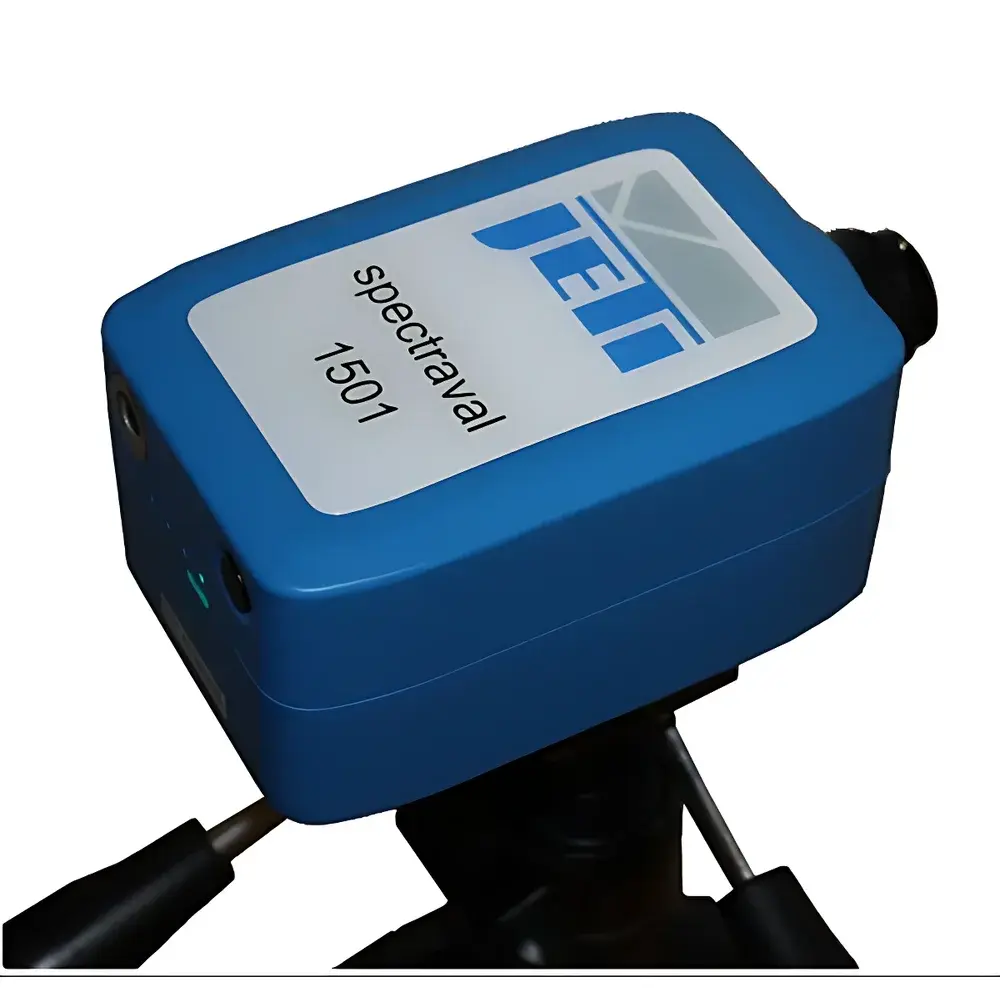
Spectraval 1501 Spectroradiometer for Luminance and Colorimetry
| Origin | Germany |
|---|---|
| Manufacturer Type | Authorized Distributor |
| Origin Category | Imported |
| Model | 1501 |
| Price Range | USD 6,800 – 13,600 |
| Wavelength Range | 380–780 nm (NIR variant up to 1000 nm) |
| Optical Bandwidth | 4.5 nm (HiRes variant: 2 nm) |
| Spectral Resolution | 1 nm |
| Field of View | 1.8° (6 mm diameter at 20 cm |
| Luminance Range | 0.2–180,000 cd/m² (Illuminant A), 0.2–140,000 cd/m² (typical white LED) |
| Luminance Accuracy | ±3% (@ 100 cd/m², Illuminant A) |
| Luminance Repeatability | ±1% |
| Chromaticity Accuracy | ±0.002 in CIE 1931 x,y coordinates (@ Illuminant A) |
| Chromaticity Repeatability | ±0.0005 in x,y (@ Illuminant A) |
| CCT Repeatability | ±20 K (@ Illuminant A) |
| Wavelength Accuracy | ±0.5 nm |
| Dimensions | 140 × 80 × 70 mm |
| Weight | 400 g |
| Operating Temperature | 10–40 °C |
| Relative Humidity | <85% RH at 35 °C |
| Power Supply | USB bus-powered or internal rechargeable Li-ion battery |
| Interface | Bluetooth v4.2 + USB 2.0 (LAN variant available) |
| Shutter Type | Piezoelectric actuated dark-current compensation shutter |
| Measurement Modes | Spectral radiance, luminance, chromaticity (CIE 1931 xy, CIE 1976 u'v'), dominant wavelength, purity, correlated color temperature (CCT), CRI (Ra), CQS, TM-30 Rf/Rg, PAR (400–700 nm), melanopic EDI (EML) |
Overview
The Spectraval 1501 is a high-precision, portable spectroradiometer engineered for traceable spectral radiance and photometric measurements across the visible spectrum (380–780 nm). It operates on the principle of diffraction-grating-based spectral dispersion coupled with a back-thinned CCD detector, enabling direct measurement of spectral power distribution (SPD) with 1 nm data interval resolution. Unlike filter-based tristimulus colorimeters, the Spectraval 1501 delivers full-spectrum acquisition—essential for evaluating modern light sources with narrowband emission (e.g., micro-LEDs, quantum-dot displays) and for computing advanced photobiological metrics such as melanopic equivalent daylight illuminance (EDI). Its calibrated optical path, temperature-stabilized detector housing, and piezoelectric shutter for automated dark current subtraction ensure metrological integrity under variable ambient conditions. Designed for integration into production line QA, display calibration labs, and R&D environments, the instrument meets the foundational requirements of ISO/CIE 12640-3, IEC 62368-1 Annex H, and VESA DisplayHDR™ test protocols.
Key Features
- High-fidelity spectral acquisition with 4.5 nm FWHM optical bandwidth (2 nm optional in HiRes variant), minimizing stray-light-induced errors in narrow-spectrum source evaluation
- Laser-assisted targeting system for precise spatial alignment—critical for small-area measurements on OLED pixels, automotive HUDs, or AR/VR microdisplays
- Piezoelectric shutter mechanism enabling real-time dark-signal compensation without mechanical wear or timing drift
- Extended dynamic range supporting HDR characterization: validated luminance measurement from 0.2 cd/m² (low-light ambient mode) up to 140,000 cd/m² (white LED peak)
- Dual interface architecture: native Bluetooth v4.2 for wireless lab mobility and USB 2.0 for deterministic latency-critical automation; LAN and fiber-optic isolation variants available for EMI-sensitive cleanroom deployment
- On-board battery operation (up to 8 hours) with USB-C charging—enabling field use without tethering to mains power
- Comprehensive firmware-level computation of photometric, colorimetric, and photobiological quantities per CIE S 026/E:2018, IES TM-30-20, and ANSI/IES RP-16-17
Sample Compatibility & Compliance
The Spectraval 1501 accommodates planar and curved emissive surfaces—including LCD, OLED, Mini-LED, microLED, laser phosphor projectors, and automotive lighting modules—via its fixed 1.8° field-of-view optics. Optional lens adapters (e.g., 0.5° telephoto, 5° wide-angle) extend flexibility without compromising NIST-traceable calibration. All factory calibrations are performed against NIST-traceable standards (STD-1000 series) and documented per ISO/IEC 17025 requirements. The instrument supports GLP-compliant audit trails when used with Spectraval Control Software v5.x, including timestamped calibration history, user authentication logs, and immutable raw SPD export (ASCII .spc format). It satisfies essential clauses of FDA 21 CFR Part 11 for electronic records when configured with digital signature-enabled reporting modules.
Software & Data Management
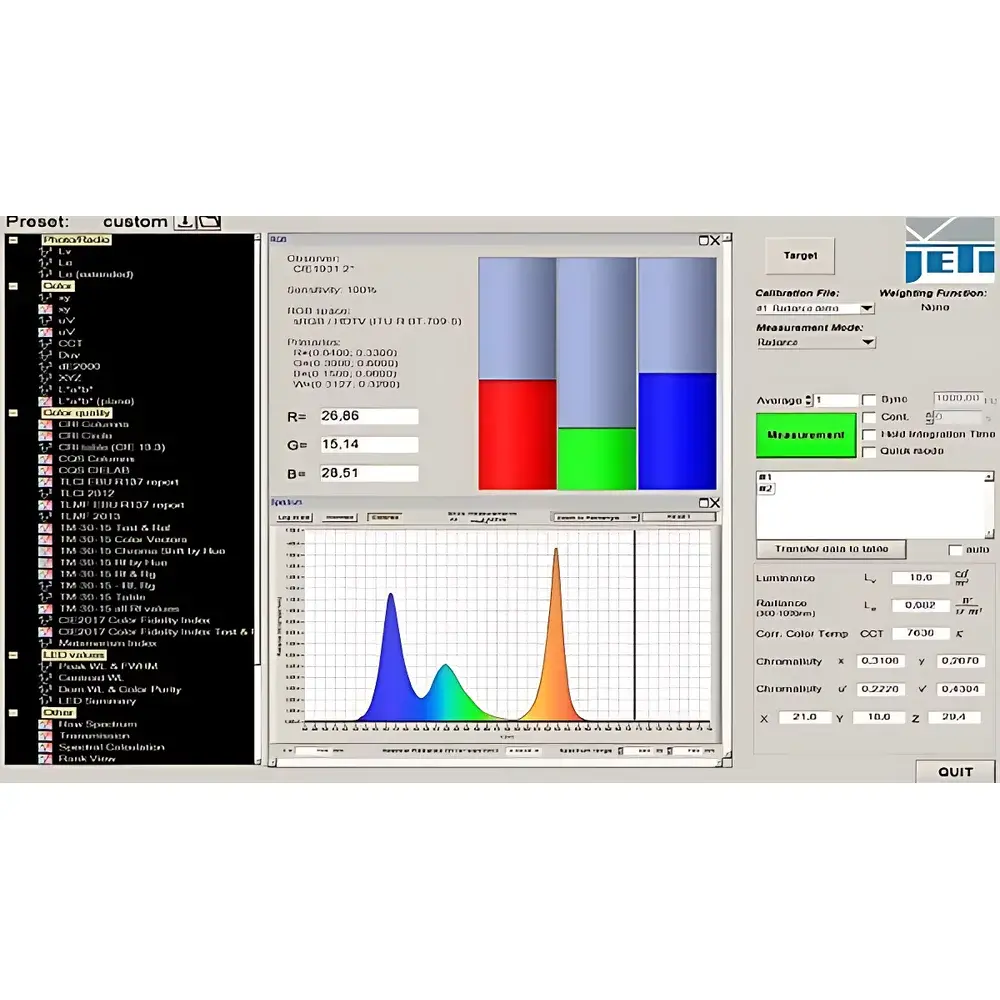
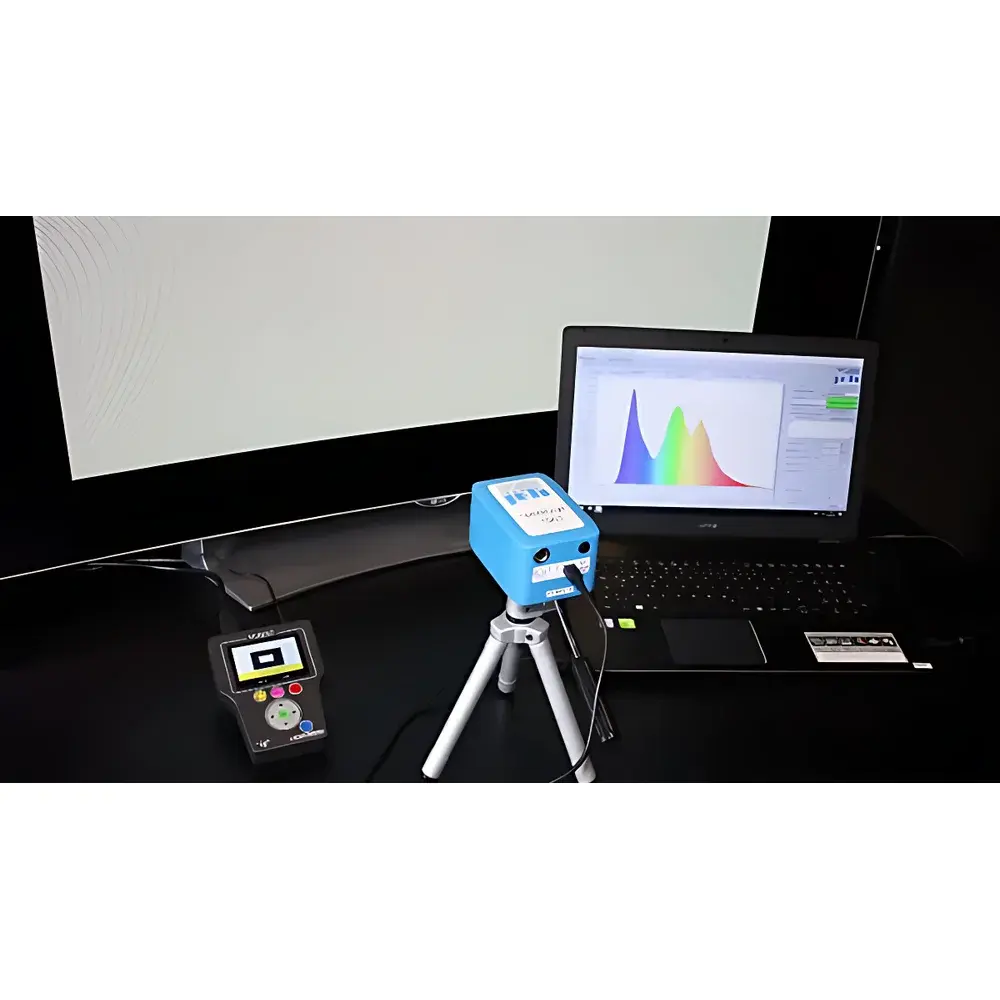
Spectraval Control Software (Windows/macOS) provides full remote control, real-time spectral visualization, batch measurement scripting, and compliance-ready reporting. The SDK includes a documented Windows DLL (C/C++, C#, Python ctypes bindings) and SCPI-compliant serial command set—enabling seamless integration into LabVIEW, MATLAB, or custom CI/CD test frameworks. Raw spectral data exports support ASTM E308-22 conversion tables and can be ingested directly into industry-standard tools such as LightTools, ASAP, or Photopia for optical simulation validation. All computed metrics—including TM-30 Rf/Rg, CQS Qa, melanopic EDI, and PAR—adhere to the latest CIE technical reports and are recalculable from raw SPDs to ensure long-term reproducibility.
Applications
- Display manufacturing: pixel-level uniformity mapping, gamut verification per DCI-P3/sRGB/Rec.2020, and HDR tone-mapping validation
- Lighting design: spectral quality assessment of horticultural LEDs, circadian lighting systems, and human-centric lighting installations
- Automotive electronics: head-up display (HUD) brightness/contrast certification, instrument cluster chromaticity homogeneity testing
- AR/VR development: near-eye display luminance stability analysis under thermal cycling and temporal modulation
- Academic research: spectral characterization of novel phosphors, perovskite emitters, and bio-integrated light sources
- Regulatory testing: pre-compliance screening for ENERGY STAR, DesignLights Consortium (DLC), and EU Ecodesign Lot 10 requirements
FAQ
Is the Spectraval 1501 suitable for measuring ultra-high-brightness microLED arrays?
Yes—the instrument’s extended luminance range (up to 140,000 cd/m²) and low-noise amplifier architecture enable stable acquisition even at peak pulsed intensities typical of microLED backplanes.
Can raw spectral data be exported for third-party analysis?
Yes—ASCII-formatted .spc files contain wavelength-indexed irradiance/radiance values with metadata (integration time, calibration ID, temperature), fully compatible with Python (NumPy/Pandas), MATLAB, and optical simulation platforms.
How often does the instrument require recalibration?
Annual recalibration is recommended per ISO/IEC 17025 guidelines; however, built-in reference LED stability monitoring and dark-signal trending allow users to assess calibration drift between service intervals.
Does it support CIE 2015 colorimetric observer functions?
Yes—firmware v5.2+ implements both CIE 1931 2° and CIE 2015 2°/10° observer functions, selectable per measurement session.
What is the uncertainty budget for chromaticity measurement?
At 100 cd/m² and Illuminant A, expanded uncertainty (k=2) for CIE 1931 x,y is ±0.002, derived from contributions of detector nonlinearity, spectral stray light, and calibration standard uncertainty.



