
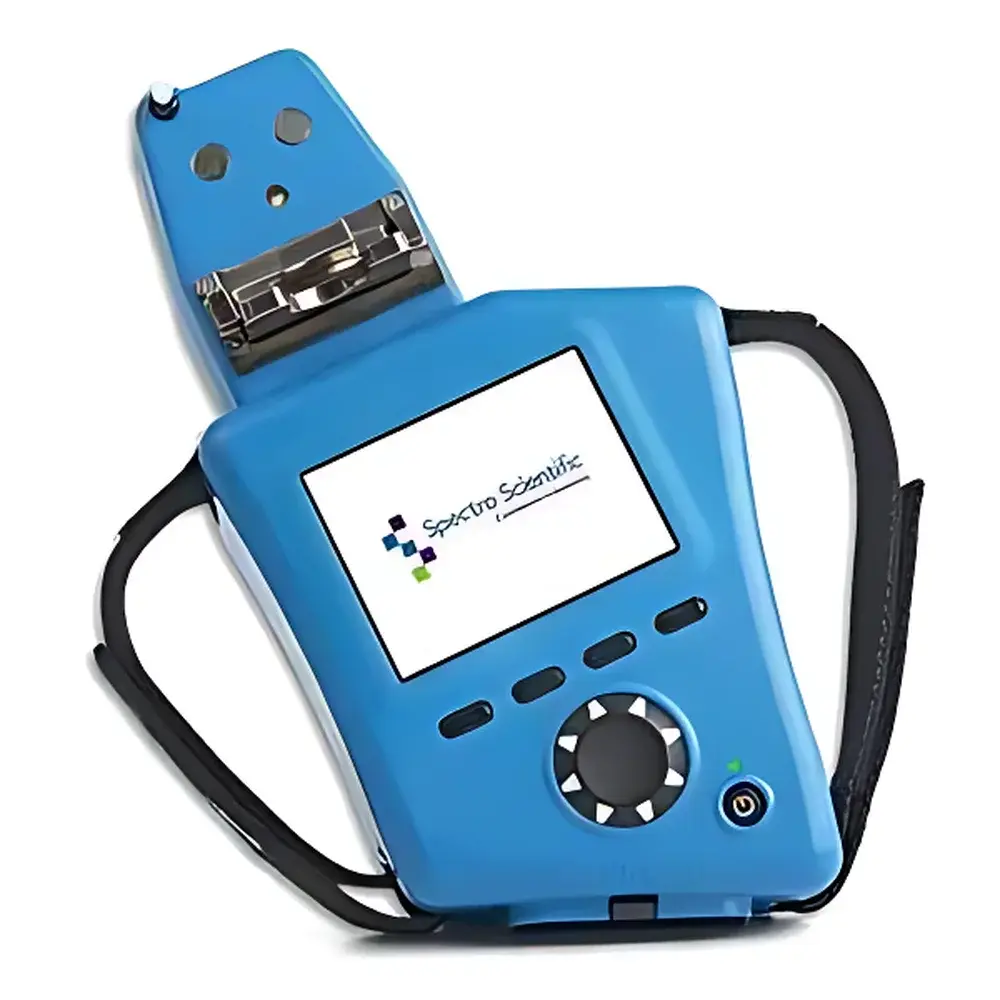
Spectro Scientific FluidScan 1000 Series Handheld FTIR Oil Analyzer
| Brand | Spectro Scientific |
|---|---|
| Origin | USA |
| Manufacturer Type | Original Equipment Manufacturer (OEM) |
| Product Origin | Imported |
| Model | FluidScan 1000 |
| Product Category | Portable Instrument |
| Application Scope | In-service lubricant and grease condition monitoring |
| Compliance | ASTM D7889, JOAP Standard Practice |
| Detection Capability | Oxidation, Nitration, Sulfation, Additive Depletion, Base Number (BN), Acid Number (AN), Water Content (free & dissolved, down to 300 ppm), Glycol Contamination, Fuel Dilution, Soot Load, Oil Type Verification |
| Sample Volume | 1 drop (~25 µL) |
| Analysis Time | < 60 seconds per sample |
| Calibration | Factory-calibrated with industry-validated multivariate algorithms |
| Database | Pre-loaded spectral library of >700 commercial lubricants and greases |
| Reporting | On-device pass/fail alerts + automated PDF report generation |
| Software Integration | FluidScan Manager PC software (Windows-based) with trend analysis, fleet-level reporting, and audit-ready data export |
Overview
The Spectro Scientific FluidScan 1000 Series is a field-deployable, Fourier Transform Infrared (FTIR) spectrometer engineered for real-time, quantitative condition monitoring of in-service lubricating oils and greases. Unlike conventional benchtop IR systems requiring solvent cleaning, vacuum drying, or KBr pellet preparation, the FluidScan 1000 employs a patented flip-top sample cell and solid-state waveguide-based mid-infrared optical architecture—eliminating moving parts, external purge gases, and consumables. Its core measurement principle relies on absorption spectroscopy in the 4000–600 cm⁻¹ wavenumber range, where functional groups (e.g., C=O stretch at ~1710 cm⁻¹ for oxidation, O–H broad band at ~3400 cm⁻¹ for water, S=O at ~1370 cm⁻¹ for sulfation) exhibit characteristic vibrational signatures. The integrated high-sensitivity linear array detector captures full-spectrum interferograms with sufficient signal-to-noise ratio (SNR > 1000:1) and spectral resolution (4 cm⁻¹) to resolve overlapping peaks critical for multicomponent quantification—enabling laboratory-grade accuracy in a handheld form factor weighing under 1.2 kg.
Key Features
- ASTM D7889-compliant methodology for field-based oil condition assessment, validated against reference laboratory FTIR and titration methods
- One-drop sampling (25 µL typical) with no solvent use, no cell cleaning, and zero sample preparation time
- Patented waveguide-optics design delivering robust thermal and mechanical stability across -10°C to 50°C ambient operation
- On-device color-coded alert system (green/yellow/red) aligned with JOAP severity thresholds for oxidation, AN/BN, water, and contamination indices
- Preloaded spectral database of >700 OEM-approved lubricants—including turbine oils, hydraulic fluids, engine oils, gear oils, and synthetic greases—enabling automatic oil-type identification and baseline-matched trending
- Embedded multivariate calibration models for simultaneous quantification of oxidation, nitration, sulfation, additive depletion (e.g., ZDDP, detergents), total acid number (TAN), total base number (TBN), free/dissolved water (LOD: 300 ppm), glycol, fuel dilution, and soot
- Integrated Bluetooth 5.0 and USB-C connectivity for direct synchronization with FluidScan Manager software
Sample Compatibility & Compliance
The FluidScan 1000 supports direct analysis of mineral, synthetic, and semi-synthetic lubricants—including ISO VG 32 to VG 680 hydraulic oils, API CK-4/CJ-4 engine oils, MIL-PRF-23699 turbine oils, and NLGI #00 to #3 greases—without dilution or filtration. It complies with ASTM D7889 “Standard Practice for Field-Based Condition Monitoring of In-Service Lubricants Using FTIR Spectroscopy” and aligns with Joint Oil Analysis Program (JOAP) Technical Bulletin 2022 guidelines for severity classification. Data integrity meets GLP/GMP documentation requirements: each report embeds instrument serial number, operator ID, timestamp, GPS coordinates (optional), sample ID, and full spectral metadata. All calibrations are traceable to NIST-traceable reference standards, and firmware supports 21 CFR Part 11-compliant electronic signatures when used with FluidScan Manager’s audit trail module.
Software & Data Management
FluidScan Manager is a Windows-based desktop application providing secure, scalable fleet-level data management. It ingests raw spectra and result files (.fsd format), enabling cross-unit comparison, statistical process control (SPC) charting, and automated alarm escalation via email or SMS. Trend analysis tools support regression modeling of oxidation rate (ΔAbs/cm⁻¹/month), TBN depletion slope, and water accumulation kinetics—critical for remaining useful life (RUL) estimation. Reports conform to ISO 4406 (particle count), ISO 13357 (oil condition), and SAE JA1012 (oil analysis terminology) nomenclature. Export options include CSV, PDF (with digital signature), and XML for integration into CMMS platforms (e.g., IBM Maximo, SAP PM, UpKeep). All data modifications are logged with user ID, timestamp, and reason code—ensuring full forensic auditability.
Applications
The FluidScan 1000 is deployed across asset-intensive sectors where unplanned downtime incurs high operational risk: power generation (gas/steam turbines, transformers), marine propulsion (main engines, reduction gears), mining (haul trucks, hydraulic shovels), wind energy (gearboxes, pitch/yaw systems), rail transport (locomotive diesel engines), defense (armored vehicle transmissions), and aviation ground support equipment. It enables maintenance teams to shift from time-based to condition-based oil change policies—extending drain intervals by 25–60% while maintaining equivalent wear protection. Field technicians use it during routine walkdowns to triage units showing early-stage oxidation or coolant ingress, preventing catastrophic bearing failure or varnish formation in servo-valve circuits. Its ruggedized IP54 enclosure and MIL-STD-810G shock/vibration rating ensure reliability in harsh industrial environments.
FAQ
Does the FluidScan 1000 require annual recalibration?
No. The solid-state optical path and factory-installed multivariate models are drift-compensated; only periodic verification using certified reference oils (e.g., Spectro’s QC-Check standards) is recommended every 6 months.
Can it differentiate between free and dissolved water in turbine oil?
Yes. Its mid-IR spectral resolution resolves the distinct O–H stretching bands: sharp peak at ~3700 cm⁻¹ (free water) and broad band centered at ~3400 cm⁻¹ (dissolved water), enabling quantification down to 300 ppm total water content.
Is FluidScan Manager compatible with networked enterprise databases?
Yes. Through ODBC-compliant drivers and RESTful API endpoints, FluidScan Manager can push structured analytical results to SQL Server, Oracle, or cloud-based data lakes for AI-driven predictive maintenance modeling.
How is spectral interference from soot or metal particles mitigated?
The algorithm applies Mie scattering correction and baseline normalization routines prior to peak integration, ensuring accurate quantification even in heavily sooted diesel engine oils (up to 8% soot by volume).
Does the device support custom calibration development for proprietary lubricants?
Yes. Spectro Scientific offers Custom Model Development Services (CMDS), where clients provide representative used-oil samples and reference lab data to build application-specific PLS or PCR models validated per ASTM E1655.





