
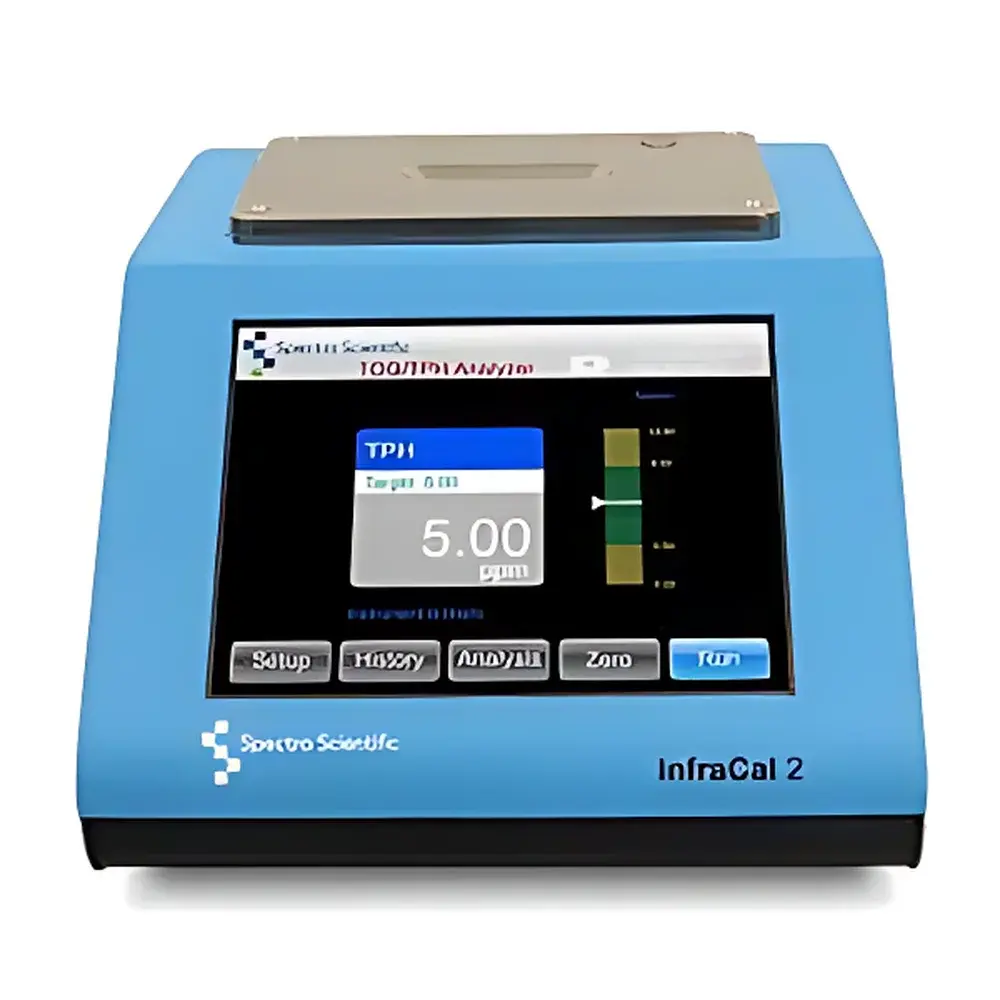
Spectro Scientific InfraCal 2 Series Portable Oil-in-Water Analyzer
| Brand | Spectro Scientific |
|---|---|
| Origin | USA |
| Model | InfraCal 2 Series |
| Instrument Type | Portable |
| Measurement Principle | Infrared Absorption (Transmittance/Reflectance) |
| Compliance | ASTM D7066 (Transmittance Method), EPA Method 1664 (Reflectance Method) |
| Power Source | Rechargeable Lithium Battery |
| Calibration | Multi-curve Internal Calibration |
| Data Handling | Onboard Storage & USB/Bluetooth Export |
| Security | Password-Protected User Settings & Calibration Curves |
| Alarm | Configurable Threshold Alerts |
| Environmental Rating | Ruggedized for Field Use |
Overview
The Spectro Scientific InfraCal 2 Series Portable Oil-in-Water Analyzer is a field-deployable infrared photometric instrument engineered for rapid, quantitative determination of hydrocarbon contaminants in aqueous and semi-solid matrices. It operates on the fundamental principle of selective infrared absorption—specifically at wavelengths where aliphatic and aromatic C–H bonds exhibit strong, characteristic absorbance (e.g., ~2930 cm⁻¹, ~2960 cm⁻¹, and ~2850 cm⁻¹). Following solvent extraction (typically using Freon-113, S-316, or EPA-compliant alternatives such as hexane or cyclohexane), the extract is introduced into a standardized optical cell. The instrument measures transmittance (per ASTM D7066) or reflectance (per EPA Method 1664), converting absorbance values into concentration units (mg/L for water samples; mg/kg for soils or sludges) via preloaded, traceable calibration curves. Unlike chromatographic or gravimetric methods, the InfraCal 2 delivers results in under five minutes without requiring laboratory infrastructure—making it ideal for real-time process control, regulatory compliance verification, and emergency response scenarios.
Key Features
- Portable, battery-powered architecture with IP65-rated enclosure for operation in harsh industrial or outdoor environments—including offshore platforms, refinery perimeters, and remediation sites.
- High signal-to-noise ratio optical path design ensures measurement repeatability ≤ ±2% RSD across the 0.1–1000 mg/L dynamic range (dependent on matrix and extraction efficiency).
- Touchscreen interface with intuitive menu navigation, supporting multi-language firmware and context-sensitive help prompts.
- Onboard memory stores up to 1,000 test records with timestamp, operator ID, sample ID, calibration ID, and raw absorbance data—fully exportable via USB or Bluetooth to LIMS or Excel-compatible formats.
- Up to 10 user-defined calibration curves stored internally, each independently editable and protected by password-controlled access tiers (operator vs. administrator).
- Configurable pass/fail alarms with visual and audible indicators—enabling immediate field decisions during wastewater discharge monitoring or soil screening.
- Compliance-ready audit trail: All calibration modifications, curve updates, and measurement deletions are time-stamped and logged with user authentication.
Sample Compatibility & Compliance
The InfraCal 2 supports analysis of total oil and grease (TOG), fats, oils, and greases (FOG), and total petroleum hydrocarbons (TPH) in diverse sample types including produced water, cooling tower blowdown, industrial effluents, drill cuttings, contaminated soils, and metal parts cleaning rinse solutions. Extraction protocols follow EPA SW-846 Method 3510C (separatory funnel) or 3520C (solid-phase extraction), with solvent choice validated against method-specific interferences (e.g., chlorinated solvents for EPA 1664 equivalence). The analyzer meets ASTM D7066 for transmittance-based quantification and demonstrates analytical correlation with EPA Method 1664 when configured for reflectance mode—supporting regulatory reporting under Clean Water Act permits, RCRA land disposal restrictions, and ISO 14001 environmental management systems. Its design aligns with GLP documentation requirements, including electronic signature support and 21 CFR Part 11–compliant data integrity features when paired with Spectro’s optional software suite.
Software & Data Management
The InfraCal 2 integrates seamlessly with SpectroLink Desktop Software (Windows-based), enabling advanced curve validation, statistical trending, report generation (PDF/CSV), and secure database synchronization. Raw spectral data (absorbance vs. wavenumber) is accessible for method development and third-party validation. All onboard data entries include mandatory metadata fields (e.g., analyst initials, sample location GPS coordinates if enabled via external module, extraction lot number), ensuring full traceability from field acquisition to final report. Data encryption during transfer and role-based access controls prevent unauthorized modification—critical for auditable environmental compliance workflows.
Applications
- Real-time monitoring of oil-in-water concentrations in offshore platform produced water prior to overboard discharge.
- Verification of FOG removal efficiency in municipal and industrial wastewater treatment plants.
- Field screening of drill cuttings and tank bottom sludges against state-specific hydrocarbon action levels (e.g., Texas RBCA, California DTSC).
- Quality assurance testing of reclaimed solvents used in parts cleaning operations.
- Rapid assessment of soil contamination at brownfield sites during Phase I/II environmental site assessments.
- Validation of oil/water separator performance in petrochemical facilities under API RP 12R1 guidelines.
FAQ
What extraction solvents are compatible with the InfraCal 2?
Standard solvents include Freon-113 (historical reference), S-316, and EPA-approved substitutes such as hexane, cyclohexane, or Vertrel XF—each requiring method-specific calibration due to differential extinction coefficients.
Does the instrument require annual factory recalibration?
No. The InfraCal 2 employs stable solid-state optics and NIST-traceable reference standards; routine verification using certified check standards (e.g., TOG Standard Set SRM-1001) is recommended quarterly per ASTM D7066 Section 8.3.
Can it differentiate between mineral oil and vegetable oil?
No. It quantifies total infrared-absorbing hydrocarbons collectively; speciation requires complementary techniques such as GC-FID or FTIR fingerprinting.
Is method validation support available from Spectro Scientific?
Yes—application engineers provide protocol development assistance, interlaboratory comparison guidance, and IQ/OQ documentation templates aligned with ISO/IEC 17025 requirements.







