
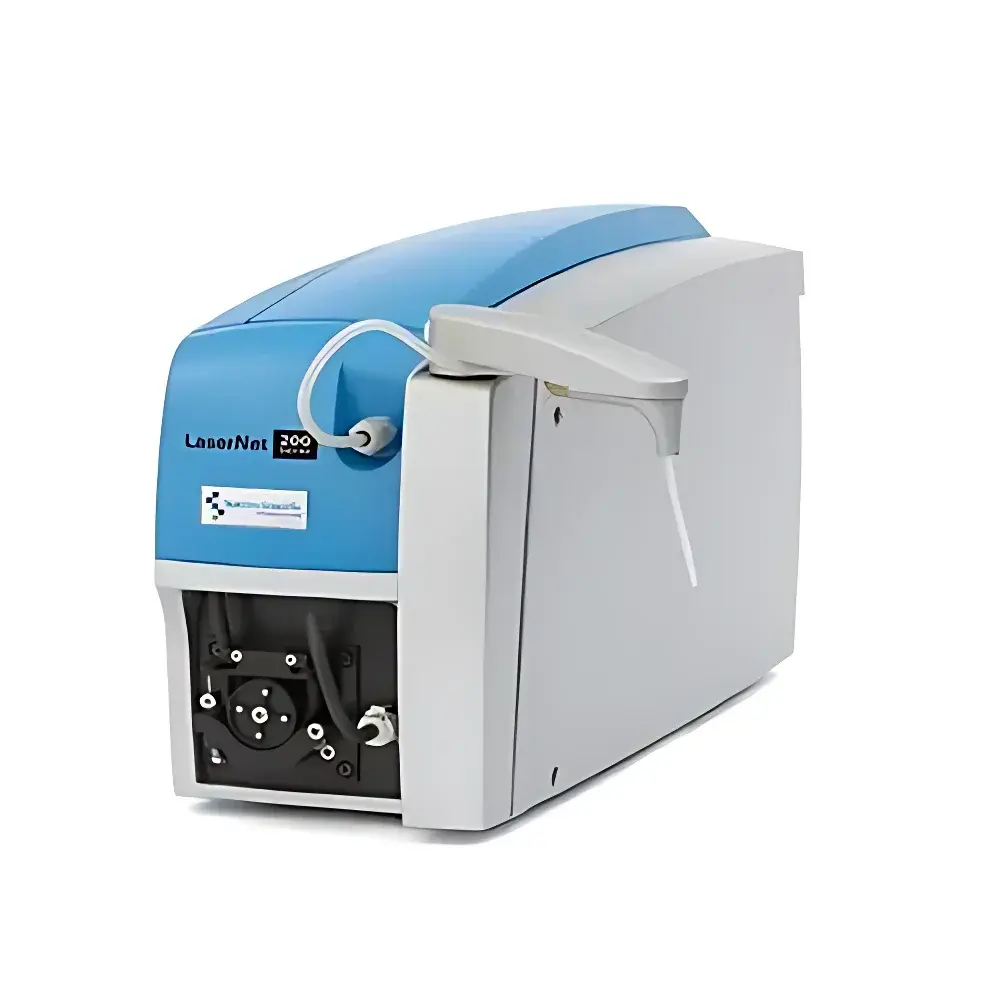
Spectro Scientific LaserNet 200 Series Multi-Function Wear Particle Analyzer
| Brand | Spectro Scientific |
|---|---|
| Origin | USA |
| Model | LaserNet 200 |
| Type | Import |
| Distribution Status | Authorized Distributor |
| Pricing | Upon Request |
Overview
The Spectro Scientific LaserNet 200 Series Multi-Function Wear Particle Analyzer is an advanced, benchtop optical diagnostic instrument engineered for real-time, in-lab analysis of lubricating oils and hydraulic fluids. It integrates three complementary analytical modalities—automated particle counting per ISO 4406 and NAS 1638, AI-driven morphological classification of wear debris using direct digital imaging, and quantitative ferrous particle detection via LaserNetTM Fines (LNF) technology. Developed collaboratively by Spectro Scientific, Lockheed Martin, and the U.S. Navy, the system employs a proprietary neural network algorithm trained on thousands of validated wear particle images to classify debris into six mechanistic categories: cutting wear, sliding wear, fatigue wear, non-metallic contaminants (e.g., silica), fibers, and fluid artifacts (water droplets, entrained air). Unlike conventional ferrography or offline microscopy, LaserNet 200 delivers fully automated, operator-independent results within 2–3 minutes per sample—without sample preparation, dilution, or solvent handling.
Key Features
- Real-time ISO/NAS-coded particle count and size distribution (4–100 µm) with automatic rejection of water droplets and air bubbles ≥20 µm
- LaserNetTM Fines (LNF) module for quantification of ferrous particle concentration (ppm) and size-resolved ferrous mass distribution
- Neural-network-based image recognition engine trained to ASTM D7690 and MIL-STD-1845A reference libraries
- Integrated self-calibration using NIST-traceable calibration suspension—no external recalibration required
- Live imaging mode enables visual verification of sample cell cleanliness and particle dynamics during rinse cycles
- Adjustable laser gain control optimized for high-soot oils (soot content <2% w/w), enabling robust analysis of diesel engine oils and other dark fluids
- Compliant with ISO 4402, ISO 11171, and ISO 11500 for particle counting methodology and reporting
Sample Compatibility & Compliance
The LaserNet 200 accepts standard 10–20 mL volumes of mineral-, synthetic-, and bio-based lubricants, including turbine oils, gear oils, hydraulic fluids, and engine oils. Its optical path accommodates viscosities up to 300 cSt at 40 °C without preheating or dilution. All reported particle counts are corrected for refractive index mismatch using embedded fluid-specific algorithms. The system meets requirements for GLP-compliant laboratories: audit trails, user access controls, electronic signatures, and data integrity safeguards align with FDA 21 CFR Part 11. Test reports include full metadata (sample ID, operator, date/time, instrument serial number, calibration status) and are exportable in CSV, PDF, and XML formats compatible with LIMS integration.
Software & Data Management
Powered by Spectro’s proprietary AnalyzeNet® software, the LaserNet 200 supports trend analysis across fleets or individual assets. The database stores historical particle counts, wear type classifications, ferrous ppm trends, and annotated particle images with searchable metadata. Customizable alert thresholds trigger notifications when ISO cleanliness codes exceed preset limits or when ferrous concentration increases >20% over baseline. Software modules support statistical process control (SPC) charting, root cause correlation matrices, and automated report generation aligned with OEM maintenance protocols (e.g., GE, Siemens, Caterpillar). Raw image archives are retained with lossless compression and SHA-256 checksum validation for forensic traceability.
Applications
- Condition-based maintenance (CBM) programs for wind turbine gearboxes, marine propulsion systems, and industrial compressors
- Root cause failure analysis in aerospace hydraulics and power transmission systems
- Quality assurance of new oil batches and reconditioned lubricants in refinery and blending facilities
- Research into tribological mechanisms in academic tribology labs and OEM R&D centers
- Third-party certification labs performing ISO 4406 compliance testing for hydraulic component manufacturers
- Field-deployable diagnostics in mobile service units supporting mining, rail, and offshore energy operations
FAQ
How does LaserNet 200 differentiate between water droplets and solid particles?
It applies dual-wavelength scattering contrast analysis combined with temporal stability tracking—water droplets exhibit refractive index shifts and coalescence behavior distinct from rigid particulates.
Can the system detect non-ferrous wear metals such as copper or aluminum?
No—LaserNet 200 identifies wear mechanisms morphologically but does not perform elemental analysis. For metal speciation, coupling with ICP-OES or RDE spectroscopy is recommended.
Is routine maintenance required beyond cleaning the flow cell?
Yes—the optical window requires periodic inspection and cleaning with spectroscopic-grade isopropanol; laser alignment is factory-verified and field-adjustable only by certified service engineers.
Does the neural network require user retraining for new equipment types?
No—the classifier is pre-trained on broad-spectrum wear morphology datasets and adapts via continuous learning from aggregated anonymized fleet data—no end-user model tuning is needed.
What is the minimum detectable ferrous concentration?
The LNF module achieves a limit of quantitation (LOQ) of 5 ppm ferrous iron in base oils, with linearity maintained up to 2,000 ppm across typical viscosity ranges.



