
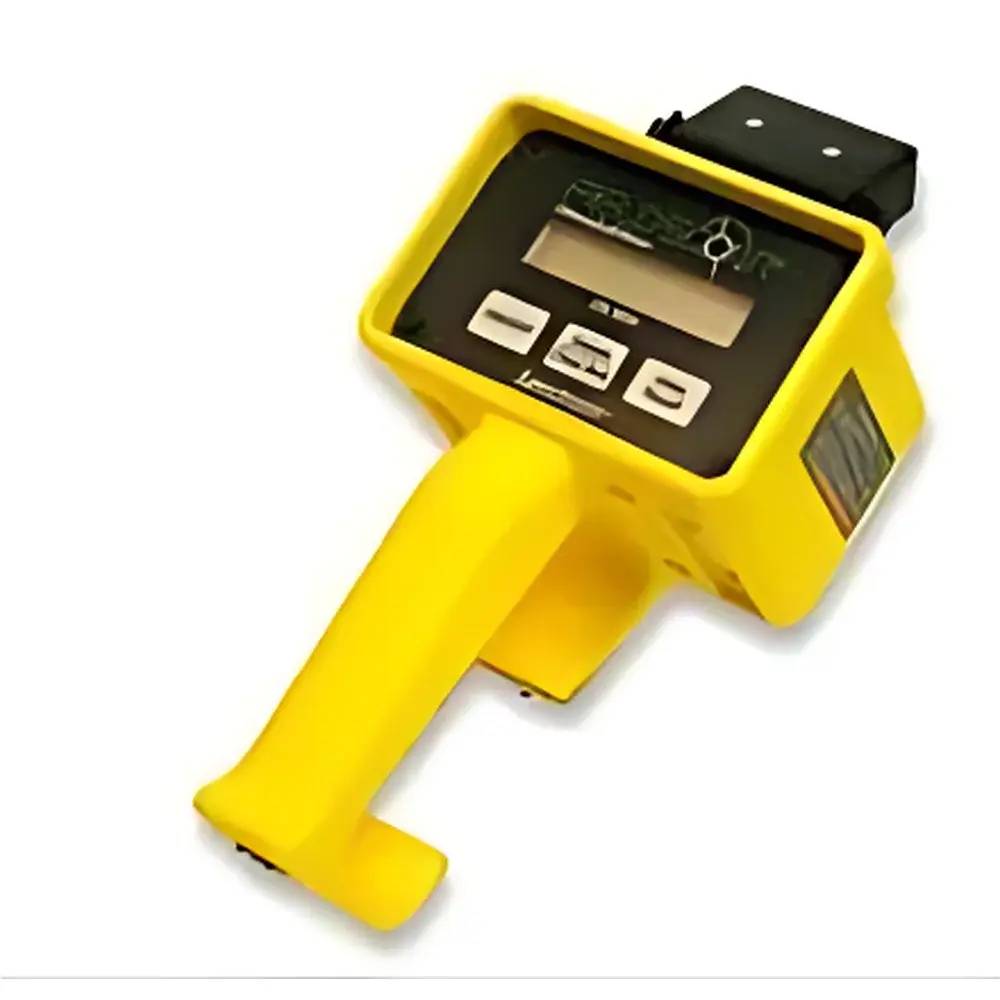
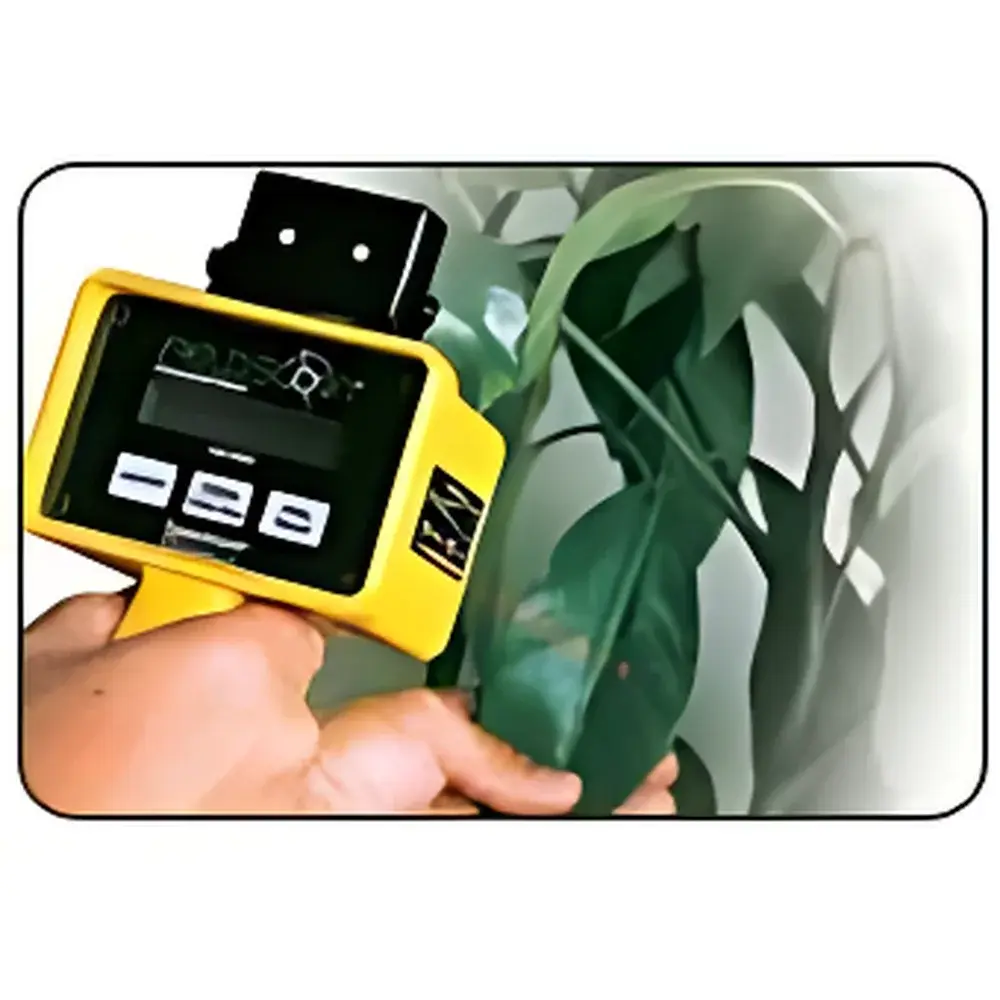
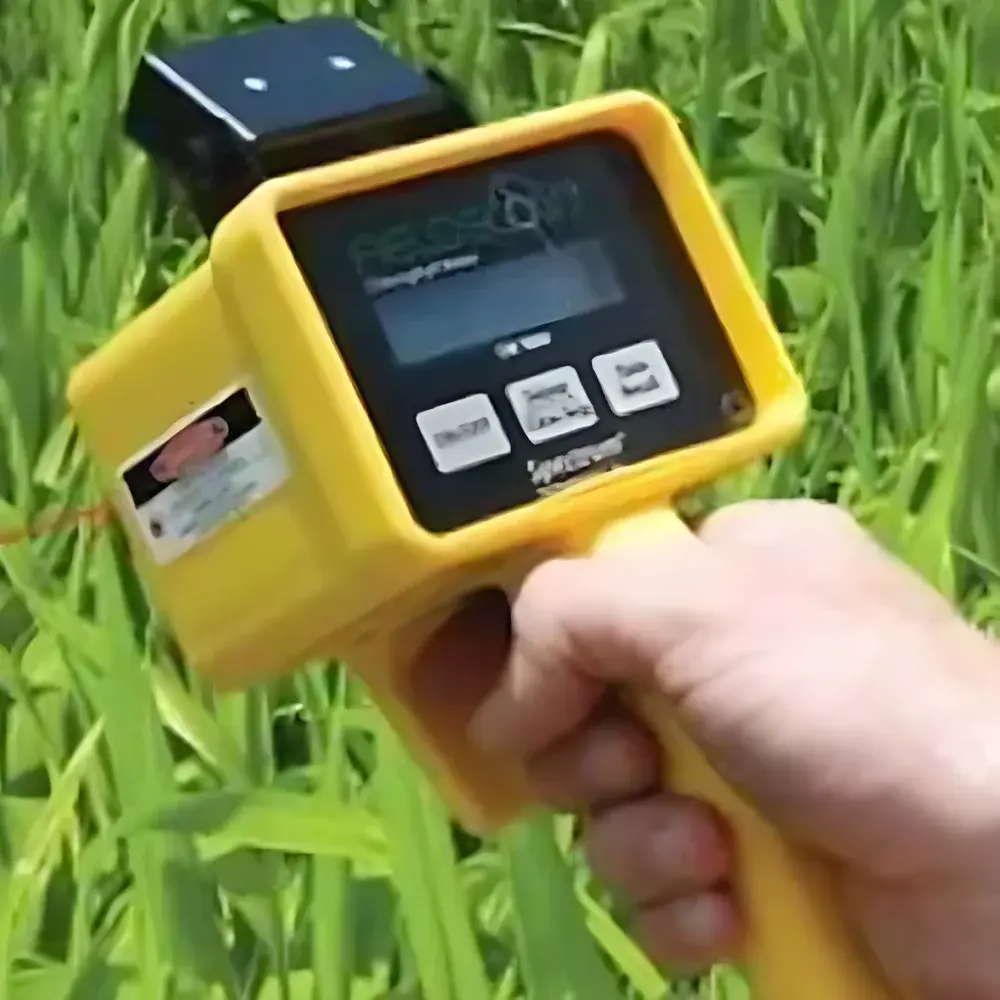
Spectrum FIELDSCOUT CM1000 Portable Chlorophyll Meter
| Brand | Spectrum |
|---|---|
| Origin | USA |
| Manufacturer Type | Authorized Distributor |
| Import Status | Imported |
| Model | FIELDSCOUT CM1000 |
| Price | Upon Request |
| Measurement Principle | Dual-wavelength (700 nm & 840 nm) reflectance-based relative chlorophyll index |
| Measurement Distance Range | 30.5–183 cm |
| Spot Diameter | 1.35 cm (at 3.5 cm), 3 cm (at 46 cm), 11.8 cm (at 122 cm) |
| Measurement Time | 2 s per reading |
| Output Range | 0–999 (unitless relative chlorophyll index) |
| Repeatability | ±5% of reading |
| Power | Two AA alkaline batteries (~3,000 measurements per set) |
| Memory Capacity | 1,350 readings with GPS metadata |
| GPS Interface | Yes (via optional 2950CV5 cable) |
| Data Logger | Integrated, standalone operation |
| Environmental Compensation | Automatic ambient light correction |
| Weight | Lightweight handheld design |
Overview
The Spectrum FIELDSCOUT CM1000 is a field-deployable, non-destructive chlorophyll meter engineered for rapid, repeatable assessment of relative chlorophyll content in intact plant leaves. It operates on a validated optical principle grounded in NASA-derived point-scan reflectance technology—specifically measuring the differential reflectance at two discrete near-infrared and red wavelengths (700 nm and 840 nm). This dual-band ratio approach correlates strongly with leaf chlorophyll concentration while minimizing interference from leaf thickness, surface texture, and minor variations in incident illumination. Unlike destructive extraction methods requiring solvent-based spectrophotometry, the CM1000 delivers real-time, in situ data without tissue damage—enabling longitudinal monitoring of photosynthetic pigment status across crop growth stages, stress response trials, or ecological transects. Its design adheres to core principles of plant physiological metrology: minimal operator dependency, environmental robustness, and traceable optical calibration.
Key Features
- Non-invasive measurement: No leaf clipping, grinding, or chemical reagents required—preserves sample integrity for repeated sampling.
- Automatic ambient light compensation: Onboard photodiode continuously adjusts for variable sky conditions, shading, and diurnal irradiance shifts—ensuring stable readings under full sun, overcast, or partial canopy shade.
- Variable spot size optics: Field-of-view scales predictably with measurement distance (1.35 cm at 3.5 cm; 11.8 cm at 122 cm), supporting both high-resolution single-leaf assays and broader canopy-level surveys.
- Standalone data acquisition: Fully functional without external computing devices—measurements stored directly to internal non-volatile memory with timestamping.
- Integrated GPS readiness: Optional 2950CV5 interface cable enables georeferenced data logging compatible with GIS mapping and spatial analysis workflows.
- Field-optimized ergonomics: Lightweight handheld chassis with intuitive trigger operation, rubberized grip, and low-power AA battery architecture suitable for multi-hour deployments.
Sample Compatibility & Compliance
The CM1000 is validated for use on broadleaf and narrow-leaf species—including but not limited to maize, soybean, wheat, rice, alfalfa, Arabidopsis, and native forbs—with consistent performance across mature, senescing, and moderately stressed foliage. It is not intended for conifer needles, highly pubescent leaves, or submerged aquatic vegetation due to optical scattering limitations. While the instrument does not output absolute chlorophyll concentration (µg/cm²), its relative index exhibits strong linear correlation (R² > 0.88) with laboratory-validated SPAD-502 equivalents and acetone-extraction HPLC reference values across major agronomic species. The device complies with IEC 61000-4-2 (ESD immunity) and meets IP54 ingress protection standards for dust and water splashing resistance. All firmware and calibration protocols are maintained under Spectrum’s ISO 9001-certified quality management system.
Software & Data Management
Data export is supported via the optional FIELDSCOUT DataLogger software (2950S package), which provides USB connectivity, batch download, CSV export, and basic statistical aggregation (mean, SD, min/max per session). Raw files retain embedded metadata including date/time, measurement index, GPS coordinates (if enabled), and instrument serial number—facilitating audit-ready documentation for GLP-aligned field studies. The software supports configurable project tagging and hierarchical folder structures, enabling alignment with experimental design frameworks such as randomized complete block or split-plot layouts. Although the CM1000 itself does not implement FDA 21 CFR Part 11 electronic signature controls, its data export workflow is compatible with validated LIMS environments when paired with appropriate procedural controls.
Applications
- Variable-rate nitrogen management: Quantify chlorophyll gradients across fields to inform site-specific fertilizer application maps.
- Drought and nutrient stress phenotyping: Track temporal declines in relative chlorophyll index during controlled abiotic stress experiments.
- Crop breeding programs: Screen large populations for chlorophyll retention traits under terminal drought or heat stress.
- Ecological monitoring: Assess photosynthetic vigor of indicator species in restoration plots or climate gradient transects.
- Greenhouse and growth chamber validation: Verify lighting uniformity and spectral quality by mapping chlorophyll response across rack positions.
- Educational field labs: Demonstrate non-destructive plant physiology techniques with immediate visual feedback and reproducible datasets.
FAQ
Does the CM1000 provide absolute chlorophyll concentration in µg/cm²?
No—it reports a unitless relative chlorophyll index calibrated against empirical reflectance ratios. Conversion to absolute units requires species-specific regression models derived from concurrent lab extractions.
Can the instrument measure through dew or light rain?
Surface moisture may scatter incident light and reduce measurement repeatability. Wipe leaves dry before scanning for optimal accuracy.
Is calibration required before each use?
The CM1000 performs automatic zero-reference compensation on startup using an internal dark reference. No user-performed calibration is needed under standard operating conditions.
What GPS accuracy can be expected with the 2950CV5 cable?
When connected to a WAAS-enabled external GPS receiver, positional accuracy is typically ≤3 meters horizontal RMS under open-sky conditions.
How is data integrity ensured during extended field use?
All stored readings reside in non-volatile flash memory—data persists even after battery replacement or unexpected power loss.




