
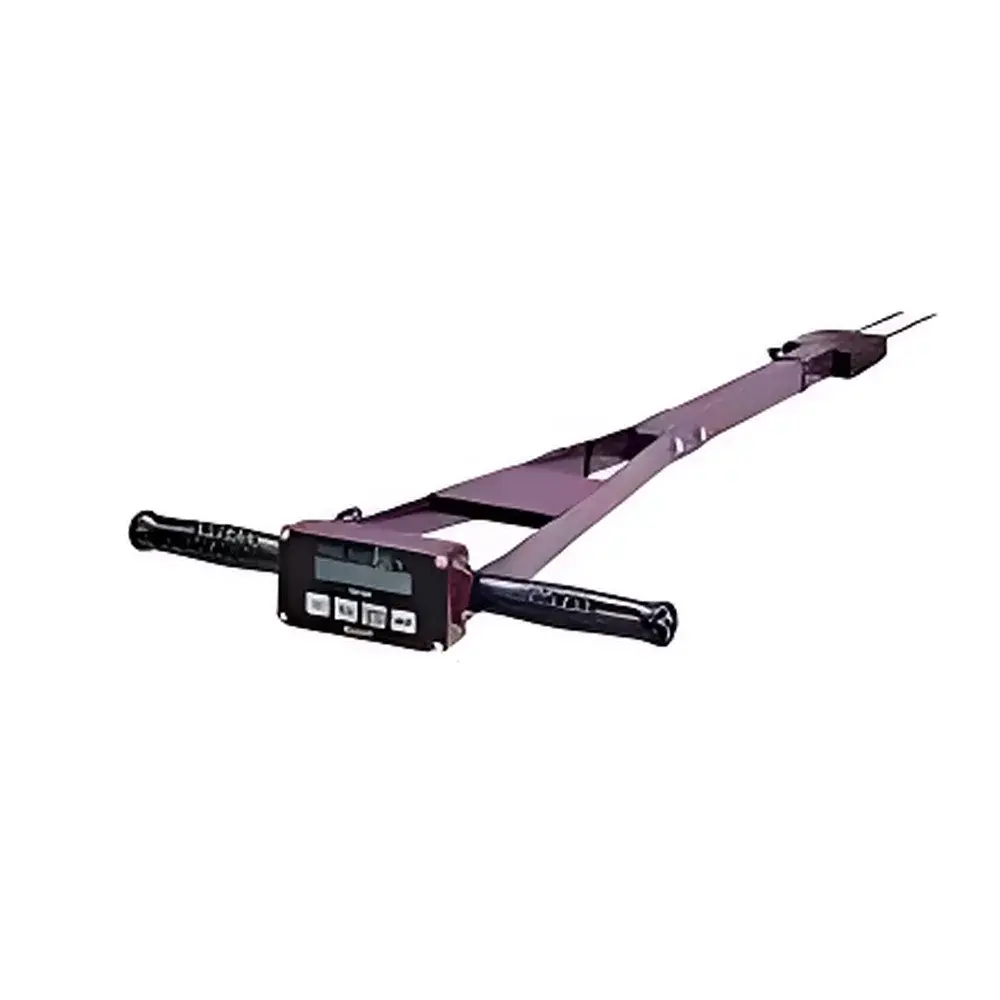
Spectrum Technologies TDR300 Portable Time-Domain Reflectometry Soil Moisture Analyzer
| Brand | Spectrum Technologies |
|---|---|
| Origin | USA |
| Model | TDR300 |
| Instrument Type | Volumetric Water Content (VWC) and Relative Water Content (RWC) Analyzer |
| Measurement Principle | Time-Domain Reflectometry (TDR) |
| Probe Length Options | 7.5 cm, 12 cm, 20 cm |
| Accuracy | ±3.0% VWC (EC < 2 dS/m, clay < 30%) |
| Resolution | 1.0% VWC |
| Data Storage | 2700 readings (1250 with GPS sync) |
| Interface | RS-232 |
| Power | 4 × AAA alkaline batteries (≈12 months typical life) |
| Weight | 1.36 kg |
| Dimensions (Meter) | 10.5 × 7 × 1.8 cm |
| Probe Dimensions | 10.41 × 7.11 × 1.78 cm |
| Probe Rod Diameter | 5 mm |
| Rod Spacing | 33 mm |
| Measurement Modes | Volumetric Water Content (VWC), Relative Water Content (RWC) |
Overview
The Spectrum Technologies TDR300 Portable Time-Domain Reflectometry Soil Moisture Analyzer is a field-deployable, precision instrument engineered for direct, non-destructive measurement of volumetric water content (VWC) in mineral and organic soils. Based on the physical principle of time-domain reflectometry, the TDR300 transmits a high-frequency electromagnetic pulse (typically 100–150 MHz) along three parallel stainless-steel rods embedded in the soil. The travel time of the reflected pulse is directly correlated to the dielectric permittivity of the surrounding medium, which—under standard soil conditions—is predominantly governed by water content. This physics-based relationship enables calibration-independent estimation of VWC across diverse textural classes (sand, loam, clay), provided bulk electrical conductivity remains below 2 dS/m and clay content does not exceed 30%. Designed for agronomic monitoring, irrigation scheduling, hydrological research, and environmental impact assessment, the TDR300 delivers repeatable, laboratory-grade data without requiring soil sampling or gravimetric drying.
Key Features
- Integrated data logger with 2700-point internal memory (reduced to 1250 points when synchronized with external GPS/DGPS units for georeferenced mapping)
- Dual-mode display: real-time VWC (% v/v) and user-defined Relative Water Content (RWC) for irrigation threshold management
- RS-232 serial interface enabling direct connection to PCs, dataloggers, or GIS-enabled field tablets for automated data export and batch processing
- Modular probe compatibility: interchangeable 7.5 cm, 12 cm, and 20 cm rod configurations to accommodate shallow-rooted crops, deep-profile monitoring, or layered soil investigations
- Rugged, handheld enclosure rated for outdoor use in ambient temperatures from −20 °C to +50 °C and relative humidity up to 95% non-condensing
- Low-power architecture powered by four standard AAA alkaline cells, supporting approximately 12 months of intermittent field operation under typical usage patterns
Sample Compatibility & Compliance
The TDR300 is validated for use in mineral soils, peat, and composted organic media where bulk EC remains ≤2 dS/m. Performance deviation increases predictably above this threshold due to signal attenuation and dispersion effects; users are advised to apply empirical salinity corrections or select alternative sensing modalities (e.g., capacitance with built-in EC compensation) in high-salinity environments such as coastal agriculture or reclaimed wastewater-irrigated fields. While not certified to ISO/IEC 17025 for accredited testing, the instrument adheres to ASTM D5778 (Standard Test Method for Electronic Friction Cone and Piezocone Penetration Testing) principles for electromagnetic soil property inference. Its measurement protocol aligns with USDA NRCS Soil Survey Field and Laboratory Methods Manual (2014) Chapter 4 guidelines for in situ VWC validation. No regulatory certification (e.g., EPA, CE, or FDA) applies, as it functions solely as a field data acquisition tool—not a diagnostic or compliance-reporting device.
Software & Data Management
Data retrieval occurs via ASCII-formatted text files exported through the RS-232 port using terminal emulation software (e.g., PuTTY, Tera Term) or Spectrum’s legacy PC application (v3.2+). Each record includes timestamp, probe ID, VWC (%), RWC (%), battery voltage, and—when GPS-linked—WGS84 latitude, longitude, and elevation. Files are structured for direct import into spreadsheet applications (Microsoft Excel, LibreOffice Calc), statistical packages (R, Python pandas), or GIS platforms (QGIS, ArcGIS Pro) for spatial interpolation and kriging analysis. Audit trails are maintained manually via file naming conventions and metadata logs; the device itself does not support FDA 21 CFR Part 11-compliant electronic signatures or automated audit logging. For GLP/GMP-aligned workflows, users must implement external documentation protocols for instrument calibration verification (performed annually using reference moisture standards traceable to NIST SRM 2192).
Applications
- Irrigation optimization in row crops, orchards, and vineyards through real-time root-zone monitoring
- Soil moisture network deployment for watershed-scale hydrologic modeling and drought early-warning systems
- Greenhouse substrate moisture control to minimize leaching and nutrient runoff
- Long-term ecological research on soil–plant–atmosphere continuum dynamics
- Validation of satellite-derived soil moisture products (e.g., SMAP, Sentinel-1) at ground-truth sites
- Calibration and verification of buried permanent TDR probes or capacitance sensors
FAQ
What soil types are compatible with the TDR300?**
The TDR300 is suitable for mineral soils (sand to clay loam) and organic substrates (peat, coir) with bulk electrical conductivity ≤2 dS/m and clay content <30%. Performance may degrade in saline or highly conductive soils.
Does the TDR300 require factory calibration?**
No routine recalibration is required. The instrument uses a fixed time-of-flight algorithm based on known propagation velocity in air and water. Users should verify accuracy annually using certified moisture standards or gravimetric comparison.
Can the TDR300 measure soil temperature or salinity?**
No. It measures only dielectric permittivity, from which VWC is derived. Temperature and EC must be assessed separately using complementary sensors.
Is the RS-232 interface compatible with modern laptops?**
Yes—via USB-to-RS232 adapters compliant with FTDI or Prolific chipset drivers. Native RS-232 ports are obsolete on most current laptops, but adapter reliability is well established in field instrumentation workflows.
How does probe length affect measurement depth?**
Probe length determines the effective sampling depth: 7.5 cm probes assess the top 5 cm; 12 cm probes cover ~10 cm; 20 cm probes resolve moisture to ~18 cm. All probes maintain a consistent 33 mm rod spacing to ensure uniform electromagnetic field geometry.
Related Products







