
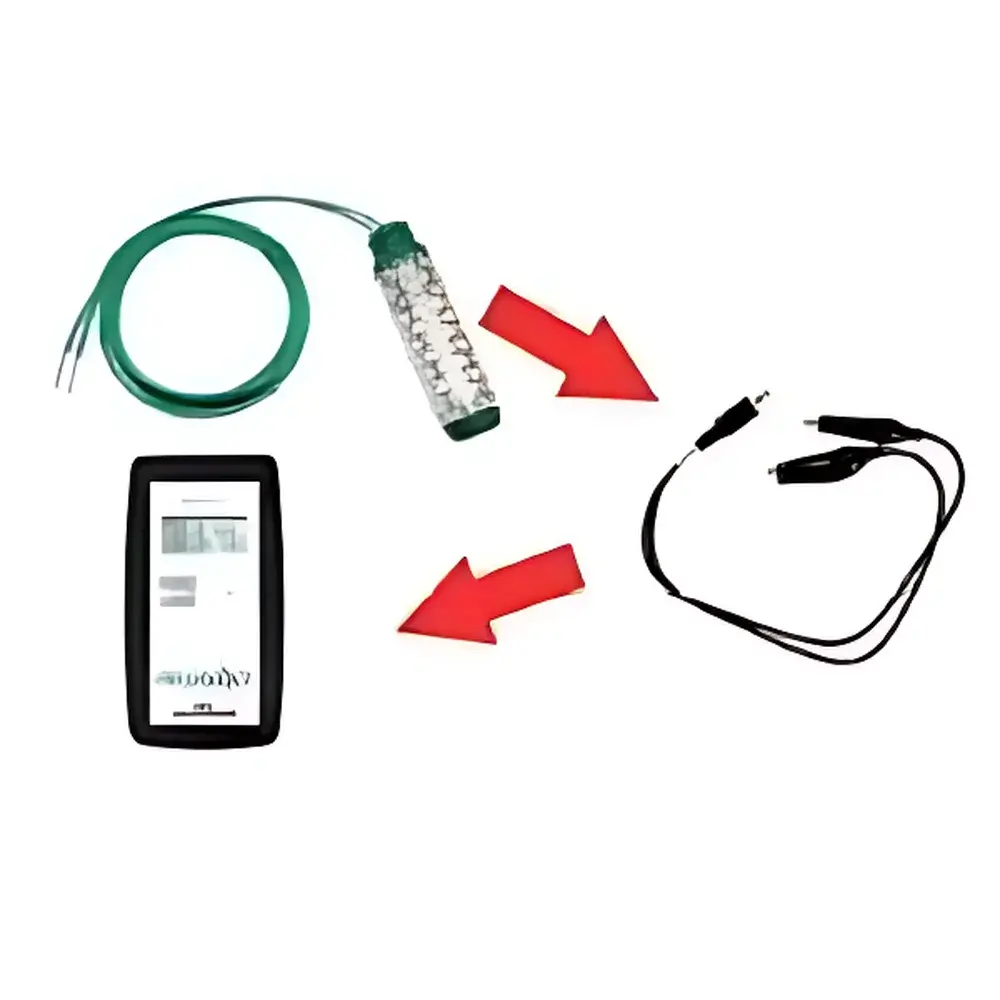
Spectrum Technologies Watermark 6450WD Soil Water Potential Sensor
| Brand | Spectrum Technologies |
|---|---|
| Origin | USA |
| Model | 6450WD |
| Instrument Type | Soil Water Potential Sensor |
| Measurement Range | 0–239 cb (kPa) |
| Housing Material | ABS Plastic, Stainless Steel, Hygroscopic Fiber |
| Sensor Dimensions | Ø22 mm × 83 mm |
| Weight | 0.067 kg |
| Cable | 2-conductor, AWG 20, 1.5 m |
| Display | Integrated LCD |
| Compliance | ASTM D4318, ISO 11277, USDA NRCS Soil Water Monitoring Protocols |
Overview
The Spectrum Technologies Watermark 6450WD Soil Water Potential Sensor is an electronic gypsum-based tensiometric sensor engineered for reliable, long-term in situ measurement of soil matric potential (water potential) across a range of agricultural, horticultural, ecological, and land management applications. Unlike classical mercury- or water-filled tensiometers—which require frequent maintenance, are sensitive to air entry, and fail under dry or frozen conditions—the Watermark sensor operates on the principle of electrical resistance change in a porous gypsum matrix saturated with a conductive electrolyte. As soil dries, water is drawn from the sensor’s hydrated core, increasing its bulk electrical resistance proportionally to the matric suction (expressed in centibars or kPa). This analog resistance signal is calibrated to the standard 0–239 cb (0–239 kPa) range, covering the full spectrum from field capacity to the permanent wilting point for most mineral soils.
Key Features
- Robust, non-dissolving ceramic-gypsum composite sensing element with uniform pore distribution—eliminates drift due to material degradation or preferential flow paths
- Integrated LCD display enables real-time, on-site reading without external data loggers (optional logging via analog voltage or SDI-12 output)
- Compact cylindrical form factor (Ø22 mm × 83 mm) facilitates minimal soil disturbance during installation and supports multi-depth profiling
- Corrosion-resistant stainless steel electrodes and ABS housing ensure durability in diverse soil textures, pH ranges, and redox environments
- No power supply required at the sensor node—passive operation reduces system complexity and battery dependency in remote deployments
- Calibrated output traceable to NIST-traceable reference standards; factory calibration certificate included
Sample Compatibility & Compliance
The Watermark 6450WD is validated for use in mineral soils (sand, loam, clay), organic soils (peat, compost-amended media), and containerized substrates—including greenhouse growing media and turf root zones. It is not recommended for saturated, highly saline (>4 dS/m EC), or strongly reducing soils where electrode polarization may occur. The sensor conforms to established methodologies outlined in ASTM D4318 (Standard Test Methods for Liquid Limit, Plastic Limit, and Plasticity Index of Soils), ISO 11277 (Soil Quality — Determination of Particle Size Distribution), and USDA-NRCS National Soil Survey Handbook Part 601, Chapter 3 (Soil Water Monitoring Guidelines). Its passive analog output supports integration into GLP-compliant monitoring networks when paired with certified data loggers featuring audit-trail functionality per FDA 21 CFR Part 11 requirements.
Software & Data Management
While the 6450WD operates as a standalone field-read device, its analog resistance output (0–2.5 V or 0–5 V, user-selectable) and optional SDI-12 digital interface enable seamless integration with industry-standard environmental data acquisition platforms—including Campbell Scientific CR series loggers, Onset HOBO systems, and Decagon (now METER Group) EM50/EM60 gateways. Spectrum Technologies provides free PC-based configuration software (Watermark Utility v3.2+) supporting batch calibration correction, unit conversion (cb ↔ kPa ↔ MPa ↔ Ψm), and export to CSV, Excel, or time-series-compatible formats (e.g., NetCDF, JSON-LD). All collected datasets retain embedded metadata (sensor ID, timestamp, temperature compensation flag), facilitating FAIR (Findable, Accessible, Interoperable, Reusable) data practices in research and regulatory reporting contexts.
Applications
- Irrigation scheduling in precision agriculture and viticulture—optimizing water use efficiency while maintaining crop-specific water potential thresholds
- Ecological restoration monitoring—tracking soil moisture stress responses in native plant establishment trials
- Green infrastructure performance assessment—quantifying infiltration and retention dynamics in bioswales and rain gardens
- Soil physics education and laboratory instruction—demonstrating matric potential gradients, hysteresis, and unsaturated hydraulic conductivity estimation
- Long-term climate observatory networks—deployed in USDA ARS Long-Term Agroecosystem Research (LTAR) sites and NEON soil sensor arrays
FAQ
How does the Watermark 6450WD differ from traditional tensiometers?
It uses a solid-state, electrolyte-saturated gypsum block with embedded electrodes, eliminating the need for water refilling, vacuum maintenance, or susceptibility to freezing. Its resistance-based output is inherently stable under low-water-potential conditions where tensiometers cavitate.
Is temperature compensation built-in?
No—temperature effects on resistance are minimal within typical field ranges (0–40°C), but users should record concurrent soil temperature for post-hoc correction using published empirical coefficients (e.g., −0.15% / °C).
What is the expected service life in continuous burial?
Under normal agricultural conditions, functional lifespan exceeds 3–5 years; performance validation is recommended annually via bench calibration against a saturated salt solution reference (e.g., LiCl for 1500 cb).
Can it be used in sandy soils?
Yes—but due to rapid drainage and low water-holding capacity, readings below ~50 cb may exhibit higher variability; pairing with volumetric water content sensors (e.g., capacitance probes) is advised for integrated soil water status assessment.
Does it meet ISO/IEC 17025 calibration requirements?
The sensor itself is not individually accredited, but its calibration protocol aligns with ISO/IEC 17025 Clause 6.6 (traceability of measurements); third-party lab verification services are available through Spectrum Technologies’ authorized calibration centers.







