
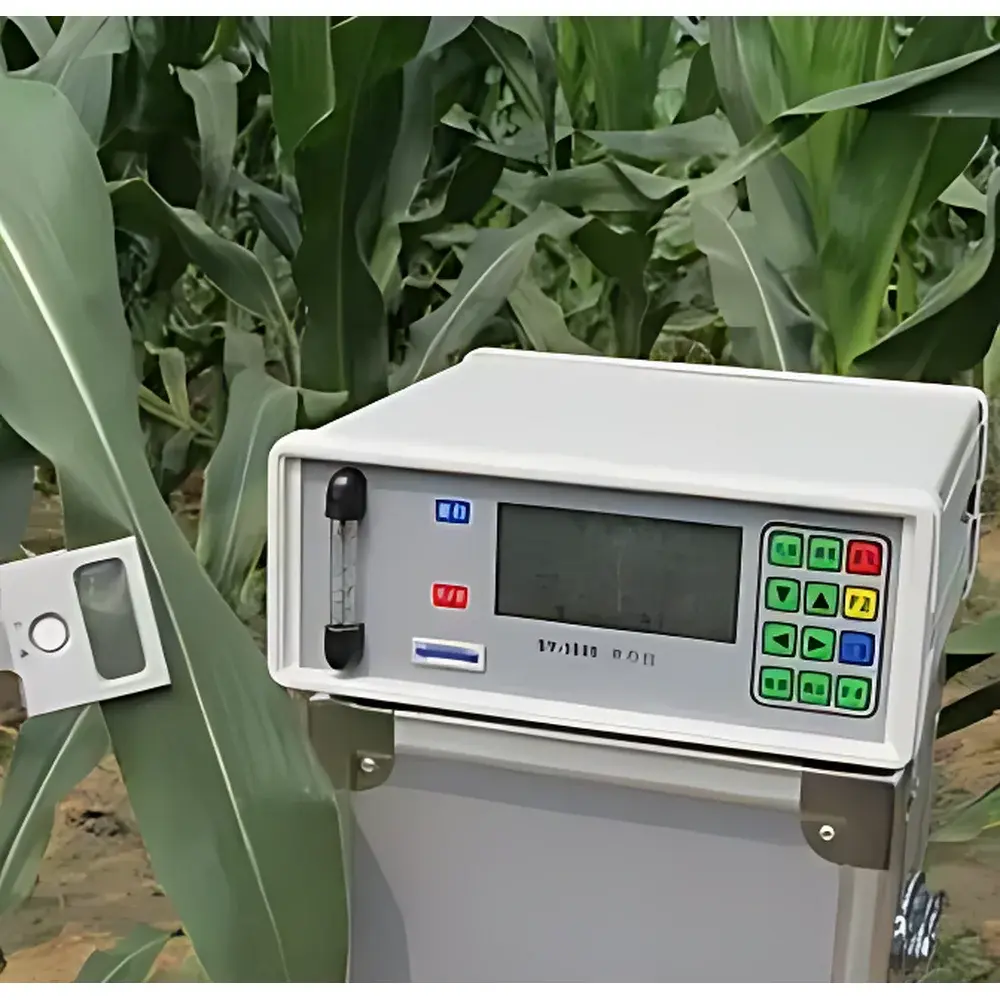
Tlyon Tlyon-1020 Portable Photosynthesis System
| Brand | Tlyon |
|---|---|
| Model | Tlyon-1020 |
| Measurement Principle | Non-dispersive infrared (NDIR) CO₂ analysis, thermistor-based leaf/ambient temperature sensing, capacitive humidity sensing, calibrated silicon photodiode PAR sensor |
| CO₂ Range | 0–1500 ppm |
| CO₂ Resolution | 0.1 ppm |
| CO₂ Accuracy | ±3 ppm |
| Leaf & Chamber Temperature Range | 0–50 °C |
| Temp Resolution | 0.1 °C |
| Temp Accuracy | ±0.2 °C |
| Relative Humidity Range | 0–100 % RH |
| RH Resolution | 0.1 % RH |
| RH Accuracy | ≤±3 % RH |
| PAR Range | 0–2500 µmol·m⁻²·s⁻¹ |
| PAR Accuracy | <±5 µmol·m⁻²·s⁻¹ |
| Flow Control | Glass rotameter |
| Chamber Dimensions (Std) | 55 mm × 20 mm |
| Power Supply | 7.4 V DC Li-ion battery |
| Operating Duration | 7–9 h |
| Data Storage | 2 GB microSD card |
| Display | 320×160 dot-matrix LCD, Chinese UI |
| Dimensions | 260 × 260 × 130 mm |
| Weight | 3.25 kg (main unit) |
| Compliance | Designed for field-deployable plant physiology studies per ISO 17025-aligned measurement practices |
| Software | On-device data logging with timestamped CSV export |
| Optional Accessories | Modular leaf chambers (I–III), 2 L canopy chamber, 1.4 L soil respiration chamber, plug-and-play red-blue LED light source (0–3000 µmol·m⁻²·s⁻¹, user-adjustable) |
Overview
The Tlyon Tlyon-1020 Portable Photosynthesis System is a field-deployable, integrated gas exchange instrument engineered for quantitative assessment of plant physiological responses under natural or controlled conditions. It operates on the principle of open-system gas exchange, combining non-dispersive infrared (NDIR) CO₂ detection with simultaneous monitoring of water vapor, temperature gradients, and photosynthetically active radiation (PAR). By measuring real-time differentials in CO₂ concentration and H₂O mole fraction across a sealed leaf chamber—and integrating concurrent readings of leaf surface temperature, ambient air temperature/humidity, and incident PAR—the system computes four primary physiological parameters: net photosynthetic rate (An, µmol CO₂·m⁻²·s⁻¹), transpiration rate (E, mmol H₂O·m⁻²·s⁻¹), stomatal conductance (gs, mol H₂O·m⁻²·s⁻¹), and intercellular CO₂ concentration (Ci, ppm). Its modular architecture supports rapid adaptation to diverse sample geometries and experimental objectives—from single-leaf assays to soil respiration or whole-canopy gas flux estimation.
Key Features
- Integrated multi-parameter sensing: Simultaneous acquisition of CO₂, H₂O, temperature (leaf and chamber), relative humidity, and PAR—enabling calculation of An, E, gs, Ci, and intrinsic water-use efficiency (WUEi = An/gs)
- High-fidelity NDIR CO₂ analyzer with 0–1500 ppm range, 0.1 ppm resolution, and ±3 ppm accuracy—calibrated against traceable NIST-certified standards
- Dual-temperature measurement: Platinum resistance thermometer (Pt100) for leaf surface temperature and Swiss-made digital thermistor for chamber air—both with 0.1 °C resolution and ±0.2 °C uncertainty
- Capacitive humidity sensor (0–100 % RH, ±3 % RH accuracy) co-located with CO₂ and flow path to minimize sampling delay and condensation artifacts
- Calibrated silicon photodiode PAR sensor with optical correction filter; spectral response matched to CIE photopic luminosity curve (400–700 nm); linearity validated to 2500 µmol·m⁻²·s⁻¹
- Battery-powered operation (7.4 V Li-ion, 7–9 h continuous use) with low-power electronics architecture optimized for extended field campaigns
- Modular chamber interface supporting interchangeable leaf chambers (25×25 mm, 55×20 mm, 65×10 mm), 2 L canopy chamber, and 1.4 L soil respiration chamber—each with precision-machined gaskets and pressure-balanced seals
Sample Compatibility & Compliance
The Tlyon-1020 accommodates a broad spectrum of biological samples without requiring destructive preparation. Standard leaf chambers are compatible with dicot, monocot, succulent, and needle-type foliage; optional chambers extend utility to mosses, lichens, detached roots, seeds, insect larvae, and bulk soil cores. For regulatory and methodological traceability, the system adheres to measurement principles outlined in ASTM E2912–21 (Standard Guide for Gas Exchange Measurements in Plant Physiology) and ISO 17025–2017 (General requirements for competence of testing and calibration laboratories). While not certified for GLP or FDA 21 CFR Part 11 compliance out-of-the-box, its timestamped CSV data export, audit-ready metadata tagging (operator ID, chamber type, calibration date), and stable analog signal conditioning support integration into validated workflows when paired with laboratory-managed data governance protocols.
Software & Data Management
Data acquisition and visualization occur via an embedded real-time operating system with a 320×160 monochrome LCD interface. All measurements are logged at user-selectable intervals (1–60 s) with automatic time/date stamping and chamber identification. Raw sensor outputs—including differential CO₂ (ΔCO₂), differential H₂O (ΔH₂O), flow rate, PAR, and dual-temperature values—are stored in comma-separated value (CSV) format on a removable 2 GB microSD card. No proprietary software is required for data retrieval: files are directly readable in Excel, R, Python (pandas), or MATLAB. Firmware updates are performed via USB-C connection using signed binary packages; version history and calibration coefficients are retained in non-volatile memory to ensure measurement continuity across maintenance cycles.
Applications
- Field phenotyping of crop genotypes under drought, heat, or elevated CO₂ stress
- Evaluation of stomatal responsiveness to abscisic acid (ABA) or light intensity gradients
- Comparative photosynthetic efficiency screening across cultivars in breeding programs
- Soil microbial respiration assays using the integrated 1.4 L soil chamber
- Canopy-level carbon assimilation estimates via the 2 L transparent enclosure
- Teaching laboratories in plant physiology, ecology, and environmental science—supporting inquiry-based experiments on light saturation curves, A/Ci response, and temperature optima
- Post-harvest physiology studies on cut flowers, fruits, and vegetables using modified chamber configurations
FAQ
What calibration standards are supported?
Factory calibration uses NIST-traceable CO₂ gas mixtures (0 ppm, 350 ppm, 1000 ppm) and certified humidity generators. Field recalibration is possible using zero-air scrubbers and span gas cylinders (optional accessories).
Is PAR sensor cosine correction applied?
Yes—the silicon photodiode incorporates a diffuser and optical filter engineered to meet ISO 9060:2018 Class C cosine response specifications (error <±5 % at 60° zenith angle).
Can the system operate in high-humidity tropical environments?
Designed for 0–100 % RH operation with anti-condensation airflow management; however, prolonged exposure above 95 % RH at temperatures <10 °C may require periodic desiccant cartridge replacement (accessory).
How is flow rate controlled and verified?
Flow is manually adjusted via a calibrated glass rotameter (range: 0–1.5 L·min⁻¹); actual flow is continuously monitored via thermal mass flow sensing in the exhaust line and displayed in real time.
Does the device support remote data transmission?
Not natively; however, the microSD card output enables offline batch transfer. Integration with third-party IoT gateways (e.g., LoRaWAN edge loggers) is feasible via TTL serial interface (RS-232 pinout available upon request).




