
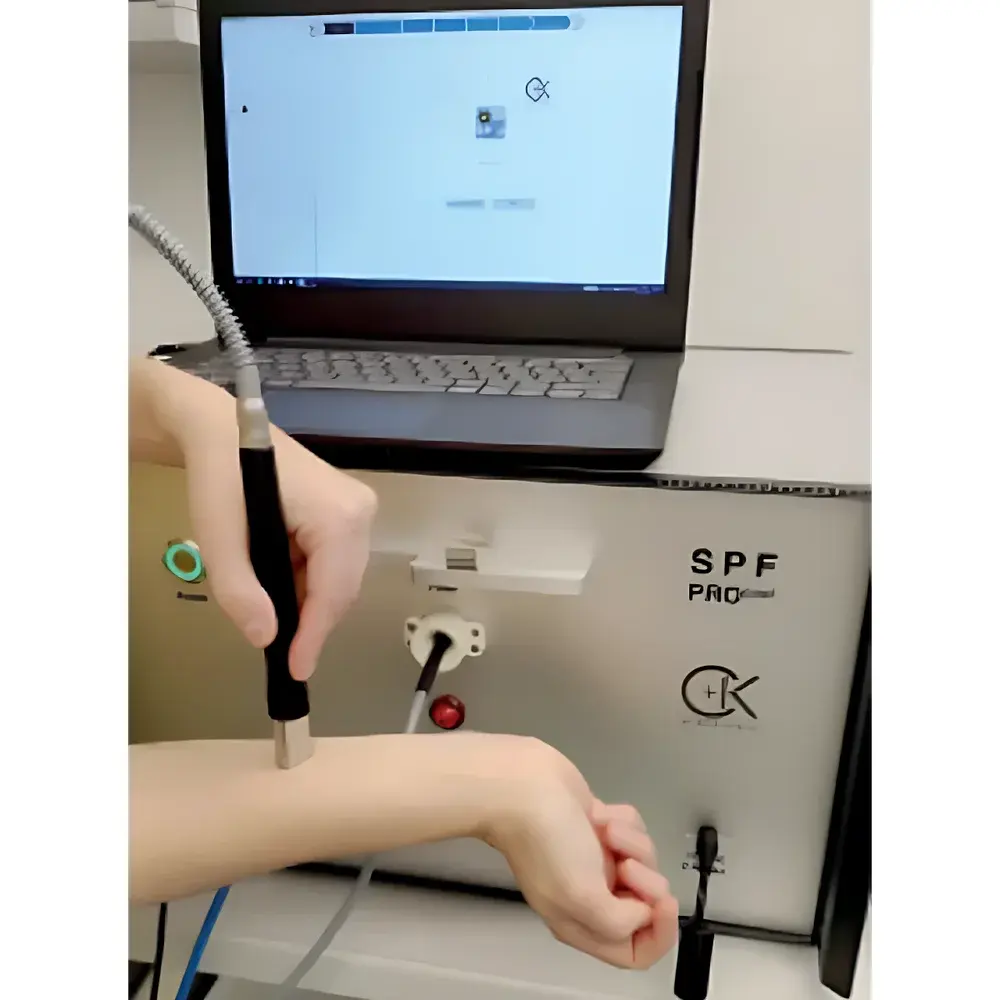
SPF-InVivoSpec DRS 320 Non-Invasive In Vivo Spectral Reflectance Analyzer (CK, Germany)
| Brand | CK |
|---|---|
| Origin | Germany |
| Manufacturer Status | Authorized Distributor |
| Origin Category | Imported |
| Model | SPF-InVivoSpec DRS 320 |
| Trigger Mode | Steady-State |
| Light Source | Tunable LED-based UV Hybrid Spectrum (290–400 nm) |
| Measurement Principle | Diffuse Reflectance Spectroscopy with Photon Banana Path Modeling |
Overview
The SPF-InVivoSpec DRS 320 is a CE-marked, non-invasive in vivo spectral reflectance analyzer engineered for quantitative, real-time assessment of sunscreen protection efficacy directly on human skin. Unlike traditional in vitro methods relying on substrate-based transmittance or ex vivo models, this instrument applies diffuse reflectance spectroscopy (DRS) to measure wavelength-resolved optical attenuation within the epidermis and upper dermis. Its core measurement principle leverages the “photon banana” path geometry—where incident UV photons undergo multiple scattering events before returning to the surface—enabling depth-sensitive quantification of UV absorption by both melanin and topically applied UV filters. The system operates across the biologically relevant UV spectrum (290–400 nm), with discrete spectral resolution optimized for distinguishing UVB (290–320 nm) and UVA (320–400 nm) contributions to photoprotection. Designed in accordance with ISO 24444:2019 for in vivo SPF determination, it delivers rapid, operator-independent results without requiring post-irradiation clinical observation periods.
Key Features
- Tunable hybrid LED light source delivering stable, narrow-band UV output from 290 nm to 400 nm—fully programmable for spectral scanning or fixed-wavelength irradiation protocols.
- Low-dose irradiation paradigm: ≤20% of minimal erythema dose (MED) for UVB and ≤10% MED for UVA on Fitzpatrick Type I skin—ensuring ethical compliance and enabling repeat measurements within a single session.
- Fiber-optic probe design with integrated source/detector geometry (source-detector separation calibrated for optimal photon banana sampling depth), enabling precise spatial registration and minimal inter-subject variability.
- Compact benchtop footprint (<45 × 35 × 20 cm) with plug-and-play USB interface and battery-backed internal calibration reference.
- Real-time spectral acquisition at 1 nm resolution with signal-to-noise ratio >800:1 (at 310 nm, 1 s integration), supporting kinetic monitoring of UV absorption dynamics during product application and drying phases.
- Automated baseline correction using pre-application skin reflectance spectra, eliminating dependence on constitutive skin pigmentation and enabling cross-ethnicity comparability.
Sample Compatibility & Compliance
The SPF-InVivoSpec DRS 320 is validated for use on intact, healthy human volar forearm or back skin under controlled ambient lighting and temperature (22 ± 2 °C, RH 40–60%). It supports all common sunscreen formulations—including lotions, sprays, sticks, and emulsions—without requiring solvent extraction or film thickness standardization. As an in vivo device, it complies with ISO 24444:2019 Annex A requirements for spectral irradiance uniformity, detector linearity, and biological endpoint correlation. All measurement protocols adhere to Good Clinical Practice (GCP) principles and support Institutional Review Board (IRB)-approved study designs. Data integrity meets ALCOA+ criteria; audit trails, electronic signatures, and user access control are implemented per FDA 21 CFR Part 11 when operated with optional compliant software modules.
Software & Data Management
The included SpectraView™ v4.2 software provides full control over spectral acquisition parameters, real-time visualization of reflectance curves, and automated SPF calculation via the inverse logarithmic integral method defined in ISO 24444. Raw spectral data are stored in vendor-neutral HDF5 format with embedded metadata (wavelength calibration, integration time, subject ID, anatomical site, product batch). Batch processing supports statistical comparison across products, volunteers, and timepoints using built-in ANOVA and Bland-Altman modules. Export options include CSV, PDF reports compliant with GLP documentation standards, and direct integration with LIMS via RESTful API.
Applications
- Accelerated in vivo SPF screening during formulation development (reducing cycle time from days to hours per test panel).
- Comparative evaluation of UVA-PF (protection factor) and critical wavelength (λc) alongside SPF.
- Time-resolved studies of sunscreen film formation, water resistance, and rub-off kinetics.
- Photostability assessment through repeated spectral acquisition pre- and post-UVA exposure.
- Clinical validation of in vitro SPF models by generating ground-truth in vivo correlation datasets.
- Ethical dermatological research involving pediatric or photosensitive cohorts where MED minimization is mandatory.
FAQ
Does the SPF-InVivoSpec DRS 320 replace ISO 24444-compliant sunburn endpoint testing?
No—it serves as a predictive, high-throughput supplement. For regulatory submissions, final SPF certification still requires the classical 24-hour post-irradiation erythema assessment per ISO 24444. However, DRS 320 data strongly correlate (r² > 0.92) with clinical endpoints and are accepted for internal R&D prioritization.
Can it measure SPF values above 26?
Yes, but with caveats: for SPF > 26, the instrument’s dynamic range requires empirical correction using in vitro SPF data (e.g., from COLIPA/ISO 24443 instrumentation) to maintain traceability. This hybrid workflow is documented in CK Technical Note TN-DRS-07.
Is calibration traceable to national metrology institutes?
Yes—factory calibration uses NIST-traceable tungsten-halogen and deuterium lamp standards. Annual recalibration services include spectral irradiance verification against PTB (Physikalisch-Technische Bundesanstalt) reference detectors.
What skin types has it been validated for?
Clinical validation includes Fitzpatrick Skin Types I–IV per ISO 24444 Annex B. Performance remains robust across melanin index (MI) 20–70 due to intrinsic normalization against pre-application baseline spectra.




