
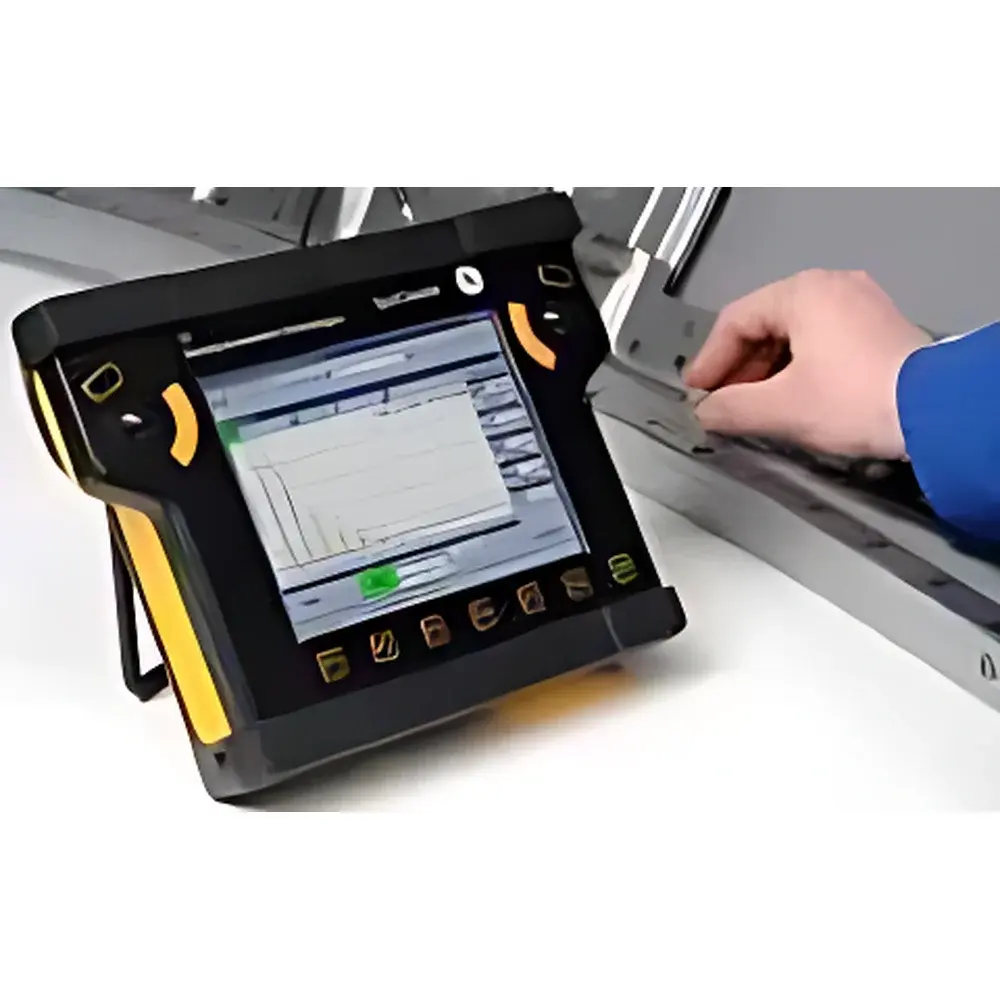
SpotChecker Portable Ultrasonic Spot Weld Inspection System
| Origin | USA |
|---|---|
| Manufacturer Type | Authorized Distributor |
| Origin Category | Imported |
| Model | SpotChecker |
| Price Range | USD 28,000 – 70,000 |
| Instrument Type | Dedicated Ultrasonic Spot Weld Integrity Tester |
Overview
The SpotChecker Portable Ultrasonic Spot Weld Inspection System is a purpose-built, handheld ultrasonic testing (UT) instrument engineered for rapid, non-destructive evaluation of resistance spot welds in high-volume manufacturing environments—particularly automotive body-in-white (BIW) assembly lines. Unlike conventional general-purpose ultrasonic flaw detectors, the SpotChecker employs time-of-flight diffraction (TOFD)-enhanced pulse-echo methodology optimized for thin-sheet steel and aluminum alloys (typically 0.5–3.0 mm per sheet), with proprietary signal processing algorithms calibrated to distinguish between acceptable weld nugget formation, partial penetration, expulsion, and interfacial cracking. Its compact architecture integrates a dual-element focused transducer probe (5–10 MHz, 6 mm diameter) and real-time A-scan/B-scan fusion display, enabling immediate pass/fail assessment without reliance on operator interpretation of raw waveform morphology. Designed for integration into Tier-1 and OEM production quality gates, the system operates independently of external PCs and delivers traceable, auditable inspection records compliant with AIAG CQI-15 and VDA 6.3 process audit requirements.
Key Features
- Lightweight ergonomic design: 3.2 kg including rechargeable Li-ion battery pack, enabling extended shift use without operator fatigue
- IP65-rated enclosure: Dust-tight and protected against low-pressure water jets—validated for shop-floor deployment near welding cells, robotic stations, and paint booths
- Hot-swappable dual-battery system: Enables uninterrupted operation during continuous line audits; battery life ≥ 6 hours per charge under typical duty cycle
- Intuitive human-machine interface: 8.4-inch resistive touchscreen with dual trackball navigation for precise cursor control in gloved-hand environments
- Dedicated weld integrity software (UltraLOG v4.x): Preconfigured inspection templates for common joint configurations (e.g., lap-shear, coach-peel), automatic defect classification (nugget size, void presence, spatter interference), and embedded pass/fail logic per ISO 10893-11 and AWS D8.1M criteria
- Onboard connectivity: Dual USB 2.0 ports (host/device), integrated 802.11n Wi-Fi, and Bluetooth 4.2 for secure data export, remote firmware updates, and synchronization with enterprise MES/QMS platforms
- Backward compatibility: Fully interoperable with existing USLT 2000-series probes, calibration blocks, and reporting infrastructure—minimizing legacy system obsolescence risk
Sample Compatibility & Compliance
The SpotChecker is validated for use on ferrous and non-ferrous spot-welded assemblies, including mild steel (DC04, HSLA), galvanized steel (GA, GI), and 5xxx/6xxx series aluminum alloys. It supports weld diameters from 4.0 mm to 8.0 mm and accommodates stack-ups up to 4 sheets (max. total thickness 6.0 mm). All measurement protocols conform to ASTM E273-22 (Standard Practice for Ultrasonic Testing of Welds), ISO 17640:2017 (Non-destructive testing — Ultrasonic testing of welds — Manual method), and EN 14751:2015 (Ultrasonic testing of resistance spot welds in metallic materials). Calibration verification is performed using NIST-traceable reference standards (e.g., AWS B4.0 Annex A weld test blocks) and documented per ISO/IEC 17025 requirements.
Software & Data Management
UltraLOG software provides full GLP/GMP-compliant data governance: each inspection record includes embedded metadata (operator ID, timestamp, GPS coordinates if enabled, probe serial number, calibration status), digital signature capture, and tamper-evident audit trails. Export formats include CSV (for SPC analysis), PDF inspection reports (with embedded A-scan overlays), and XML-compatible structured data for direct ingestion into SAP QM, Siemens Opcenter Quality, or custom LIMS. The system supports 21 CFR Part 11 electronic signature functionality when deployed with enterprise authentication servers (LDAP/Active Directory). Firmware updates are delivered via encrypted OTA packages with SHA-256 checksum validation.
Applications
- Automotive OEM and Tier-1 production lines: In-process verification of spot weld integrity prior to hemming, painting, or final assembly
- Body shop quality assurance: Statistical process control (SPC) of weld parameter drift across robotic welding cells
- Supplier incoming inspection: Rapid screening of sub-assemblies received from contract manufacturers
- Weld process development labs: Correlation studies between electrical parameters (current, time, force) and ultrasonic response signatures
- Aerospace structural repair validation: Verification of repair welds on aluminum airframe components per NAS 410 and EN 4179
FAQ
Does the SpotChecker require formal NDT Level II certification to operate?
No—UltraLOG’s guided workflow and automated defect classification eliminate the need for certified UT personnel. However, operators must complete the manufacturer’s 4-hour competency validation course, documented per ISO 9712 Clause 7.3.
Can the SpotChecker be used on painted or coated welds?
Yes—provided coating thickness does not exceed 150 µm and exhibits acoustic impedance close to steel (e.g., epoxy primers, cathodic electrodeposition coatings). Painted surfaces require coupling gel application and probe pressure optimization per procedure WPS-SC-003.
Is calibration traceable to national standards?
Yes—each unit ships with a certificate of calibration traceable to NIST SRM 2241 (Ultrasonic Reference Standards) and includes quarterly self-test routines verified against internal reference echoes.
What is the maximum operating temperature range?
−10 °C to +50 °C ambient, with relative humidity ≤ 95% non-condensing—validated per MIL-STD-810G Method 501.6.
How is data security managed during wireless transmission?
All WLAN and Bluetooth communications use AES-256 encryption; device pairing requires mutual certificate authentication, and no inspection data is stored on cloud servers unless explicitly configured via enterprise policy.



