
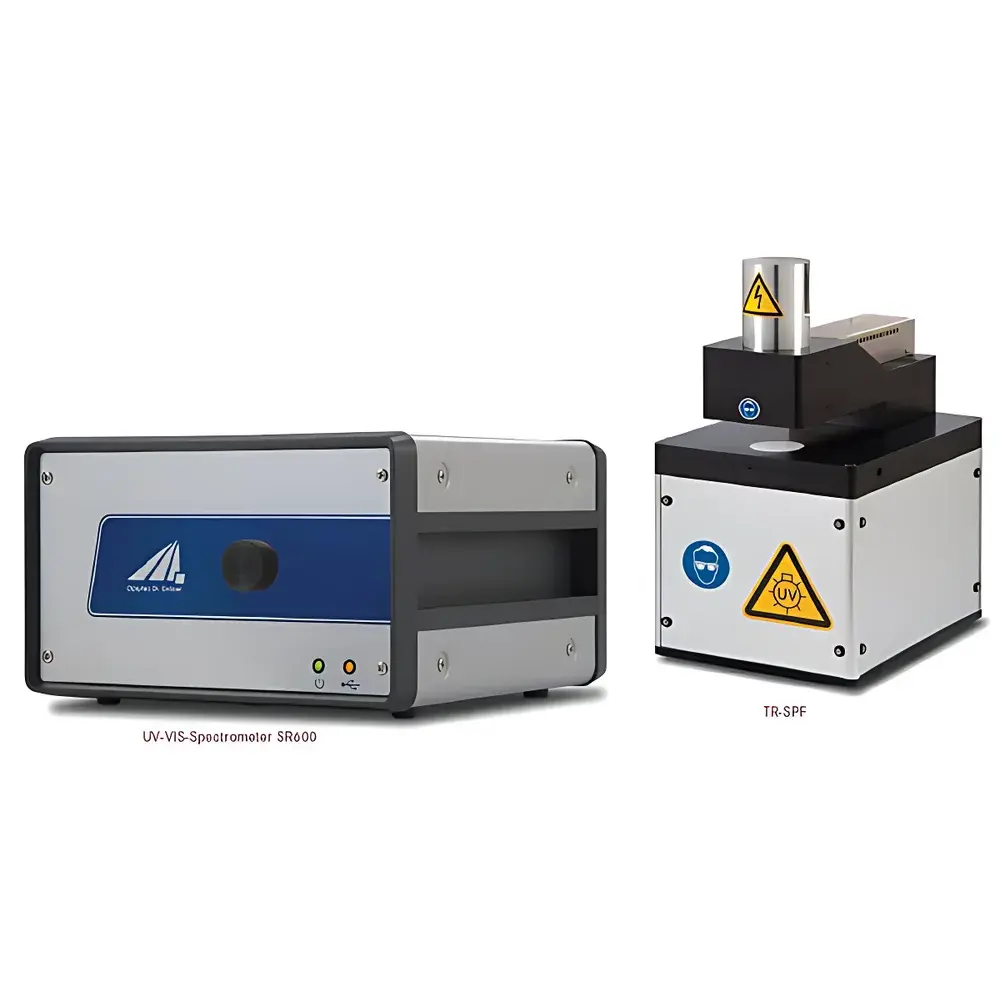
SR600 UV-Vis Spectrophotometer
| Origin | Imported |
|---|---|
| Manufacturer Type | Distributor |
| Model | SR600 |
| Optical Design | Single-beam |
| Detector | Photomultiplier Tube (PMT) |
| Wavelength Range | 200–800 nm |
| Wavelength Accuracy | ±0.5 nm |
| Spectral Bandwidth (FWHM) | 1.2 nm |
| Stray Light | <0.01% at 220 nm |
| Automation | Motorized Wavelength Scanning |
| Data Interface | USB 2.0 |
| Dynamic Range | 10⁵:1 |
| Detector Resolution | 16-bit |
| Integration Time | 7 ms to 60 s |
| Dimensions | 145 × 260 × 315 mm |
| Weight | 6.8 kg |
| Power Supply | AC 110–230 V, 15 W |
| Operating Temperature | 5–40 °C |
| Storage Temperature | −10–60 °C |
| Relative Humidity | <80% non-condensing |
Overview
The SR600 UV-Vis Spectrophotometer is a high-performance, single-beam modular spectroradiometric system engineered for precision spectral measurement across the ultraviolet, visible, and near-visible spectrum (200–800 nm). Unlike conventional scanning instruments with moving gratings or slits, the SR600 employs a fixed-grating monochromator architecture coupled with a high-sensitivity photomultiplier tube (PMT) detector—eliminating mechanical wear, enhancing long-term wavelength stability, and enabling rapid spectral acquisition with sub-millisecond timing resolution. Its optical design features a holographic concave grating (blazed at 250 nm), F/2 aperture, and 140 mm focal length, delivering consistent spectral dispersion of 24.2 nm/mm and a nominal spectral resolution of 1.2 nm (FWHM). The instrument is factory-calibrated traceable to Physikalisch-Technische Bundesanstalt (PTB) standards, ensuring metrological integrity for applications demanding quantitative radiometric accuracy—including UV irradiance, photobiological action spectra, colorimetry, and spectral radiance characterization.
Key Features
- Single-beam optical path with PTB-traceable calibration for absolute spectral irradiance and radiance measurements
- Photomultiplier tube (PMT) detector offering superior signal-to-noise ratio in the deep-UV region (down to 200 nm), enabled by ultra-low stray light (<0.01% at 220 nm)
- Integrated mechanical shutter for automated dark-current compensation—critical for low-light and pulsed-source measurements
- Motorized wavelength scanning with ±0.5 nm accuracy and repeatability better than ±0.1 nm over full range
- 16-bit ADC with adjustable integration time (7 ms – 60 s), supporting dynamic range up to 10⁵:1 via multi-acquisition averaging
- USB 2.0 interface with hardware trigger I/O (1 input, 1 output) for synchronization with external sources such as xenon flash lamps or LED drivers
- Compact benchtop form factor (145 × 260 × 315 mm; 6.8 kg) designed for integration into controlled laboratory environments or industrial process monitoring stations
Sample Compatibility & Compliance
The SR600 supports diverse sample configurations through optional accessories—including fiber-optic probes, integrating spheres (for total flux and LED testing), cuvette holders (10 mm pathlength), solid-sample stages, and xenon flash lamp modules compatible with sunscreen protection factor (SPF) and photostability assessment per ISO 24444 and COLIPA guidelines. Its spectral fidelity enables resolution of closely spaced mercury emission lines (577.0 nm and 579.1 nm), validating compliance with ASTM E308-22 for colorimetric data acquisition. All firmware and software operations adhere to GLP/GMP-relevant audit trail requirements, with timestamped metadata logging, user-access controls, and exportable .csv/.spc formats suitable for regulatory submissions under FDA 21 CFR Part 11 when deployed with validated USB-Spec software configurations.
Software & Data Management
Controlled exclusively via USB-Spec—a dedicated Windows-based application (compatible with Windows 7/8/10, ≥1 GB RAM, 50 MB free HDD)—the SR600 provides real-time spectral visualization, baseline correction, peak identification, and mathematical operations (e.g., derivative spectra, ratioing, smoothing). The software includes preconfigured modules for CIE color space calculation (XYZ, L*a*b*, u’v’), spectral irradiance integration (W/m²/nm → W/m²), and photobiological weighting functions (e.g., erythemal, actinic, blue-light hazard per ICNIRP and EN 62471). Raw spectral datasets retain full 16-bit depth and include embedded calibration coefficients, detector temperature logs, and integration-time stamps—ensuring full traceability and reproducibility across laboratories.
Applications
- Radiometry & Photometry: Absolute spectral irradiance measurement of lamps, LEDs, solar simulators, and UV curing systems per CIE S 025/E:2015 and IEC 62471
- Materials Characterization: Transmittance/absorbance profiling of optical filters, waveguides, thin-film coatings, and UV-blocking polymers
- Photochemical & Biological Research: Action spectrum determination for photolysis, DNA damage studies, and vitamin D synthesis modeling
- Color Science: Spectral reflectance and transmittance analysis for pigment validation, display calibration, and textile quality control
- Pharmaceutical & Chemical QA/QC: Quantitative analysis of chromophores in solution (e.g., nucleic acids, proteins, APIs) following USP and EP 2.2.25 protocols
- Process Monitoring: In-line spectral verification during coating, curing, or sterilization processes where real-time UV dose feedback is required
FAQ
Is the SR600 compliant with international photometric standards?
Yes—the instrument’s PTB-traceable calibration, spectral bandwidth specification (1.2 nm FWHM), and stray light performance meet the metrological requirements of CIE Publication 69, ISO/IEC 17025, and ASTM E275 for spectrophotometric reference instrumentation.
Can the SR600 be used for LED binning and luminous flux measurement?
When paired with an NIST-traceable integrating sphere and calibrated reference lamp, the SR600 delivers spectral power distribution (SPD) data compliant with LM-79-19 and IES TM-30-20 for photometric and colorimetric LED characterization.
Does the system support automated sequence measurements?
Yes—USB-Spec software enables programmable measurement sequences including timed acquisitions, external trigger synchronization, and conditional logic (e.g., acquire only if signal exceeds threshold), facilitating unattended operation in production QA environments.
What maintenance is required for long-term wavelength stability?
The fixed-grating monochromator design eliminates periodic recalibration needs associated with moving optics; however, annual verification using a mercury-argon emission lamp (optional accessory) is recommended to confirm wavelength accuracy and resolution performance.
Is detector cooling available as an option?
A thermoelectrically cooled PMT module is available upon request, reducing dark current noise by >50% and extending effective dynamic range to 10⁶:1 for ultra-low-light applications such as fluorescence excitation profiling or weak chemiluminescence detection.




