
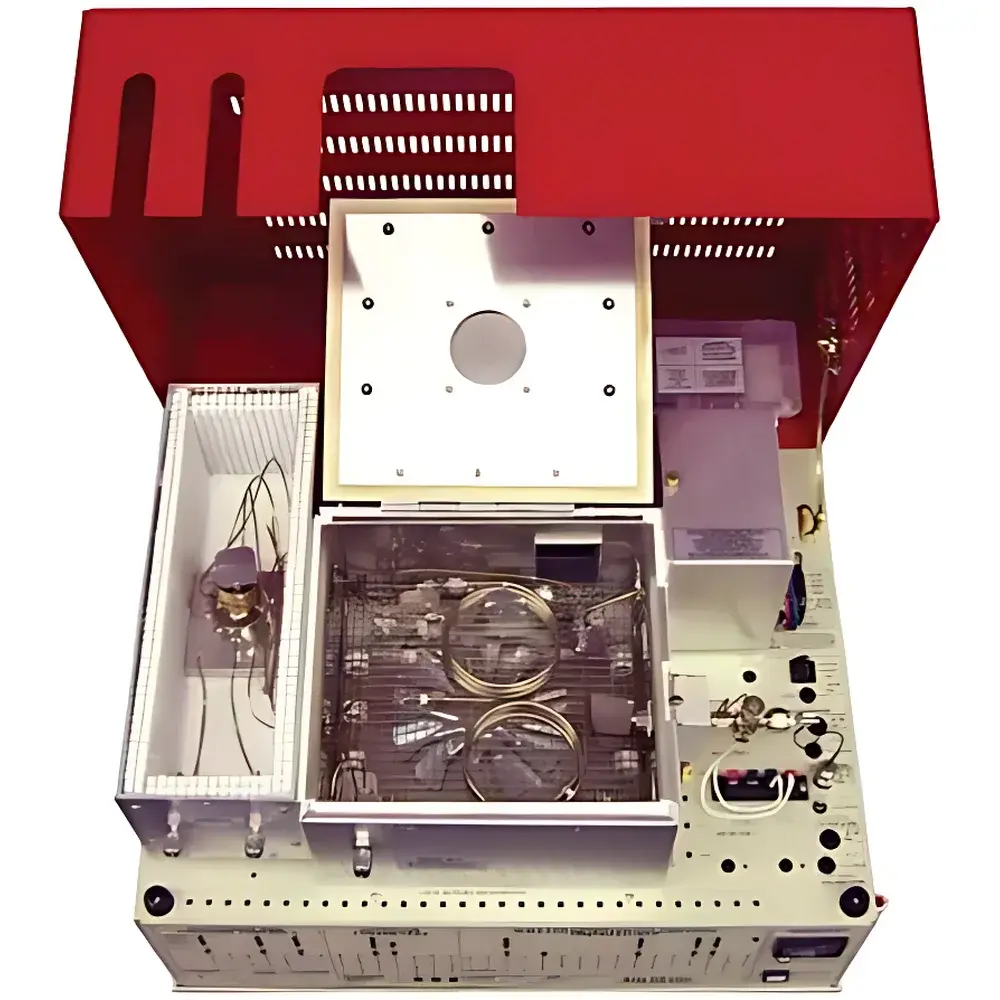
SRI 8610C Portable Gas Chromatograph for Environmental Gas Analysis
| Brand | SRI |
|---|---|
| Origin | USA |
| Model | SRI-8610C |
| Instrument Type | Portable Gas Chromatograph |
| Temperature Control Range | 0–400 °C |
| Temperature Ramp Rate | 0.1 °C/min (programmable) |
| Cool-down Time | ~15 min (400 °C to ambient) |
| Carrier Gas Flow Control | Electronically adjustable |
| Carrier Gas Pressure Control | 0–80 psi (EPC-programmable) |
| Injector Maximum Operating Temperature | 400 °C |
| Injector Pressure Setpoint Range | 0–80 psi (programmable) |
| Injector Total Flow Setpoint Range | Adjustable |
Overview
The SRI 8610C Portable Gas Chromatograph is a field-deployable, laboratory-grade analytical instrument engineered for precise separation and quantification of permanent gases and light hydrocarbons in environmental, industrial, and emergency response applications. Based on classical gas chromatographic principles—utilizing capillary or packed column separation coupled with selective detection—the 8610C delivers high reproducibility and robust performance under variable ambient conditions. Its compact chassis (49.5 × 36.8 × 34.3 cm), integrated temperature-controlled oven (19.8 × 19.0 × 7.6 cm internal volume), and dual-detector capability make it uniquely suited for on-site monitoring of ambient air, stack emissions, landfill gas, refinery off-gas, and indoor air quality matrices. The system operates on fundamental GC physics: analyte volatility and partitioning behavior govern elution order, while detector response (TCD, FID, or HID) provides quantitative signal proportional to concentration.
Key Features
- Programmable column oven with infinite segment temperature ramping (0–400 °C), 0.01 °C resolution, and ±0.1 °C thermal stability; rapid cool-down via integrated fan-assisted airflow (~15 min from 400 °C to ambient)
- Electronic Pressure Control (EPC) across all gas lines—carrier, makeup, and detector gases—with programmable pressure setpoints (0–80 psi) and flow modulation at up to 90 psi/min slew rate
- Modular detector architecture supporting simultaneous installation of up to four detectors from a library of 16 compatible types—including Thermal Conductivity Detector (TCD), Flame Ionization Detector (FID) with methane converter, and Helium Ionization Detector (HID)
- Multi-mode injection system accommodating five concurrent inlet configurations from a catalog of 12 options, including 10-port gas sampling valves for automated loop injection
- Full PC-based control via PeakSimple chromatography software, enabling method development, real-time data acquisition, peak integration, calibration curve generation, and audit-ready reporting
- Ruggedized aluminum chassis designed for transport and operation in non-laboratory environments; meets MIL-STD-810G criteria for shock, vibration, and thermal cycling resilience
Sample Compatibility & Compliance
The SRI 8610C is validated for analysis of gaseous mixtures containing H2, O2, N2, CO, CO2, CH4, C2H6, C2H4, C3H8, C4H10, C5H12, and C6–C8 aliphatics. With TCD/FID configuration, detection limits reach 5 ppm for carbon-containing compounds; with TCD/HID, sensitivity extends to 10 ppm for noble gases and trace impurities. The platform supports compliance with ASTM D1945 (analysis of natural gas), EPA Method TO-15 (VOCs in air), ISO 8573-5 (compressed air purity), and USP (residual solvents). Data integrity adheres to FDA 21 CFR Part 11 requirements when configured with electronic signatures, audit trails, and role-based access controls within PeakSimple.
Software & Data Management
PeakSimple v6.x provides full instrument control, sequence management, and post-run processing. It supports multi-channel acquisition (up to 8 analog inputs), baseline correction algorithms (e.g., asymmetrical least-squares smoothing), and customizable report templates compliant with GLP/GMP documentation standards. Raw data files (.chd) are stored in vendor-neutral formats with embedded metadata (method parameters, calibration history, operator ID, timestamp). Export options include CSV, PDF, and XML for LIMS integration. Software validation packages—including IQ/OQ documentation, test protocols, and summary reports—are available upon request for regulated environments.
Applications
- Environmental monitoring: Ambient air quality assessment (NOx, CO, VOCs), landfill gas composition tracking (CH4/CO2 ratio), and fugitive emission screening
- Industrial process control: Refinery fuel gas analysis, syngas composition verification, and petrochemical cracking off-gas profiling
- Regulatory compliance: Stack testing per EPA Performance Specifications 8 and 18, and Clean Air Act Title V reporting
- Emergency response: Rapid identification of hazardous release events (e.g., ammonia leaks, chlorine contamination, hydrocarbon vapor clouds)
- Research & education: Teaching chromatographic theory, method development labs, and catalyst evaluation studies requiring real-time gas-phase product analysis
FAQ
Is the SRI 8610C certified for use in hazardous locations?
No—standard configurations are rated for Class I, Division 2 environments only. Explosion-proof variants require custom engineering and third-party certification (e.g., ATEX or IECEx).
Can the 8610C be operated remotely via Ethernet or Wi-Fi?
Yes—Ethernet connectivity enables remote control and data streaming over LAN/WAN using TCP/IP protocol; Wi-Fi requires optional USB-to-WiFi adapter and firmware update.
What column types are supported?
Both packed columns (e.g., molecular sieve 5A, Porapak Q) and fused-silica capillaries (e.g., DB-1, PLOT Al2O3) are compatible; column switching and backflush capabilities are software-controllable.
Does the system support automated calibration with internal standards?
Yes—PeakSimple supports multi-level external standard calibration, internal standard normalization, and area-normalized relative response factor (RRF) calculations.
What maintenance intervals are recommended for EPC modules and detectors?
EPC transducers require annual zero/span verification; FID jet cleaning every 200 runs; TCD filament inspection every 6 months; HID discharge cell replacement every 12–18 months depending on helium purity and usage frequency.
Related Products



