
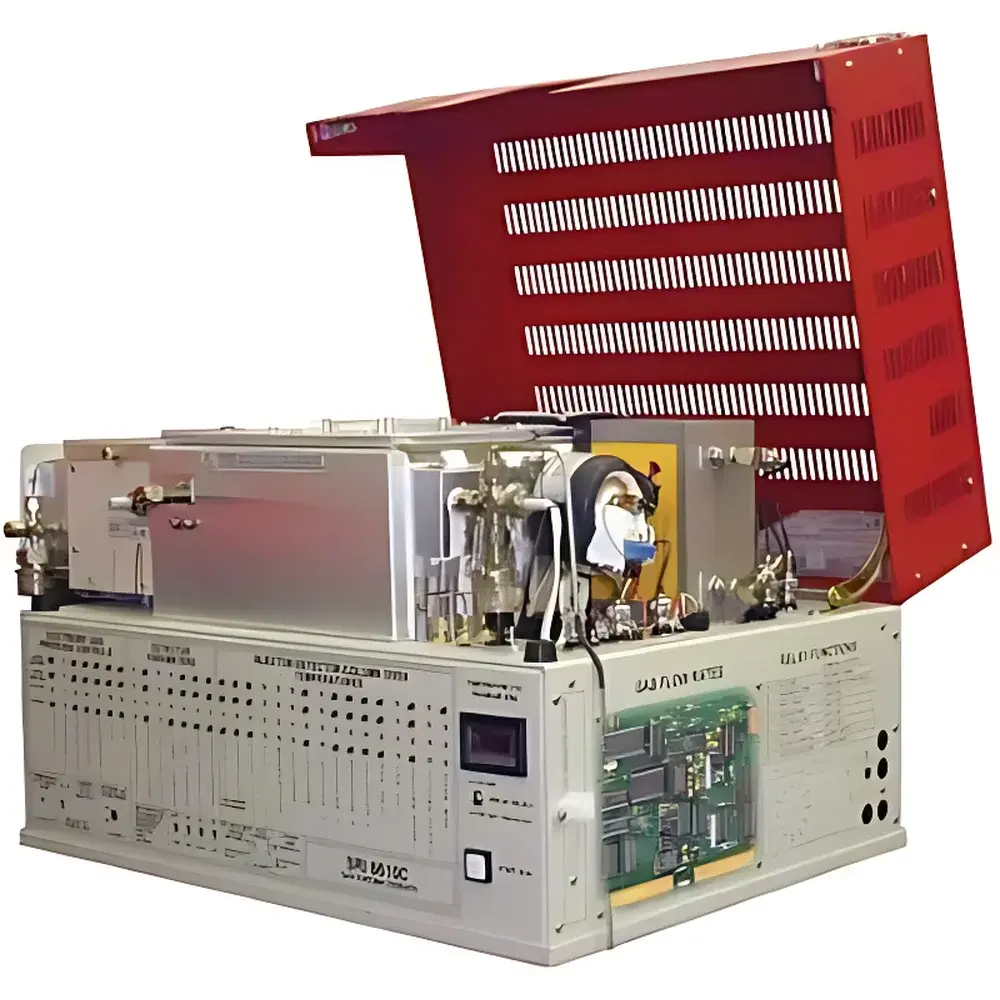
SRI 8610C Portable Gas Chromatograph for Pesticide Residue Analysis
| Brand | SRI |
|---|---|
| Origin | USA |
| Model | 8610C (Pesticide Residue Configuration) |
| Instrument Type | Portable Gas Chromatograph |
| Temperature Control Range | 0–400 °C |
| Temperature Ramp Rate | 0.1 °C/min (minimum programmable increment) |
| Cooling Time | ~15 min (from 400 °C to ambient) |
| Carrier Gas Flow Range | Adjustable (EPC-controlled) |
| Carrier Gas Pressure Range | 0–80 psi (programmable EPC) |
| Injector Maximum Temperature | 400 °C |
| Injector Pressure Setpoint Range | 0–80 psi (programmed) |
| Injector Total Flow Setpoint Range | Adjustable |
Overview
The SRI 8610C Portable Gas Chromatograph is a field-deployable, laboratory-grade analytical system engineered for precise and reliable quantification of pesticide residues in environmental, agricultural, and food safety applications. Built upon SRI Instruments’ legacy of robust GC design—trusted by the U.S. Environmental Protection Agency (EPA), National Institute of Standards and Technology (NIST), USDA, CDC, and major industrial R&D labs—the 8610C integrates high-fidelity separation performance with operational flexibility in a compact chassis. Its core architecture employs capillary gas chromatography with electron pressure control (EPC) for all pneumatic functions, ensuring reproducible retention times and peak area precision across variable ambient conditions. The system operates on the fundamental principle of differential partitioning of volatile and semi-volatile analytes between a mobile phase (inert carrier gas) and a stationary phase (MXT-30 m × 0.53 mm fused-silica column), enabling selective elution and detection of trace-level organophosphates, organochlorines, carbamates, and sulfur-containing pesticides.
Key Features
- Modular, multi-detector platform supporting simultaneous installation of up to four detectors—including Electron Capture Detector (ECD), Nitrogen-Phosphorus Detector (NPD), and Flame Photometric Detector with sulfur-specific filter (FPD-S)—enabling orthogonal selectivity and method cross-validation.
- Programmable oven with 0.01 °C resolution, ±0.1 °C thermal stability, and infinite temperature ramp/hold segments; rapid cooling via integrated fan reduces cycle time between injections without compromising column integrity.
- Full electronic pressure and flow control (EPC) across all gas lines: carrier, make-up, detector gases, and injector pressures—all programmable from 0 to 80 psi at 90 psi/min response rate, eliminating mechanical regulators and minimizing drift.
- Four independent injection ports compatible with split/splitless, on-column, PTV, and large-volume injection modes—12 total configurations available to optimize sensitivity and matrix tolerance for complex biological or soil extracts.
- Integrated silent air compressor eliminates external gas cylinder dependency; enables fully autonomous operation in field laboratories, mobile units, or regulatory inspection sites.
- Compact footprint (49.5 × 36.8 × 34.3 cm) and ruggedized aluminum chassis meet MIL-STD-810G shock/vibration requirements for transport and on-site deployment.
Sample Compatibility & Compliance
The 8610C is validated for analysis of regulated pesticide residues per EPA Methods 8081B (organochlorines), 8082A (PCBs), 8083A (organophosphates), and 8270D (semi-volatile organics). Its ECD achieves sub-20 ppt detection limits for halogenated compounds (e.g., DDT, endosulfan); NPD delivers ≤100 ppb sensitivity for nitrogen- and phosphorus-containing pesticides (e.g., chlorpyrifos, diazinon); FPD-S provides ≤200 ppb detection for sulfur-based agents (e.g., captan, folpet). All hardware and firmware comply with ISO/IEC 17025:2017 calibration traceability requirements. Data acquisition supports 21 CFR Part 11-compliant audit trails when paired with validated third-party chromatography data systems (CDS), fulfilling GLP and GMP documentation mandates for contract testing laboratories.
Software & Data Management
Control and data acquisition are executed via SRI’s GCWin software suite (Windows OS), offering real-time monitoring of oven temperature, detector baselines, EPC setpoints, and flow profiles. Method development includes automated retention time locking (RTL) and retention index calculation using internal standards. Raw data files (.SRD) are exportable in ASTM E1947-compliant format for interoperability with LIMS platforms. Software supports instrument qualification protocols (IQ/OQ/PQ), electronic signature workflows, and customizable report templates aligned with AOAC International and SANTE/2023/2023 guidelines for pesticide residue reporting.
Applications
- Routine screening of fruits, vegetables, grains, and animal feed for multi-residue pesticide profiles under EU MRLs and U.S. tolerances.
- Field-based monitoring of soil and water samples near agricultural zones to assess leaching and runoff contamination.
- Regulatory compliance testing for FDA Food Safety Modernization Act (FSMA) verification programs.
- Forensic toxicology support for organophosphate poisoning investigations.
- Method development and validation in contract research organizations (CROs) serving agrochemical registrants under EPA FIFRA and OECD 501–511 test guidelines.
FAQ
Is the 8610C suitable for unattended overnight operation in a fixed lab environment?
Yes—the system supports full method scheduling, auto-shutdown, and remote status monitoring via Ethernet; however, its primary design emphasis is on portability and rapid deployment rather than continuous 24/7 duty cycles.
Can the ECD and NPD operate simultaneously during a single run?
No—detector selection is sequential per analysis; however, the modular detector bay allows hot-swap configuration without oven cooldown, enabling same-day multi-detection workflows.
What column dimensions and phases are supported beyond the standard MXT-30 m × 0.53 mm?
The 8610C accommodates columns ranging from 10–60 m length and 0.10–0.53 mm ID, including polar (wax), mid-polarity (5% phenyl), and non-polar (5% phenyl methyl siloxane) stationary phases—subject to maximum temperature limits and EPC flow calibration.
Does the system include built-in calibration verification tools?
Yes—GCWin includes automated leak-check routines, pressure decay diagnostics, and baseline noise/offset trending; certified reference standards kits (e.g., EPA 8270 Mix, PESTICIDE-MIX-1) are recommended for routine performance qualification.
Is firmware upgrade support provided post-purchase?
SRI offers free firmware updates for the lifetime of the instrument, delivered via secure download portal with version-controlled release notes and compatibility matrices.






