
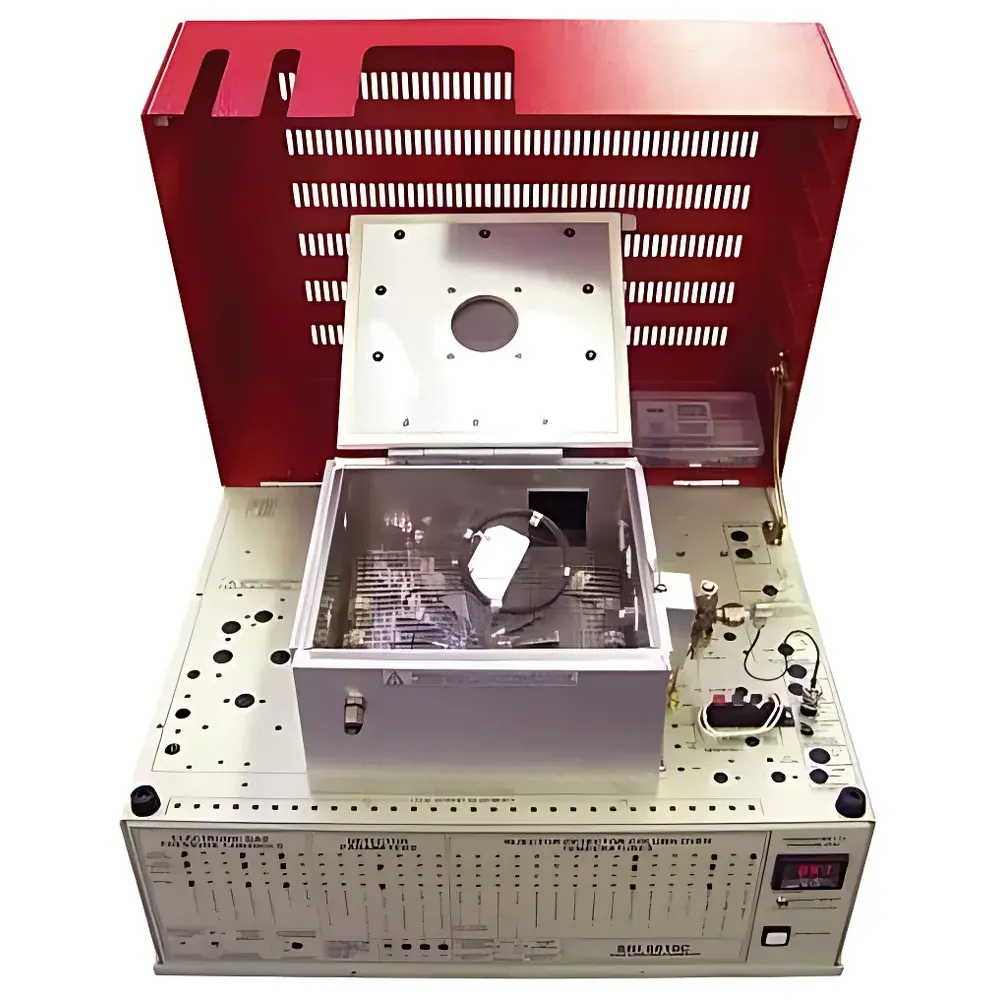
SRI 8610C Portable Gas Chromatograph for Routine Environmental Analysis
| Brand | SRI |
|---|---|
| Origin | USA |
| Model | 8610C (Routine Configuration) |
| Instrument Type | Portable Gas Chromatograph |
| Application Field | Environmental Monitoring |
| Oven Temperature Range | 0–400 °C |
| Temperature Ramp Rate | 0.1 °C/min (minimum programmable increment) |
| Cool-down Time | ~15 min (from 400 °C to ambient) |
| Carrier Gas Flow Control | Electronically adjustable |
| Carrier Gas Pressure Range & Control | 0–80 psi, program-controlled via EPC |
| Injector Maximum Operating Temperature | 400 °C |
| Injector Pressure Setpoint Range | 0–80 psi, fully programmable |
| Injector Total Flow Setpoint Range | Electronically adjustable |
Overview
The SRI 8610C Portable Gas Chromatograph is a field-deployable, laboratory-grade analytical instrument engineered for routine qualitative and quantitative analysis of volatile and semi-volatile organic compounds in environmental matrices. Based on classical gas chromatographic separation principles—where analytes are partitioned between a mobile phase (inert carrier gas) and a stationary phase (capillary or packed column)—the 8610C delivers high reproducibility and method robustness under variable operational conditions. Its compact benchtop footprint (49.5 × 36.8 × 34.3 cm) and modular architecture enable seamless integration into mobile labs, field stations, and fixed-site environmental monitoring facilities. Designed and manufactured in the United States, the system complies with fundamental design expectations for regulatory-grade instrumentation, supporting method development and validation aligned with EPA Methods 8015, 8260, and 8270, as well as ISO 10380 and ASTM D3612.
Key Features
- Programmable oven with infinite-segment temperature ramping (0–400 °C), 0.01 °C resolution, and ±0.1 °C thermal stability; integrated forced-air cooling reduces cooldown time from 400 °C to ambient in approximately 15 minutes.
- Electronic Pressure Control (EPC) across all gas channels—including carrier, makeup, and detector gases—enabling precise, repeatable pressure regulation from 0 to 80 psi at up to 90 psi/min slew rate.
- Dual-detector compatibility: factory-configurable for Flame Ionization Detection (FID) or Thermal Conductivity Detection (TCD), both optimized for trace-level hydrocarbon and permanent gas analysis respectively.
- Universal direct injection port rated to 400 °C, accepting both liquid and gaseous samples without derivatization; compatible with packed columns and wide-bore (0.53 mm ID) capillary columns.
- Modular hardware architecture supports future expansion: up to four detectors and five injection modes may be installed concurrently, with twelve injector and sixteen detector options available through SRI’s certified accessories portfolio.
- Full PC-based control via PeakSimple chromatography data system (CDS), supporting real-time acquisition, peak integration, calibration curve generation, and report export in CSV/PDF formats.
Sample Compatibility & Compliance
The 8610C accommodates a broad spectrum of sample types relevant to environmental compliance testing: ambient air, soil headspace extracts, water purge-and-trap concentrates, landfill gas, and industrial stack emissions. Its FID configuration meets sensitivity requirements for total petroleum hydrocarbons (TPH), BTEX, and aliphatic/aromatic VOCs per EPA Method 8015B; the TCD variant supports permanent gas analysis (O₂, N₂, CO, CH₄, CO₂) per ASTM D1945 and ISO 6974-2. All configurations adhere to GLP documentation standards, with audit-trail-capable software logging for instrument parameters, sequence execution, and user actions—facilitating FDA 21 CFR Part 11 readiness when deployed in regulated laboratories.
Software & Data Management
PeakSimple v6.x serves as the native CDS platform, offering intuitive method setup, baseline correction algorithms, retention time locking, and multi-point external standard calibration. Raw data files (.PSD) are stored with embedded metadata (instrument ID, operator, date/time stamp, method name), ensuring full traceability. Export functions support LIMS integration via ASCII-delimited formats, while PDF reports include chromatograms, peak tables, integration parameters, and pass/fail flags against user-defined specification limits. Optional upgrades provide automated system suitability testing (SST), electronic signature workflows, and secure network deployment under Windows domain authentication.
Applications
- Field-based screening of VOC contamination in groundwater and soil vapor using portable purge-and-trap interfaces.
- Real-time monitoring of landfill gas composition (CH₄, CO₂, NMHC) for emissions reporting and flare efficiency assessment.
- Quality control of fuel blends and refinery intermediates in upstream and midstream operations.
- Indoor air quality (IAQ) surveys targeting formaldehyde, acetaldehyde, and other carbonyl compounds following OSHA/NIOSH sampling protocols.
- Method verification and troubleshooting in accredited environmental testing laboratories maintaining ISO/IEC 17025 compliance.
FAQ
Is the SRI 8610C compliant with EPA-approved methods for environmental analysis?
Yes—the system is routinely deployed in EPA-certified laboratories for Methods 8015B (FID), 8260D (purge-and-trap/FID), and 8270E (TIC/TCD), provided column selection, calibration standards, and QC procedures follow method-specified criteria.
Can the 8610C operate unattended for extended sequences?
It supports scheduled runs via PeakSimple’s sequence manager, including auto-shutdown, oven cool-down, and detector quenching; however, continuous operation beyond 72 hours requires external power conditioning and ambient temperature stabilization.
What column configurations are supported out-of-the-box?
Standard delivery includes compatibility with 0.53 mm ID fused-silica capillary columns and stainless-steel packed columns (e.g., Porapak Q, HayeSep D); custom column ovens or guard column adapters are available as optional accessories.
Does the EPC system support helium, hydrogen, and nitrogen as carrier gases?
Yes—all three gases are fully supported; hydrogen offers optimal speed-resolution trade-offs for fast GC applications, while helium remains preferred for legacy method transfer and regulatory continuity.
Is remote diagnostics or firmware update capability built-in?
Firmware updates require local USB connection and SRI-provided utilities; remote access to instrument status and basic parameter monitoring is possible via optional Ethernet-enabled I/O modules and third-party SCADA integration.



