
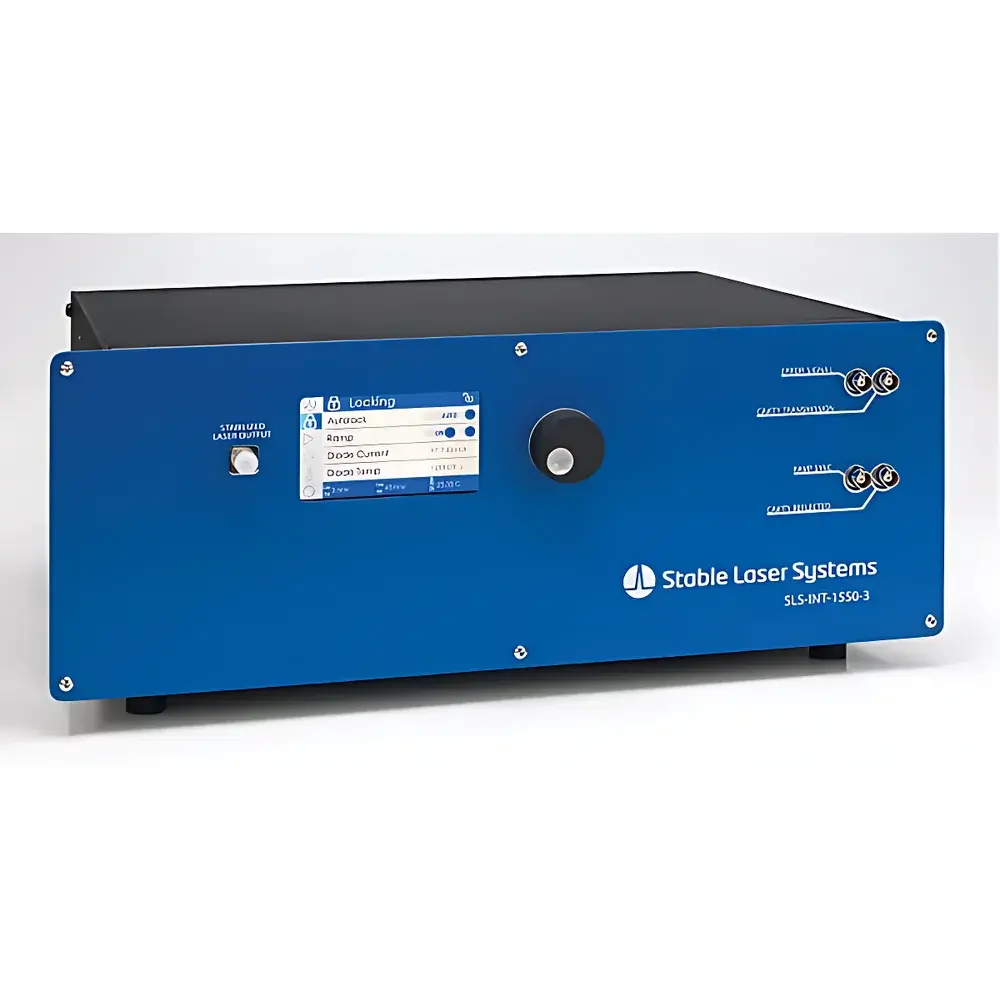
Stable Laser Systems 3 Hz Ultra-Narrow Linewidth Stabilized Laser System
| Brand | Stable Laser Systems |
|---|---|
| Model | 3 Hz Ultra-Narrow Linewidth |
| Wavelength Range | 1530–1565 nm |
| Output Power | 10 mW |
| Linewidth | ≤3 Hz (FWHM) |
| Free Spectral Range (FSR) of Reference Cavity | 6 GHz |
| Allan Deviation (1 s) | <9×10⁻¹⁵ |
| Phase Noise @10 Hz offset | <−20 dBc/Hz |
| Phase Noise @10 kHz offset | <−53 dBc/Hz |
| Frequency Drift (24 h, temp-compensated) | <1 kHz |
| Operating Temperature | 18–25 °C |
| Power Consumption | <25 W |
| Dimensions | 19″ rack-mount, 4 U height |
| Weight | <40 kg |
| Vibration Isolation | Integrated passive platform |
| Fiber Interface | FC/APC, PM-1550 |
Overview
The Stable Laser Systems 3 Hz Ultra-Narrow Linewidth Stabilized Laser System is a high-fidelity optical frequency reference source engineered for metrology-grade applications requiring exceptional spectral purity and long-term frequency stability. Based on a thermally and mechanically isolated ultra-low-expansion (ULE) Fabry–Pérot reference cavity, the system employs active Pound–Drever–Hall (PDH) locking to suppress laser frequency fluctuations to sub-Hertz levels. Its ≤3 Hz intrinsic linewidth—measured as full width at half maximum (FWHM)—is achieved through dual-stage stabilization: first, coarse locking to the cavity’s longitudinal mode via piezoelectric transducer (PZT)-actuated cavity length control; second, fine current and temperature modulation of the solid-state gain medium to suppress residual noise below 100 kHz. Designed for deployment in demanding environments—including airborne platforms, mobile metrology labs, and distributed fiber sensing networks—the laser maintains alignment and vacuum integrity during transport via an integrated ion pump, enabling rapid re-deployment without realignment or pump-down cycles.
Key Features
- Turnkey Operation: Fully automated lock acquisition with one-button initialization; no manual cavity scanning or lock-point hunting required.
- Transport-Ready Vacuum Architecture: On-board non-evaporable getter (NEG) ion pump sustains cavity vacuum (<10⁻⁷ Torr) during shipping and relocation, eliminating bake-out and reducing commissioning time to under 1 hour.
- Front-Panel Touch Interface: Real-time monitoring of cavity vacuum pressure, cavity temperature, laser diode current, and TEC temperature; intuitive adjustment of PDH loop gain and filter bandwidth.
- Comprehensive Analog Monitoring Outputs: BNC ports provide simultaneous access to error signal, reflected power, and transmitted power—enabling external diagnostics, synchronous data logging, or integration into larger feedback architectures.
- Rack-Mountable Mechanical Design: 19-inch, 4-U chassis with integrated passive vibration isolation; compatible with standard laboratory racks and mobile instrument enclosures.
- Environmental Robustness: Operates stably across 18–25 °C ambient range; frequency drift <40 kHz/day uncorrected, reduced to <1 kHz/day after linear drift removal via software-based polynomial compensation.
Sample Compatibility & Compliance
The system is optimized for polarization-maintaining (PM) fiber delivery at telecom C-band wavelengths (1530–1565 nm), ensuring compatibility with industry-standard optical components including modulators, interferometers, and photonic integrated circuits. All optical paths are sealed and purged to minimize environmental sensitivity. The laser meets functional requirements for traceable frequency metrology under ISO/IEC 17025-accredited laboratories and supports audit-ready operation per GLP/GMP guidelines when paired with validated data acquisition software. While not certified to a specific regulatory standard (e.g., FDA 21 CFR Part 11), its deterministic lock behavior, full parameter logging, and hardware-enforced diagnostic visibility enable straightforward validation for use in timekeeping, quantum optics, and precision interferometry applications governed by ASTM E2877 (Standard Guide for Metrological Traceability of Optical Frequency Measurements) and ITU-T G.698.2 (coherent transmission systems).
Software & Data Management
The embedded firmware supports USB 2.0 and Ethernet (TCP/IP) communication for remote control via SCPI commands. A vendor-provided Windows/Linux-compatible GUI enables full system configuration, real-time spectrum visualization (via optional RF spectrum analyzer integration), and automated Allan deviation calculation. All monitored parameters—including cavity pressure, error signal RMS, and loop gain settings—are timestamped and exportable in CSV format. Audit trails record lock status transitions, manual gain adjustments, and thermal setpoint changes. Optional Python API facilitates integration into LabVIEW, MATLAB, or custom Python-based quantum control stacks. No cloud connectivity or telemetry is enabled by default; all data remains local unless explicitly exported by the user.
Applications
- Optical atomic clocks and strontium/ytterbium lattice clock local oscillators
- Coherent LIDAR systems requiring >100 ms coherence time for Doppler wind sensing and atmospheric profiling
- Distributed acoustic sensing (DAS) and phase-sensitive OTDR (φ-OTDR) with sub-nanometer strain resolution
- Stabilization of optical frequency combs for absolute frequency calibration and attosecond science
- Low-phase-noise microwave generation via optical heterodyning (e.g., 10 GHz carrier with <−120 dBc/Hz at 10 kHz offset)
- High-finesse cavity ring-down spectroscopy (CRDS) and gravitational wave detector pre-stabilization stages
- Time-frequency transfer over fiber networks with femtosecond-level synchronization stability
FAQ
What is the typical warm-up time before achieving full specification stability?
The system reaches thermal equilibrium and achieves specified Allan deviation within 90 minutes of power-on, assuming ambient temperature is within 18–25 °C and airflow is unrestricted.
Can the laser be locked to an external reference, such as a hydrogen maser or GPS-disciplined oscillator?
Yes—via optional analog voltage input (0–10 V) or digital frequency tuning interface, the system supports offset-locking up to ±400 MHz relative to the cavity resonance, enabling hierarchical referencing in multi-tier metrology chains.
Is the output polarization extinction ratio (PER) specified?
The PM-fiber-coupled output delivers PER >25 dB across the operating wavelength band, verified per IEC 61300-3-32 using a calibrated polarimeter.
Does the system include provisions for remote diagnostics and predictive maintenance?
Yes—the front-panel touchscreen displays real-time health indicators (e.g., ion pump current, thermal gradient across cavity spacer), and logged parameters support trend analysis for cavity aging or pump degradation prediction.
What is the expected lifetime of the internal ion pump under continuous operation?
Rated for >20,000 hours of continuous operation at base pressure <10⁻⁷ Torr; service life extends significantly under intermittent-use scenarios typical of academic or calibration-lab deployments.



