
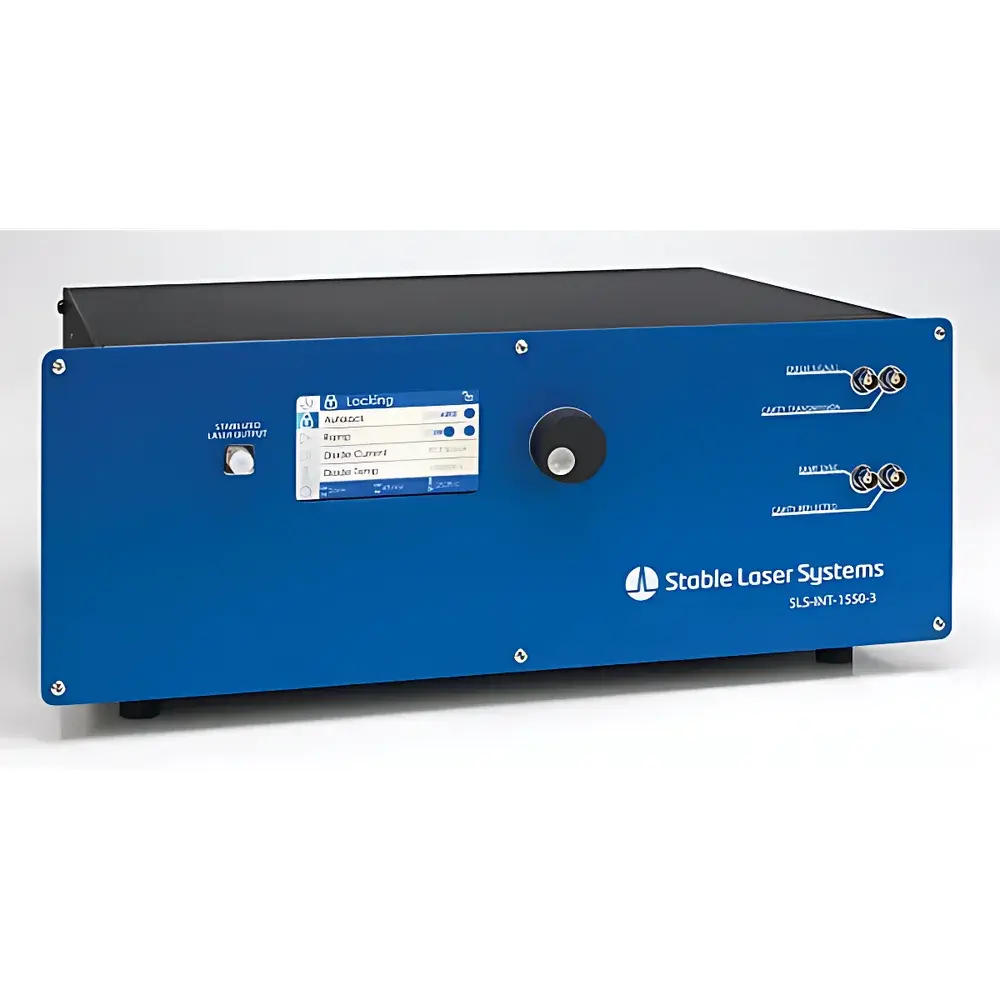
Stable Laser Systems SL-3Hz Ultra-Narrow Linewidth Stabilized Laser
| Brand | Stable Laser Systems |
|---|---|
| Origin | USA |
| Manufacturer Type | Authorized Distributor |
| Product Origin | Imported |
| Model | SL-3Hz |
| Price | Upon Request |
Overview
The Stable Laser Systems SL-3Hz Ultra-Narrow Linewidth Stabilized Laser is a high-fidelity, passively stabilized diode laser system engineered for metrology-grade frequency stability and coherence preservation. Operating in the C-band (1530–1565 nm), it employs a thermally and mechanically isolated ultra-low-expansion (ULE) reference cavity combined with Pound–Drever–Hall (PDH) locking to achieve an intrinsic linewidth of ≤3 Hz (FWHM), verified via delayed self-heterodyne interferometry. This level of spectral purity supports applications demanding long coherence times (>100 s), sub-millihertz-level frequency discrimination, and phase-coherent optical synthesis. The system is designed for laboratory and field-deployable use—its vacuum-sealed cavity is maintained by an integrated non-evaporable getter (NEG) pump and optional ion pump, enabling transport without realignment or vacuum loss. With an Allan deviation of <9×10⁻¹⁵ at 1 s (after linear drift removal), the SL-3Hz meets the stability requirements for optical atomic clocks, precision spectroscopy, and next-generation photonic microwave generation.
Key Features
- Ultra-narrow intrinsic linewidth: ≤3 Hz (measured FWHM)
- Plug-and-play operation: Fully automated lock acquisition via front-panel “Start Lock” button
- Transport-stable architecture: Integrated ion pump maintains cavity vacuum (<1×10⁻⁷ Torr) during relocation; optical alignment preserved across shocks up to 5 g
- Real-time diagnostics: 4.3-inch capacitive touchscreen displays cavity temperature, laser diode current, vacuum pressure, and thermal stage status
- Field-configurable loop dynamics: Adjustable proportional-integral (PI) filter gains and bandwidths via touchscreen interface
- Modular mechanical design: 19″ rack-mountable 4U chassis (<40 kg); includes active-passive hybrid vibration isolation platform
- Optical output: Polarization-maintaining (PM-1550) fiber with FC/APC connector; >10 mW free-space-coupled or fiber-coupled output power
Sample Compatibility & Compliance
The SL-3Hz is compatible with standard telecom-grade single-mode and polarization-maintaining fibers (ITU-T G.652.D / G.657.A1). Its optical output meets IEC 60825-1:2014 Class 3R laser safety requirements when operated within specified power limits. Frequency stability data are traceable to NIST-calibrated wavemeters and referenced against hydrogen maser-disciplined GPS timing systems. The system supports GLP-compliant operation through timestamped audit logs (stored internally and exportable via USB), including lock status, error signal history, and environmental sensor readings. While not certified to ISO/IEC 17025, its performance validation protocol aligns with ASTM E2919-22 (Standard Practice for Evaluating Frequency Stability of Optical Sources).
Software & Data Management
The embedded firmware provides full local control via touchscreen UI and remote access via Ethernet (TCP/IP) using SCPI-compatible command set. All diagnostic signals—including PDH error signal, reflected and transmitted power levels—are accessible as analog BNC outputs (±10 V range, 100 kHz bandwidth) for external monitoring or feedback integration. Internal logging captures 1-second-resolution timestamps for frequency deviation, cavity temperature, and vacuum pressure over ≥30 days. Export formats include CSV and HDF5. Optional Python SDK enables integration into LabVIEW, MATLAB, or custom quantum control stacks. Audit trails comply with FDA 21 CFR Part 11 requirements when used with external time-stamped network authentication and role-based user access controls.
Applications
- Optical frequency comb stabilization: Serving as primary local oscillator for tooth-to-tooth locking in Er:fiber and Ti:sapphire combs
- Coherent LIDAR: Enabling kilometer-range velocity resolution via heterodyne detection with >100 ms coherence time
- Distributed acoustic sensing (DAS): Providing interrogation source for phase-sensitive OTDR with sub-nanoradian phase sensitivity
- Microwave photonics: Generating low-phase-noise mm-wave carriers via optical heterodyning (e.g., 10–40 GHz)
- Optical atomic interferometry: Supporting Raman transition lasers in gravimeters and inertial sensors
- Time-frequency dissemination: Acting as flywheel oscillator in fiber-optic time transfer links targeting ≤100 as RMS timing jitter over continental distances
FAQ
What is the typical frequency drift after linear trend removal?
Frequency variation remains below ±0.5 kHz over 24 hours under stable ambient conditions (18–25 °C, <±0.5 °C/h gradient).
Can the laser be locked to an external reference cavity?
Yes—the system supports external cavity locking via TTL-synchronized mode-hop-free scanning and configurable servo input impedance (50 Ω or 1 kΩ).
Is the 3 Hz linewidth guaranteed over the entire 1530–1565 nm tuning range?
The ≤3 Hz specification applies at the factory-set nominal wavelength (typically 1542.14 nm); linewidth increases to ≤5 Hz at band edges due to cavity dispersion effects.
Does the system support dual-wavelength operation?
Not natively—but two SL-3Hz units can be synchronized via common 10 MHz reference input for beat-note generation with sub-Hz relative linewidth.
What maintenance is required for the ion pump?
The ion pump requires no scheduled maintenance; its lifetime exceeds 10 years at continuous operation and is monitored continuously via pressure readback on the front panel.






