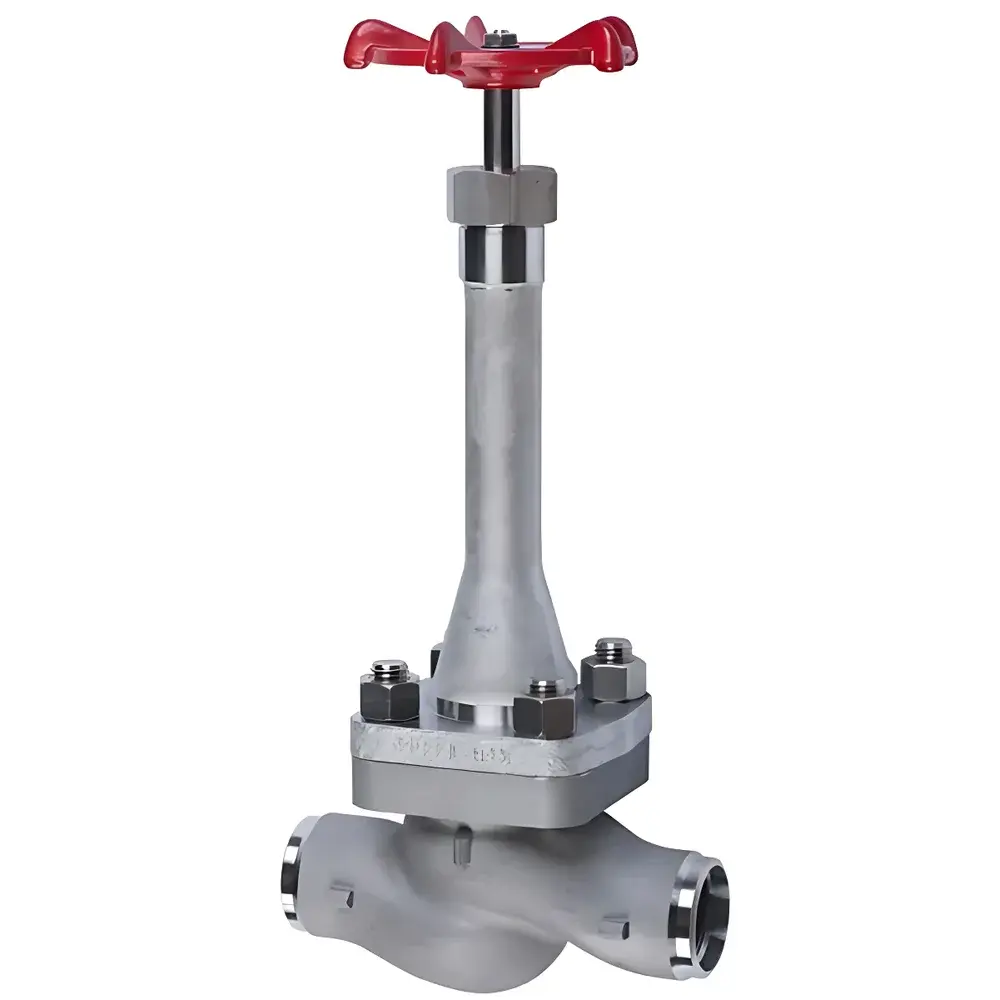
Stainless Steel Cryogenic Globe Valve with Bolted Bonnet
| Brand | IRELAND |
|---|---|
| Origin | France |
| Model | 160700 |
| Body Material | 304L Stainless Steel (standard), optional 316L |
| Connection | Butt-Weld (standard), optional Flanged |
| Design Temperature Range | −220 °C to +200 °C |
| Size Range | DN8–DN50 |
| Pressure Rating | PN10–PN100 |
| Bonnet Type | Extended Bolted Bonnet |
| Seat Integration | Integral Seat with Reusable Soft Seal Disc |
| Fire-Safe Design | Compliant with ISO 10497 |
| External Surface | Copper-Free Construction |
| Stem & Bonnet Extension | Cryogenic-Optimized Stainless Steel |
| Packing | Enhanced Graphite-Based Packing with Reinforced Gland Assembly |
| Actuation Options | Pneumatic or Electric Actuator (FO/FC), Manual Handwheel with Locking Device |
Overview
The IRELAND Model 160700 is a cryogenically engineered stainless steel globe valve designed for reliable shutoff and throttling control in ultra-low temperature process environments. Utilizing a bolted bonnet configuration with extended low-thermal-conductivity stem and bonnet components, the valve minimizes heat ingress from ambient conditions into the cryogenic fluid path—critical for maintaining packing integrity and preventing ice formation or seal degradation during operation at temperatures as low as −220 °C. Its integral seat design and reusable soft-seal disc are qualified to pass bubble-tight shut-off testing per ISO 5208 (Class VI), ensuring leak rates below 1 × 10⁻⁶ mbar·L/s for helium under test conditions. The valve conforms to EN 1515-1 for flanged connections and ASME B16.34 for pressure-containing shell design, supporting applications across air separation units (ASUs), liquefied natural gas (LNG) transfer systems, hydrogen infrastructure, and specialty chemical processing where material compatibility with oxygen, nitrogen, argon, and other inert or reactive cryogens is essential.
Key Features
- Extended bolted bonnet with cryo-optimized 304L/316L stainless steel construction, reducing thermal bridging between process media and packing chamber
- Integral seat and replaceable soft-seal disc assembly—engineered for repeatable, bubble-tight performance per ISO 5208 Class VI
- Copper-free external surfaces and wetted parts, meeting ASTM G63 and CGA G-4.1 requirements for oxygen service compatibility
- Enhanced graphite-based packing system with reinforced gland assembly, rated for sustained operation across the full temperature range (−220 °C to +200 °C)
- Fire-safe design certified to ISO 10497, providing post-fire sealing integrity in accordance with API RP 2510 and NFPA 59A
- Robust mechanical architecture validated for cyclic duty in high-reliability industrial settings, including ASU cold boxes and mobile cryogenic transport systems
Sample Compatibility & Compliance
The Model 160700 is compatible with gaseous and liquid-phase cryogenic media—including liquid oxygen (LOX), liquid nitrogen (LIN), liquid argon (LAR), hydrogen (H2), and helium (He)—as well as intermediate-temperature hydrocarbon streams up to +200 °C. All wetted materials comply with ASTM A351 CF8M (for 316L variants) and ASTM A351 CF3 (for 304L standard), with trace element analysis verifying absence of copper, zinc, or lead in contact surfaces. The valve meets pressure equipment directive (PED 2014/68/EU) Category IV requirements for Group 1 fluids and is documented with EU Declaration of Conformity and Material Test Reports (EN 10204 3.1). It supports integration into safety instrumented systems (SIS) when equipped with SIL-rated actuators and complies with IEC 61508 functional safety principles.
Software & Data Management
While the base manual version operates without embedded electronics, actuated configurations support industry-standard communication protocols including HART 7, Foundation Fieldbus, and PROFIBUS PA. Digital position feedback, diagnostic logs, and partial stroke test records are accessible via DCS-integrated asset management platforms (e.g., Emerson DeltaV, Honeywell Experion). Audit trails for maintenance events, calibration history, and operational cycles align with FDA 21 CFR Part 11 requirements when deployed in regulated pharmaceutical or biotech cryo-storage facilities. Configuration data is stored in non-volatile memory with timestamped firmware revision tracking.
Applications
- Air separation plant cold box isolation and flow regulation (O2, N2, Ar extraction loops)
- LNG receiving terminals and vaporization skids (Joule–Thomson valve bypass, boil-off gas control)
- Hazardous material transport trailers and ISO tanks handling cryogenic liquids
- Hydrogen refueling stations (liquid hydrogen dispensing, buffer tank isolation)
- High-purity semiconductor gas delivery systems requiring metal-sealed alternatives to elastomer-based valves
- Research cryostats and superconducting magnet cooling circuits requiring long-term zero-leak integrity
FAQ
What temperature extremes is this valve rated for?
The valve is qualified for continuous service from −220 °C to +200 °C, with extended bonnet geometry specifically optimized for stable packing performance below −196 °C.
Is it suitable for oxygen service?
Yes—copper-free construction, oxygen-cleaned surface finish (Ra ≤ 0.8 µm), and compliance with CGA G-4.1 and ASTM G63 make it appropriate for gaseous and liquid oxygen applications.
Can it be automated for remote operation?
Yes—pneumatic spring-return (FO/FC) and electric modulating actuators are available with IP67/NEMA 4X enclosures and SIL2-certified control modules.
Does it meet fire-safe standards?
Yes—the fire-safe variant is tested per ISO 10497 and maintains sealing integrity after 30 minutes of hydrocarbon fire exposure at 800 °C.
What documentation accompanies each unit?
Each valve ships with EN 10204 3.1 Material Test Reports, PED compliance dossier, ISO 5208 leakage test certificates, and dimensional drawings stamped by the authorized inspection body.