
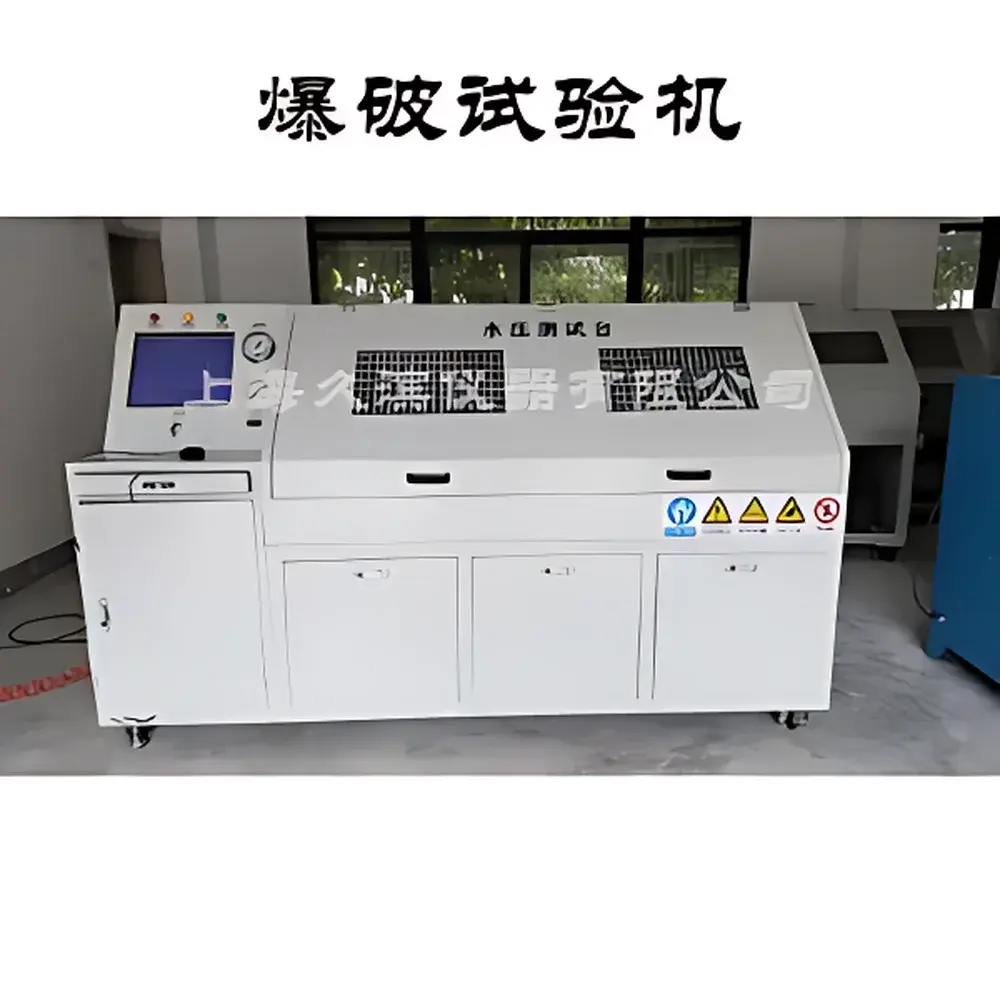
Static Creep & Pressure Cycling Test System
| Brand | Jiubin Instruments |
|---|---|
| Model | JB |
| Type | Static and Dynamic Pressure Cycling Test Bench for Automotive Cooling System Components |
Overview
The Jiubin Instruments JB Static Creep & Pressure Cycling Test System is an engineered platform designed for controlled, repeatable evaluation of structural integrity and sealing performance under sustained and cyclic pressure loads—commonly referred to as creep testing and pressure endurance testing. Unlike transient burst or proof-pressure tests, this system applies precisely regulated hydraulic pressure over extended durations (hours to thousands of hours) while simultaneously modulating thermal conditions to replicate real-world service environments in automotive cooling systems. Its core measurement principle relies on closed-loop servo-hydraulic actuation combined with proportional pneumatic level control, enabling simultaneous monitoring of pressure decay (for leak quantification), flow rate stability, and thermal drift compensation. The system is purpose-built for components subjected to long-term thermo-mechanical stress—including expansion tanks (overflow reservoirs), radiator assemblies, coolant hoses, heat exchangers, and plastic or composite fluid reservoirs—where time-dependent deformation (creep), fatigue-induced microcracking, and seal interface degradation are critical failure modes.
Key Features
- Integrated servo-hydraulic pressure generation with high-stability variable-frequency pump, delivering precise pressure regulation from 0 to 5 bar with ±0.02 bar control accuracy under steady-state conditions.
- Multi-zone thermal conditioning: independent control of test medium temperature (ambient to 150 °C) and ambient chamber temperature (–40 °C to +150 °C), enabling combined thermal–mechanical stress profiling per ISO 16750-4 and SAE J2394 requirements.
- Proportional pneumatic liquid-level balancing system that maintains programmable fill heights within expansion tanks via differential gas pressure—eliminating mechanical float mechanisms and ensuring consistent hydrostatic loading across test cycles.
- Dual-mode leak detection: pressure-decay method (minimum detectable loss: 0.1 bar over 60 min) and volumetric flow deviation monitoring (threshold: ±0.1 L/min), both compliant with TL52682 Annex B and VW PV1712 Section 5.3.2.
- Modular multi-station manifold architecture supporting up to six parallel DUTs (Devices Under Test) with individual pressure/flow isolation valves and calibrated branch sensors—ensuring load uniformity without cross-talk or pressure shadowing.
- Industrial-grade PLC-based control architecture with real-time HMI visualization, configurable test sequences (ramp-hold-cycling), automatic fault logging, and hardware-enforced safety interlocks including overpressure cutoff, thermal runaway shutdown, and emergency depressurization.
Sample Compatibility & Compliance
The JB test system accommodates a broad range of cooling system components, including but not limited to polyamide (PA66-GF30), polybutylene terephthalate (PBT), and aluminum-rubber hybrid assemblies. Fixture interfaces support standard SAE J1645 ports and ISO 2047 flanges. All operational protocols and calibration traceability align with OEM-specific validation requirements: Volkswagen Group’s PV1712 (AG9904 revision), General Motors’ GMW14242 and GMW15310, SAIC-GM’s SGM15310, and BMW’s TL52682. The system’s data acquisition architecture supports 21 CFR Part 11-compliant electronic signatures and audit trails when paired with validated software modules—meeting GLP and Tier-1 supplier GMP documentation standards.
Software & Data Management
Control and data acquisition are managed via a deterministic real-time PLC runtime environment interfaced with a Windows-based engineering workstation running custom SCADA software. All test parameters—including pressure setpoints, ramp rates, dwell durations, temperature profiles, and alarm thresholds—are defined in XML-based test recipes. Raw sensor data (pressure, temperature, flow, level) are sampled at 10 Hz and stored in binary .tdms format with embedded metadata (DUT ID, operator, timestamp, environmental conditions). Export options include CSV, PDF reports (with pass/fail annotations per clause), and direct integration into LabVIEW or MATLAB for advanced statistical process control (SPC) analysis. Calibration certificates for all transducers (including traceability to NIST or CNAS-accredited labs) are digitally archived and version-controlled.
Applications
- Long-duration static creep evaluation of polymer expansion tanks per VW PV1712 Clause 6.1.3 (1,000 h at 1.5× rated pressure, 95 °C).
- Cyclic pressure endurance testing of coolant hoses under alternating thermal–mechanical loads (e.g., –40 °C to +120 °C with 0–3.5 bar superimposed sinusoidal pressure, 10,000 cycles).
- Seal interface validation for O-ring–groove combinations in aluminum radiator end tanks using pressure-hold + flow-integration methodology per GMW15310 Section 7.4.
- Failure mode mapping of solder joints in brass–copper heat exchangers under combined thermal cycling and low-amplitude pressure pulsation (0.5–2.0 Hz).
- Pre-validation screening of new coolant formulations (e.g., G12++ compatible fluids) for material compatibility and gasket swelling kinetics.
FAQ
What cooling media are supported for testing?
G12+ antifreeze concentrate, 50/50 v/v ethylene glycol–water mixtures, and OEM-specified organic acid technology (OAT) coolants—compatible with stainless steel wetted parts and EPDM/FKM seals.
Can the system perform both static creep and dynamic cycling in a single test sequence?
Yes. Users may define multi-phase sequences combining static hold periods (up to 10,000 hours), linear pressure ramps, and sinusoidal or square-wave cycling profiles—all synchronized with independent thermal zones.
Is third-party calibration documentation included with delivery?
Each unit ships with factory calibration certificates for all pressure transducers (±0.1% FS), RTDs (±0.2 °C), and Coriolis-type flow meters (±0.3% reading), traceable to national metrology institutes.
How is data integrity ensured during extended unattended tests?
Local non-volatile memory buffers raw data continuously; network disconnection triggers automatic failover to onboard SD card storage with CRC-32 checksum validation and timestamped file rotation.
Does the system meet functional safety requirements for lab deployment?
Yes. It complies with IEC 61508 SIL2 for safety-related functions and incorporates dual-channel pressure monitoring with hardware-independent emergency venting per ISO 13849-1 Category 3.



