
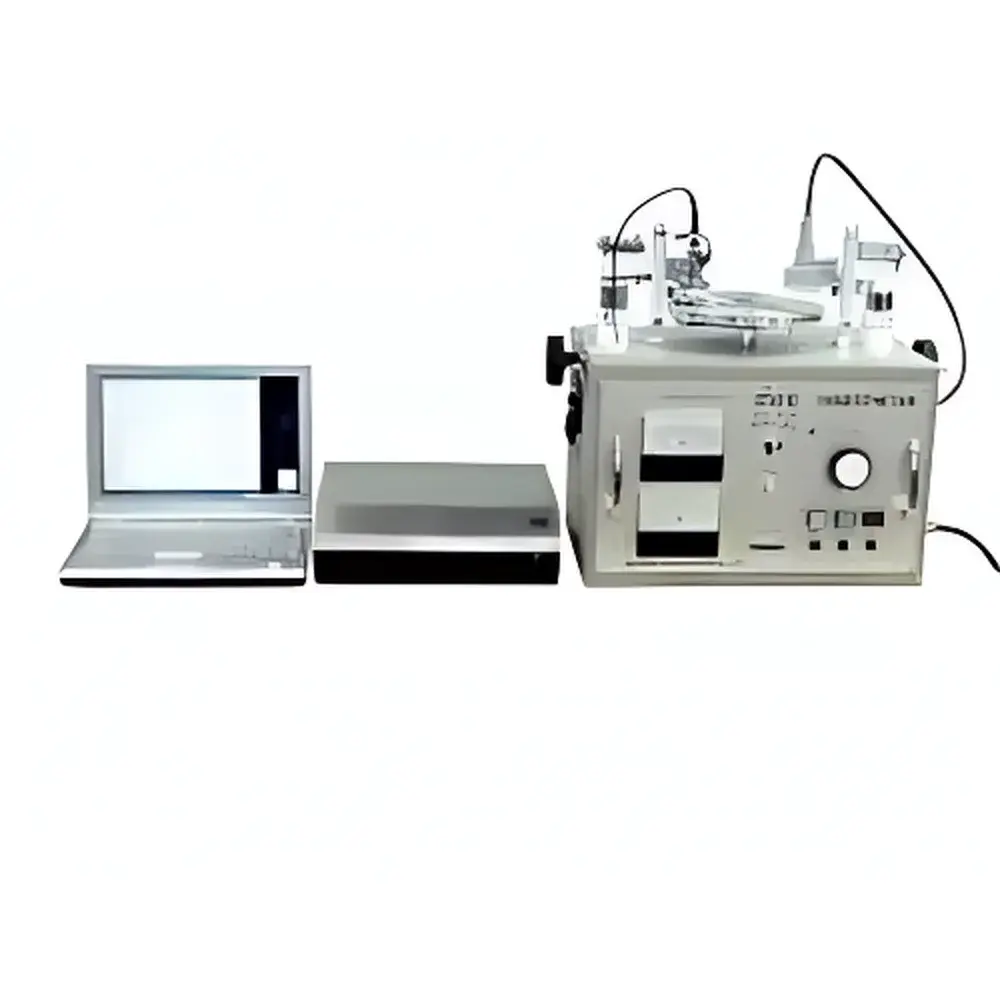
Static Honest Meter H0110/V2 Electrostatic Decay Tester (Induction-Type, for Electrostatic Propensity Assessment)
| Origin | Japan |
|---|---|
| Manufacturer Type | Authorized Distributor |
| Origin Category | Imported |
| Model | H0110/V2 |
| Pricing | Available Upon Request |
Overview
The Static Honest Meter H0110/V2 is a precision electrostatic decay tester engineered for quantitative evaluation of electrostatic dissipation behavior in thin, non-conductive materials—particularly textiles, films, fibers, and laminates. Operating on the principle of corona discharge-induced surface charging followed by real-time monitoring of voltage decay kinetics, the instrument measures the time required for surface potential to diminish to 50% of its initial value (i.e., the half-life, t1/2) under controlled environmental conditions. This decay profile serves as a fundamental metric for assessing electrostatic propensity per internationally recognized textile testing standards. The system comprises two integrated modules: the H0110/V2 high-voltage corona charging unit and the V2 electrostatic analyzer, which performs automated curve fitting, half-life computation, and data normalization. Its design adheres to core requirements of JIS L 1094 (1980), GB/T 12703, and FZ/T 01042, making it suitable for QC laboratories, R&D facilities, and certification bodies engaged in textile functional performance validation.
Key Features
- Corona-based charging system with adjustable high-voltage output (0–10 kV) for reproducible, non-contact surface ionization of diverse substrates including woven/knitted fabrics, synthetic films, carpet backing, and glass-reinforced sheets.
- V2 dedicated analyzer with single-button operation for fully automated acquisition, display, and calculation of electrostatic decay half-life (t1/2), eliminating manual curve interpretation errors.
- Configurable decay threshold setting from 2% to 100%, enabling compliance with variant test protocols beyond standard 50% criteria (e.g., for ultra-low-static or antistatic grade verification).
- Integrated environmental monitoring: automatic logging of ambient temperature (0–40 °C) and relative humidity (20–90% RH, non-condensing) synchronized with each test record.
- Flexible data visualization: independent scaling of voltage (±10 V analog output, ±1% linearity) and time axes via PC-connected software; supports overlay comparison of multiple decay curves.
- Robust mechanical architecture: cast aluminum chassis, EMI-shielded enclosure, and modular cabling (SYNC port for oscilloscope synchronization; ANALYZER port for digital signal transfer).
Sample Compatibility & Compliance
The H0110/V2 accommodates flat, flexible specimens up to 300 mm × 300 mm with thickness ≤ 5 mm—including but not limited to cotton/polyester blends, flame-retardant knits, technical geotextiles, PET film, and conductive-coated foils. Sample mounting is tool-free via magnetic clamping or optional vacuum fixture (not included). The system meets essential metrological requirements for electrostatic testing per JIS L 1094-1980 (Method A: Corona Charging), GB/T 12703.2–2014 (Electrostatic Decay Test), and FZ/T 01042–2014. While not certified to ISO/IEC 17025 out-of-the-box, its traceable HV calibration (0–3 kV CAL mode), documented measurement uncertainty (~±10% full-scale), and stable thermal management support GLP-aligned validation protocols when operated within specified environmental limits (23 ± 2 °C, 65 ± 5% RH recommended).
Software & Data Management
When connected to a Windows-based PC via USB or RS-232 interface, the V2 analyzer enables comprehensive data governance: raw decay waveforms and computed t1/2 values are saved in CSV and proprietary .SHM binary formats; timestamped folders auto-generate with embedded温湿度 metadata. Software supports batch export to Excel-compatible spreadsheets, statistical summary generation (mean, SD, CV%), and pass/fail flagging against user-defined thresholds. Audit trails include operator ID, calibration date, and environmental logs—facilitating alignment with FDA 21 CFR Part 11 readiness when deployed with validated electronic signature workflows. No cloud dependency; all data remains locally stored and encrypted at rest.
Applications
- Quality control of antistatic workwear, hospital gowns, and cleanroom garments per EN 1149-1 and IEC 61340-4-1.
- R&D screening of nanocoated fabrics, carbon-fiber hybrids, and plasma-treated textiles for charge-dissipation optimization.
- Regulatory submission support for medical device packaging (e.g., Tyvek®-lined pouches) requiring electrostatic safety documentation.
- Failure analysis of static-related defects in printing, coating, or laminating processes involving web-handled substrates.
- Comparative benchmarking of fabric finishing treatments (e.g., quaternary ammonium salts vs. polyether ester antistats) under standardized climatic conditions.
FAQ
What is the primary measurement principle of the H0110/V2?
It uses controlled corona discharge to induce surface charge, then monitors the exponential decay of surface voltage using an induction-type field meter; the half-life (t1/2) is derived from the fitted decay curve.
Does the system require periodic recalibration?
Yes—HV calibration (via CAL mode, 0–3 kV) should be verified annually using NIST-traceable electrostatic calibrators; field sensor sensitivity drift is monitored through daily zero-checks and reference sample runs.
Can the H0110/V2 test curved or three-dimensional samples?
No—it is designed exclusively for flat, planar specimens; curvature introduces field distortion and invalidates standardized decay modeling assumptions.
Is the instrument compliant with ASTM D257 or IEC 61340-2-3?
While not explicitly validated to those standards, its corona charging methodology aligns with IEC 61340-2-3 Annex B (corona-based decay testing); ASTM D257 addresses volume/surface resistivity—not decay kinetics—and thus represents a complementary, not substitutable, test method.
What power supply specifications must the lab provide?
AC 220 V ±10%, 50 Hz, 100 VA capacity; dedicated grounded outlet with surge protection is strongly recommended to ensure signal integrity and analyzer stability.
Related Products






