
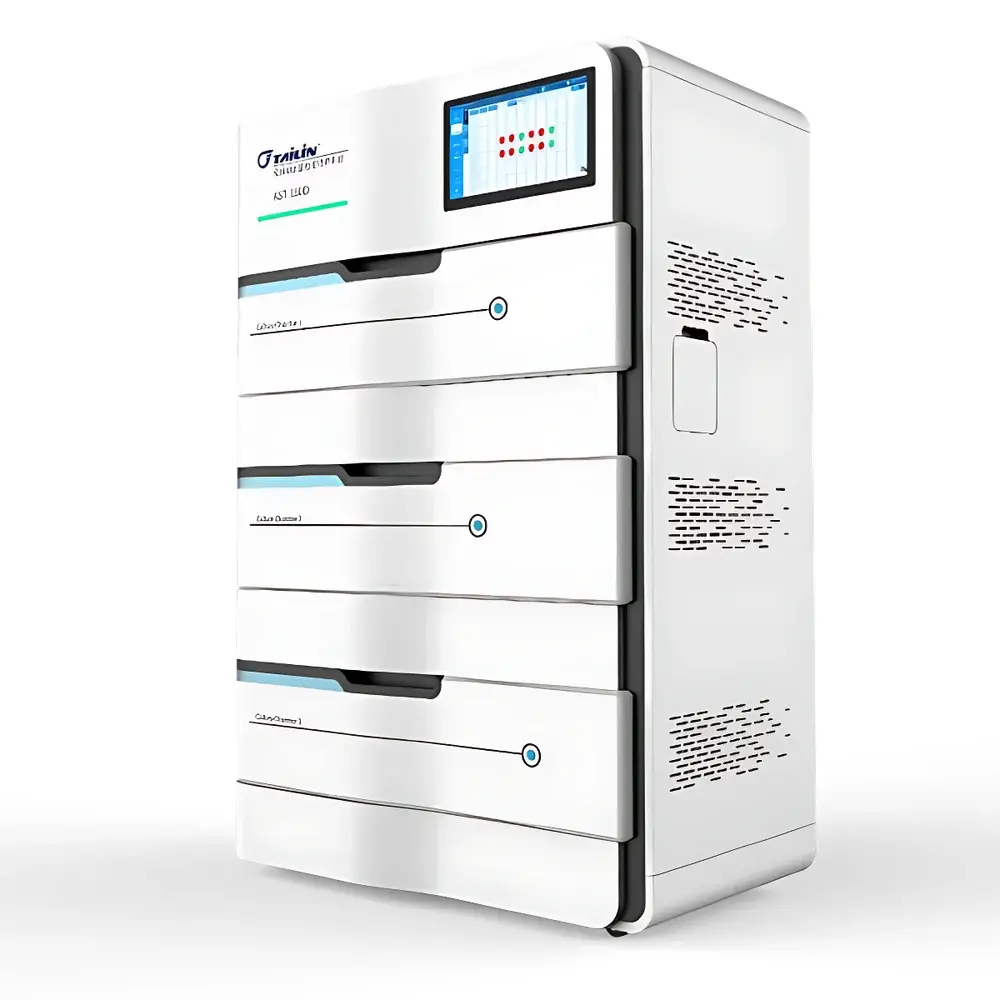
Sterile Testing Automation System AST-180D by Tailin Biotech
| Brand | Tailin Biotech |
|---|---|
| Origin | Zhejiang, China |
| Manufacturer Type | OEM Manufacturer |
| Country of Origin | China |
| Model | AST-180D |
| Pricing | Upon Request |
Overview
The Sterile Testing Automation System AST-180D is an integrated, laboratory-grade instrument engineered for automated, real-time microbial detection in pharmaceutical sterile testing applications. It operates on the physiological principle of microbial metabolic activity—specifically, CO2 generation during aerobic or facultative anaerobic respiration—which induces a pH-dependent chromogenic response in proprietary indicator sensors embedded in sterile test containers. A high-resolution, calibrated vision system continuously captures time-series images of sensor colorimetric changes and associated container QR codes, enabling traceable, position-aware data acquisition. Proprietary image analysis algorithms convert pixel-intensity gradients into quantitative growth kinetics curves, which are evaluated against statistically validated decision thresholds to determine presence/absence of viable microorganisms. Designed in alignment with pharmacopoeial requirements for sterility assurance, the AST-180D supports both direct inoculation and membrane filtration test methods per USP , EP 5.1.6, and JP 4.07. Its architecture eliminates subjective visual interpretation, reducing human error and inter-operator variability while maintaining full auditability of raw image data and algorithmic processing logs.
Key Features
- Triple independent incubation chambers with individually programmable temperature control (range: 20–40 °C, ±0.3 °C stability), supporting simultaneous static incubation and orbital shaking (50–300 rpm) for diverse microbial growth profiles.
- Optical detection module featuring industrial-grade CMOS imaging, auto-focus calibration, and LED-based uniform illumination optimized for low-noise RGB channel capture of chromogenic sensor arrays.
- Microbial detection sensitivity validated at ≤5 CFU per test unit under controlled challenge conditions, meeting verification criteria specified in USP for rapid microbiological methods.
- Fully automated workflow—from sample loading and barcode registration to kinetic curve modeling and final pass/fail classification—requiring minimal manual intervention after initial setup.
- Embedded Ethernet and optional Wi-Fi connectivity enabling remote monitoring, secure data export (CSV, PDF, XML), and integration with LIMS or MES platforms via RESTful API.
- Comprehensive electronic record system compliant with ALCOA+ principles, including user authentication, change history, and immutable audit trails aligned with FDA 21 CFR Part 11 and EU Annex 11 expectations.
Sample Compatibility & Compliance
The AST-180D accommodates standard sterile test containers (e.g., 100 mL and 200 mL vented bottles, filter funnels, and dual-chamber vials) used in direct inoculation and membrane filtration protocols. Sensor cartridges are pre-sterilized and gamma-irradiated (25 kGy), certified endotoxin-free (<0.03 EU/mL), and supplied with CoA documentation. The system has undergone formal method verification per ICH Q5C and ISO 13408-2, confirming equivalence to compendial membrane filtration procedures across Gram-positive (e.g., Bacillus subtilis), Gram-negative (e.g., Pseudomonas aeruginosa), fungal (e.g., Candida albicans), and slow-growing organisms (e.g., Mycobacterium smegmatis). All firmware and software versions are qualified under GMP-compliant IQ/OQ/PQ protocols.
Software & Data Management
Tailin’s STAS Control Suite (v3.2+) provides a role-based interface with configurable user permissions (administrator, analyst, reviewer). Raw image archives, growth curves, metadata (time stamps, chamber ID, operator ID), and algorithm parameters are stored in an encrypted SQLite database with daily automatic backup. Data export supports CSV (for statistical analysis in JMP or Minitab), PDF (signed reports with digital signature), and XML (for regulatory submission packages). Audit trail review includes filtering by event type, date range, and user; all modifications to test parameters or results require dual authorization. Software validation documentation—including risk assessment (ISO 14971), source code traceability, and regression test records—is available upon request for regulatory inspections.
Applications
The AST-180D serves as a validated alternative to traditional 14-day incubation in quality control laboratories performing sterility testing of final drug products (injectables, ophthalmics, biologics), intermediates in cell therapy manufacturing (e.g., washed leukapheresis products, cryopreserved CAR-T batches), vaccine bulk harvests, medical device extracts, and environmental monitoring isolates. It is routinely deployed in QC/QA departments of contract development and manufacturing organizations (CDMOs), academic core facilities conducting GLP-compliant safety studies, and regulatory agencies performing method equivalency assessments.
FAQ
Does the AST-180D replace compendial sterility testing per USP ?
Yes—when fully validated per USP and operated within its qualified parameters, it serves as a rapid alternative method with documented equivalence.
Can the system detect anaerobic organisms?
It detects facultative and obligate aerobes reliably; for strict anaerobes, supplemental use of anaerobic indicator formulations (available as optional kits) is recommended.
Is the software 21 CFR Part 11 compliant out-of-the-box?
Yes—the system ships with electronic signatures, audit trail logging, and access controls pre-configured to meet Part 11 technical and procedural requirements.
What maintenance is required for the optical subsystem?
Annual calibration of the imaging module and sensor illumination uniformity is recommended; no routine cleaning of optical components is needed due to sealed housing design.
How is data integrity ensured during power failure or network interruption?
All acquisitions are written to non-volatile memory prior to transmission; interrupted sessions resume automatically without data loss upon recovery.



