
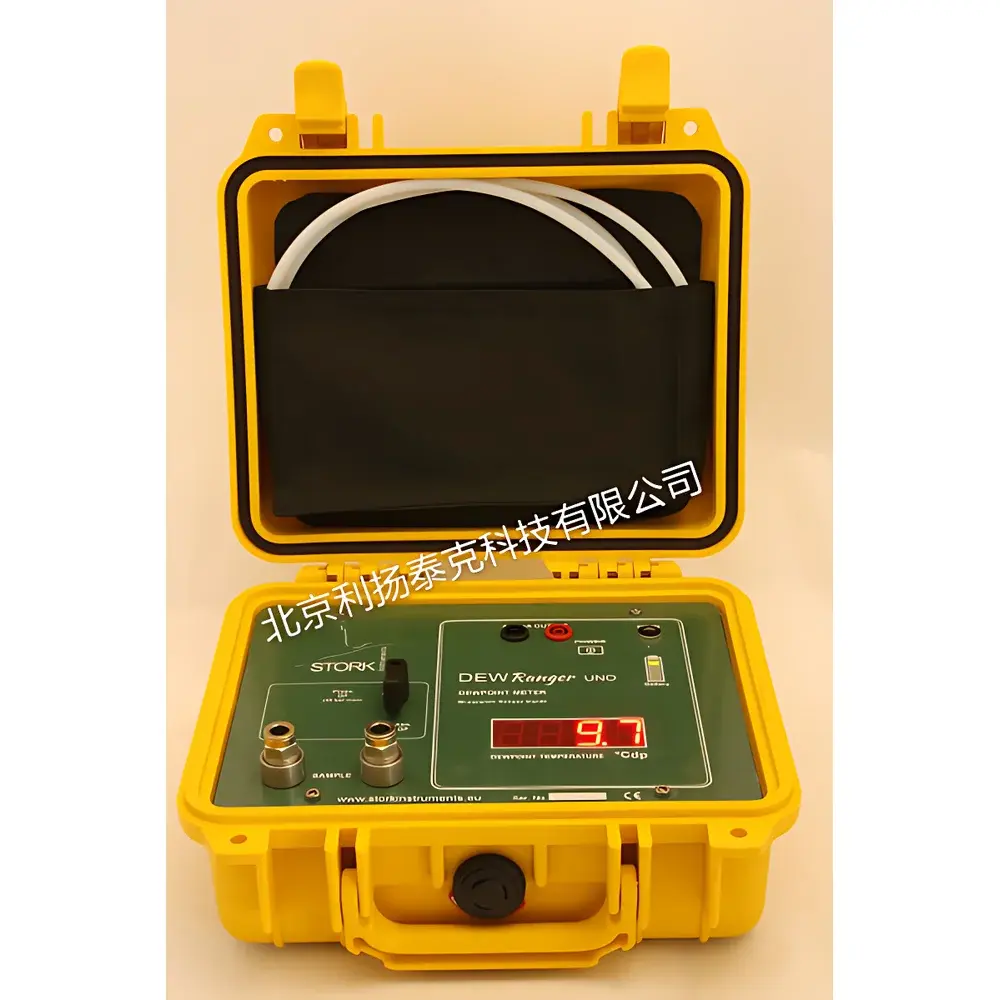
Stork DEWRanger UNO Portable Dew Point Meter
| Brand | Stork |
|---|---|
| Origin | Poland |
| Model | DEWRanger UNO |
| Product Type | Portable Dew Point Meter |
| Measurement Principle | Capacitive Sensor with Dual-Ceramic Nanofilm Technology |
| Operating Temperature | -20 °C to +50 °C |
| Accuracy | ±2 °C |
| Dew Point Range | -100 °C to +20 °C |
| Flow Rate | Up to 3 L/min |
| Pressure Rating | Max 3 MPa (Swagelok fitting) |
| Display | 4-digit LED |
| Output | 4–20 mA analog |
| Power Supply | Rechargeable Li-ion battery & AC adapter |
| Enclosure | IP67-rated yellow polypropylene housing |
| Dimensions | 270 × 125 × 250 mm |
| Weight | ~3.0 kg |
| Filter | Sintered HDPE |
| Tubing | 6 mm PTFE |
| Fitting | 6 mm quick-connect |
Overview
The Stork DEWRanger UNO is a high-performance portable dew point meter engineered for rapid, field-deployable measurement of moisture content in compressed gases and industrial process streams. It employs a proprietary dual-ceramic nanofilm capacitive sensing principle—originally pioneered by Dr. Andrew Michell at the Cavendish Laboratory, University of Cambridge—and represents a generational advancement over conventional aluminum oxide (Al₂O₃) sensors. Unlike legacy Al₂O₃-based dew point sensors—whose ~1000 nm thick hygroscopic layers suffer from slow response (particularly below -40 °C dew point) and long-term drift due to hydroxylation—the DEWRanger UNO utilizes an ultra-thin, 24 nm ceramic nanolayer architecture. This design delivers superior thermal stability across wide temperature gradients, eliminates hydration-induced calibration drift, and achieves sub-second response times even under low-humidity conditions. The instrument is calibrated traceable to international standards (NIST/UKAS equivalents) and conforms to ISO 8573-1:2010 Annex B for compressed air quality classification.
Key Features
- Dual-ceramic nanofilm capacitive sensor with 24 nm active layer thickness—enabling <1 s T₉₀ response time at -60 °C DP and exceptional long-term stability
- Extended dew point measurement range: -100 °C to +20 °C, suitable for ultra-dry applications including semiconductor purge gas, SF₆ insulation, and aerospace breathing air
- IP67-rated rugged polypropylene enclosure with integrated ergonomic handle and shock-absorbing corners—designed for repeated field use in harsh industrial environments
- Integrated sampling system: includes 6 mm Swagelok-compatible quick-connect fitting, PTFE sample tubing, and sintered HDPE particulate filter (pore size ≤5 µm)
- Simultaneous local display (4-digit LED) and isolated 4–20 mA analog output with HART compatibility for integration into SCADA or DCS systems
- Rechargeable lithium-ion battery supporting >12 hours continuous operation; auto-sleep mode extends field service life without compromising measurement readiness
Sample Compatibility & Compliance
The DEWRanger UNO is validated for use with non-corrosive, non-condensing gas matrices including nitrogen, oxygen, argon, helium, hydrogen, compressed air, natural gas, SF₆, and CO₂. It is not recommended for use with halogenated refrigerants, ammonia, or highly reactive gases without prior consultation. All units ship with a UKAS-accredited calibration certificate traceable to NPL (National Physical Laboratory) reference standards. The device complies with EN 61326-1:2013 (EMC), EN 61010-1:2010 (safety), and supports audit-ready documentation per ISO/IEC 17025:2017 laboratory requirements. Optional factory-installed validation packages include IQ/OQ documentation aligned with GMP and FDA 21 CFR Part 11 data integrity expectations.
Software & Data Management
While the DEWRanger UNO operates as a standalone field instrument, optional Stork Connect PC software enables configuration, real-time data logging (timestamped, CSV export), and firmware updates via USB-C interface. All logged measurements include metadata: ambient temperature, pressure, flow rate (if external flowmeter connected), and sensor status flags (e.g., saturation warning, low-battery alert). Audit trails are immutable and support GLP-compliant record retention. The 4–20 mA output may be interfaced with third-party historians (e.g., Siemens Desigo, Emerson DeltaV) for centralized moisture monitoring in critical utility systems.
Applications
- Petrochemical & refining: Monitoring dryness of instrument air, catalyst regeneration gas, and pipeline transmission gas per ASTM D1147 and ISO 8573-3
- Power generation: Ensuring SF₆ dielectric gas integrity in circuit breakers and GIS systems (IEC 60480 compliance)
- Pharmaceutical manufacturing: Qualifying compressed air used in sterile filling lines per ISO 8573-1 Class 2 or Class 3
- Aerospace & defense: Verifying moisture levels in aircraft pneumatic systems and avionics cooling gas per SAE AS5780
- Electronics manufacturing: Controlling purge gas dew point in semiconductor fabrication tools and glovebox environments
- Nuclear facilities: Monitoring inert gas blanket dryness in spent fuel storage and reactor coolant systems
FAQ
What is the recommended recalibration interval?
Stork recommends annual recalibration for routine industrial use; however, users operating in high-accuracy critical applications (e.g., pharmaceutical Grade A air) may perform quarterly verification using certified chilled-mirror reference standards.
Can the DEWRanger UNO measure dew point under pressure?
Yes—it measures at-line pressure up to 3 MPa. For accurate dew point reporting, users must input actual line pressure during setup; the instrument applies appropriate vapor pressure correction algorithms per IAPWS-97 formulation.
Is the sensor susceptible to silicone contamination?
The dual-ceramic nanofilm exhibits significantly higher resistance to silicone poisoning than Al₂O₃ sensors, but prolonged exposure to volatile methylsiloxanes (e.g., in compressor lubricant carryover) remains a known interference; use of coalescing pre-filters is advised.
Does it support digital communication protocols beyond 4–20 mA?
Standard configuration includes only analog output; Modbus RTU over RS-485 is available as a factory-configurable option (DEWRanger UNO-MB variant).
How is traceability documented for regulatory submissions?
Each unit ships with a unique calibration certificate listing uncertainty budget, reference standard ID, environmental conditions during calibration, and sign-off by Stork’s accredited metrology lab—fully compliant with ISO/IEC 17025 Clause 7.7.




