
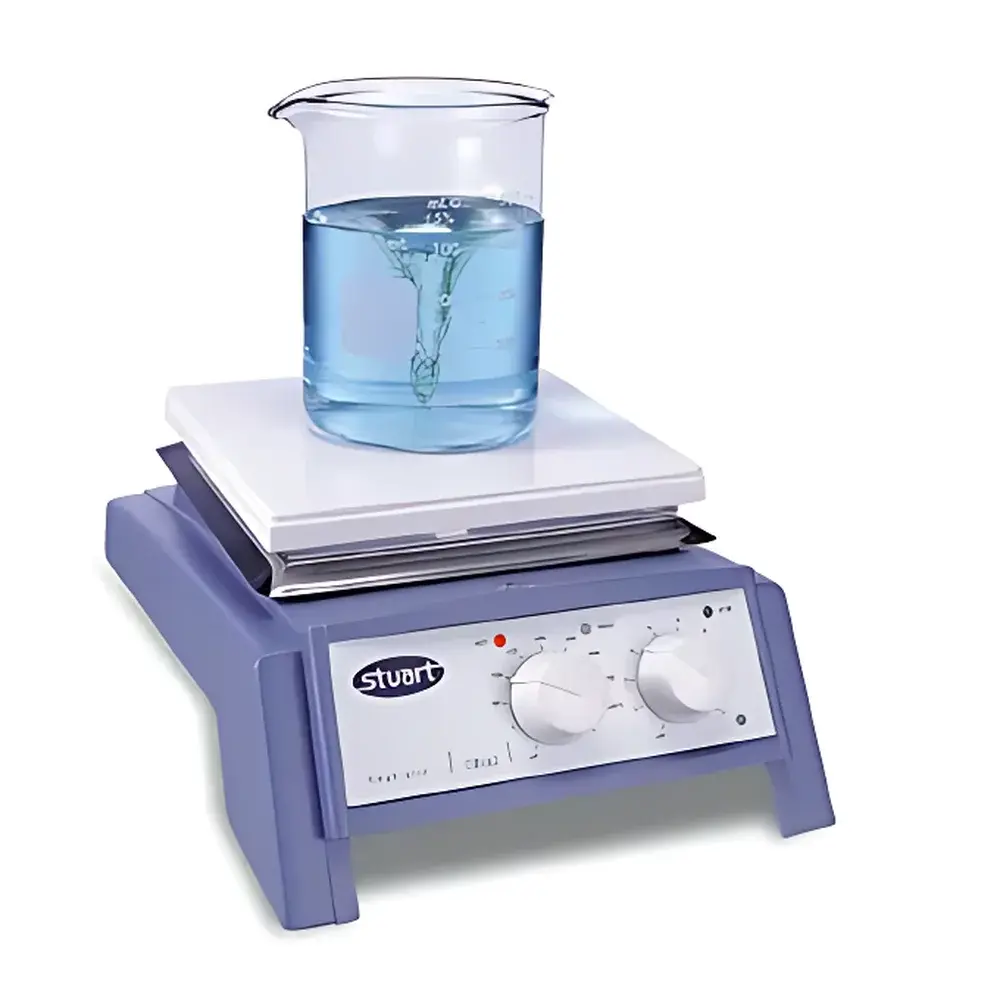
Stuart CB162/SB162/SB162-3 Heated Magnetic Stirrer
| Brand | Stuart |
|---|---|
| Origin | United Kingdom |
| Model | CB162 / SB162 / SB162-3 |
| Control Type | Analog |
| Hotplate Material | Glass-Ceramic (CB162) / Aluminum-Silicon Alloy (SB162 & SB162-3) |
| Hotplate Dimensions | 160 × 160 mm |
| Heating Area | 120 × 120 mm (CB162) / 160 × 160 mm (SB162 & SB162-3) |
| Stirring Speed Range | 100–1500 rpm |
| Max. Stirring Volume | 15 L (with standard 25 mm PTFE-coated stir bars and support stand) |
| Heating Power | 500 W (CB162) / 700 W (SB162) / 3 × 700 W (SB162-3) |
| Max. Hotplate Temperature | 450 °C (CB162) / 325 °C (SB162 & SB162-3) |
| Overall Dimensions | 190 × 300 × 110 mm (CB162 & SB162) / 600 × 270 × 110 mm (SB162-3) |
| Net Weight | 3.4 kg (CB162 & SB162) / 11 kg (SB162-3) |
| Electrical Supply | 230 V / 50 Hz |
| Max. Input Power | 750 W (CB162) / 550 W (SB162) / 2250 W (SB162-3) |
| Safety Features | Overheat Protection Circuitry, “HOT” LED Indicator (activates at >50 °C), Spill-Resistant Angled Base Design, Corrosion-Resistant Internal Electronics |
Overview
The Stuart CB162, SB162, and SB162-3 series are analog-controlled heated magnetic stirrers engineered for precision, safety, and long-term reliability in academic, industrial, and quality control laboratories. Each model employs permanent magnet coupling to drive PTFE-coated stir bars within vessels—enabling contactless mixing of liquids across a wide viscosity range without mechanical shaft penetration. The CB162 utilizes a glass-ceramic hotplate surface offering exceptional chemical resistance, thermal stability up to 450 °C, and visual thermal feedback via color-shift detection on its white matte finish. In contrast, the SB162 and SB162-3 feature aluminum-silicon alloy hotplates with superior thermal conductivity and impact resistance, delivering uniform temperature distribution across the full 160 × 160 mm heating zone at up to 325 °C. All units operate on standard 230 V / 50 Hz mains supply and integrate robust electromagnetic motor systems capable of sustaining 1500 rpm under load—validated for consistent agitation of up to 15 L volumes using recommended 25 mm stir bars and optional support stands.
Key Features
- Glass-ceramic (CB162) or corrosion-resistant aluminum-silicon alloy (SB162/SB162-3) hotplate surfaces—engineered for long-term exposure to acids, bases, solvents, and elevated temperatures
- Analog speed and temperature controls with tactile feedback—ensuring intuitive operation without software dependency or calibration drift
- Integrated overheat protection circuitry with independent thermal cutoff—compliant with IEC 61010-1 safety requirements for laboratory equipment
- “HOT” LED indicator activated automatically when surface temperature exceeds 50 °C—operational regardless of heater power state, enhancing user awareness during standby or cooldown phases
- Angled aluminum base design—directs accidental spills away from operator and electrical components, minimizing contamination risk and supporting GLP-compliant lab hygiene practices
- SB162-3 triple-position configuration—600 × 270 mm footprint accommodates three 2 L flasks simultaneously, with synchronized analog control for parallel sample processing under identical thermal and agitation conditions
Sample Compatibility & Compliance
These stirrers accommodate standard laboratory glassware—including borosilicate beakers, Erlenmeyer flasks, round-bottom flasks, and jacketed reactors—up to 2 L per position (SB162-3) or 15 L total (CB162/SB162 with appropriate support). Compatibility extends to aqueous, organic, and mildly corrosive media when paired with chemically inert PTFE- or ETFE-coated stir bars. The devices meet CE marking requirements under the Low Voltage Directive (2014/35/EU) and Electromagnetic Compatibility Directive (2014/30/EU). Their analog architecture inherently satisfies FDA 21 CFR Part 11 data integrity expectations for non-electronic record systems, and their passive safety features align with ISO/IEC 17025:2017 clause 6.4.2 regarding equipment suitability for intended use.
Software & Data Management
As fully analog instruments, the CB162, SB162, and SB162-3 do not incorporate digital interfaces, firmware, or data logging capabilities. This architecture eliminates risks associated with software validation, cybersecurity vulnerabilities, or firmware obsolescence—making them suitable for regulated environments where audit trails rely on manual logbooks or external recording systems. Users maintain full traceability through handwritten or LIMS-integrated procedural records documenting setpoints, duration, vessel type, and observed homogeneity—consistent with GMP Annex 11 and USP guidance on analytical instrument qualification.
Applications
- Buffer and reagent preparation in molecular biology and clinical diagnostics labs
- Solubility testing and dissolution profile development per USP and
- Catalyst suspension and homogeneous reaction mixture maintenance in synthetic chemistry workflows
- Standardization of titrant solutions requiring precise temperature control during mixing
- Parallel sample conditioning for ICP-OES, HPLC, or GC sample introduction protocols
- QC/QA batch release testing where reproducible agitation parameters must be documented without electronic dependencies
FAQ
What is the maximum flask size supported per position on the SB162-3?
Each of the three positions accommodates vessels up to 2 L in volume, provided appropriate support stands and stable placement are used.
Can the CB162 be used with aggressive solvents such as concentrated nitric acid?
Yes—the glass-ceramic surface resists attack from most common laboratory acids, bases, and organic solvents; however, prolonged exposure to hydrofluoric acid or molten alkalis is not recommended.
Is calibration required for analog speed or temperature settings?
No formal calibration is mandated by manufacturer specifications; however, periodic verification against traceable tachometer and surface thermocouple standards is advised per ISO/IEC 17025 internal quality procedures.
Does the “HOT” indicator remain active during power-off cooldown?
Yes—the indicator is thermally triggered and remains illuminated until the hotplate surface falls below 50 °C, irrespective of whether the unit is powered on or off.
Are replacement stir bars and support stands available as accessories?
Stuart offers a full range of PTFE-coated stir bars (5–40 mm), ceramic-core variants for high-temperature applications, and adjustable universal support stands compatible with all three models.
Related Products



