
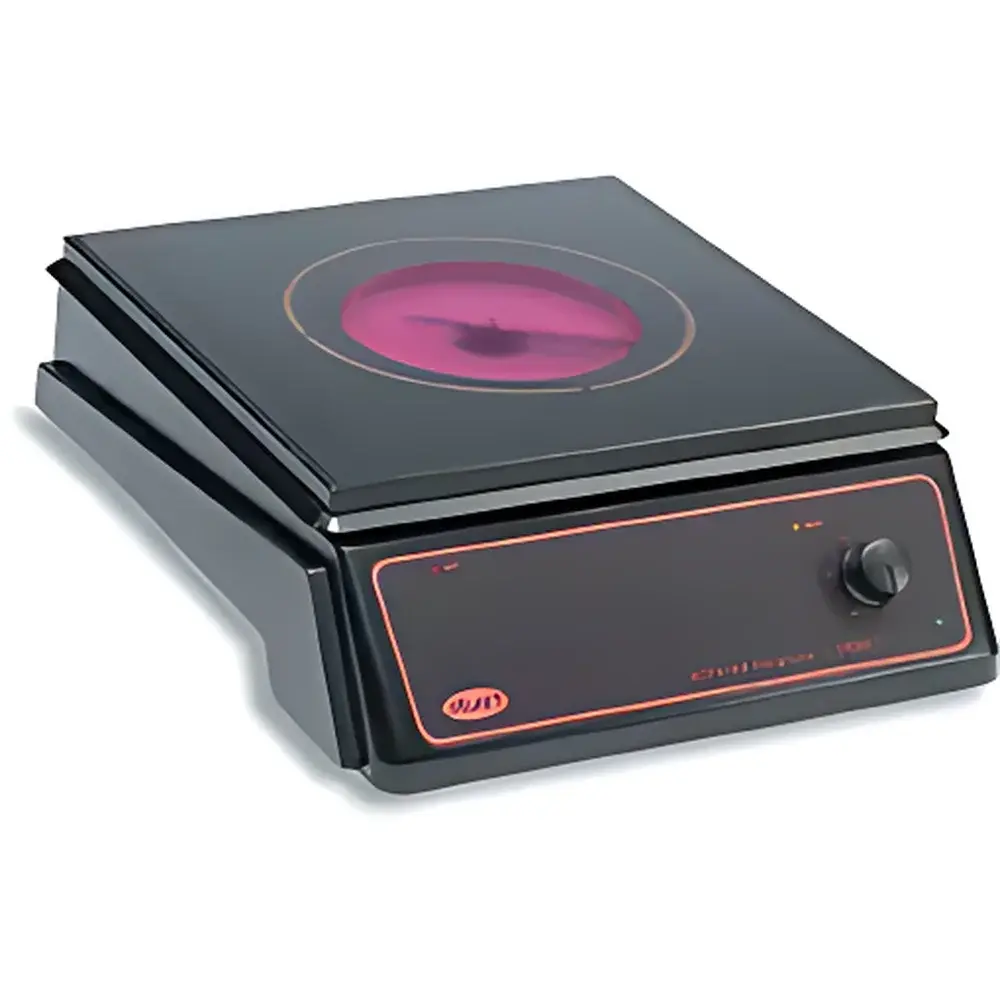
Stuart CR300 Infrared Heating Plate
| Brand | Stuart |
|---|---|
| Origin | United Kingdom |
| Model | CR300 |
| Heating Power | 900 W |
| Heating Surface Dimensions | 300 × 300 mm |
| Effective Heating Area Diameter | Ø140 mm |
| Overall Dimensions (W×D×H) | 300 × 365 × 105 mm |
| Net Weight | 4 kg |
| Heating Surface Material | Glass-Ceramic |
| Electrical Supply | 230 V / 50 Hz |
| Energy Efficiency | Up to 30% faster heating of 1 L water vs. conventional 1200 W ceramic plates |
Overview
The Stuart CR300 Infrared Heating Plate is an engineered solution for rapid, uniform, and controllable conductive-convective heating in analytical, preparatory, and routine laboratory workflows. Unlike resistive ceramic or coil-based electric plates, the CR300 employs a high-intensity infrared emitter integrated beneath a seamless glass-ceramic surface—delivering radiant energy directly to vessels and their contents with minimal thermal inertia. This architecture enables significantly reduced time-to-target temperature, particularly for volumetric samples (e.g., 1 L aqueous solutions), where comparative testing demonstrates >30% reduction in heating duration versus standard 1200 W ceramic platforms. The device operates without open coils or exposed elements, eliminating hot-spot formation and enhancing thermal homogeneity across the Ø140 mm effective zone. Designed for continuous-duty operation in ISO 17025-accredited labs and GLP-compliant environments, the CR300 supports reproducible sample preparation for digestion, evaporation, solvent removal, and reagent warming protocols.
Key Features
- 900 W infrared heating system optimized for energy efficiency and thermal responsiveness—validated for accelerated heating of up to 1 L liquid volumes
- 300 × 300 mm low-profile glass-ceramic top plate with chemical resistance to common acids (e.g., HNO₃, HCl), bases, and organic solvents; non-porous surface prevents residue absorption and simplifies decontamination
- Dual-stage safety architecture: real-time surface temperature monitoring triggers a flashing “HOT” LED indicator above 50 °C, while integrated spill detection circuitry automatically cuts power upon liquid ingress beneath the plate perimeter
- Robust mechanical design with reinforced aluminum housing and vibration-damped feet—suitable for benchtop use adjacent to sensitive instrumentation (e.g., balances, spectrometers)
- No external controller required: analog rotary dial provides intuitive, drift-free power adjustment across full 0–100% output range with tactile feedback
Sample Compatibility & Compliance
The CR300 accommodates standard laboratory glassware including borosilicate beakers (up to 2 L), Erlenmeyer flasks, digestion tubes, and stainless-steel crucibles—provided base diameters fall within the Ø140 mm active zone. Its glass-ceramic surface meets DIN EN 1870-10 mechanical impact requirements and exhibits thermal shock resistance up to ΔT = 300 K. The unit complies with IEC 61000-6-3 (EMC emission limits) and IEC 61000-6-2 (immunity to electrostatic discharge and RF fields). While not intrinsically rated for hazardous area use, its sealed construction and absence of ignition sources make it suitable for general chemistry labs operating under OSHA 1910.1200 and CLP Regulation (EC) No. 1272/2008 guidelines.
Software & Data Management
The CR300 is a standalone analog instrument with no embedded microprocessor, firmware, or digital interface—intentionally designed to eliminate software validation burdens in regulated environments. All operational parameters are manually set and verified via physical controls and visual indicators. This architecture ensures full compliance with FDA 21 CFR Part 11 requirements for “non-computerized systems,” as no electronic records, audit trails, or user access controls are generated. For laboratories maintaining electronic lab notebooks (ELN), temperature profiles may be documented externally using calibrated handheld thermometers or IR pyrometers traceable to NIST standards.
Applications
- Routine sample pre-concentration and solvent evaporation prior to ICP-MS or AAS analysis
- Controlled acid digestion of environmental soils and biological tissues per EPA Method 3050B and ISO 11466
- Pre-warming of reagents and buffers in molecular biology workflows (e.g., agarose gel preparation, enzyme activation)
- Accelerated drying of filtration membranes and gravimetric precipitates in quality control laboratories
- Heating support for reflux and distillation setups where precise, stable, and contactless thermal input is preferred over mantle heaters
FAQ
Is the CR300 compatible with temperature probes or external controllers?
No—the CR300 lacks analog/digital outputs or input ports; it is a manually operated heater. For closed-loop temperature control, users must integrate a separate PID controller with external thermocouple feedback.
Can the glass-ceramic surface withstand concentrated sulfuric acid exposure?
Short-term incidental contact (70% H₂SO₄ may cause etching. Always consult the Stuart Chemical Resistance Guide (Ref: STU-CRG-2023) before use with aggressive agents.
Does the unit include overtemperature protection beyond the “HOT” indicator?
Yes—a redundant bimetallic thermal cutoff interrupts power at 320 °C, independent of the LED circuit, preventing sustained overheating under fault conditions.
What is the expected service life under continuous 8-hour daily operation?
Based on accelerated lifetime testing per IEC 60068-2-64, the infrared emitter maintains ≥95% nominal output after 15,000 hours; glass-ceramic integrity remains unaffected by thermal cycling within specified ambient ranges (10–40 °C).



