
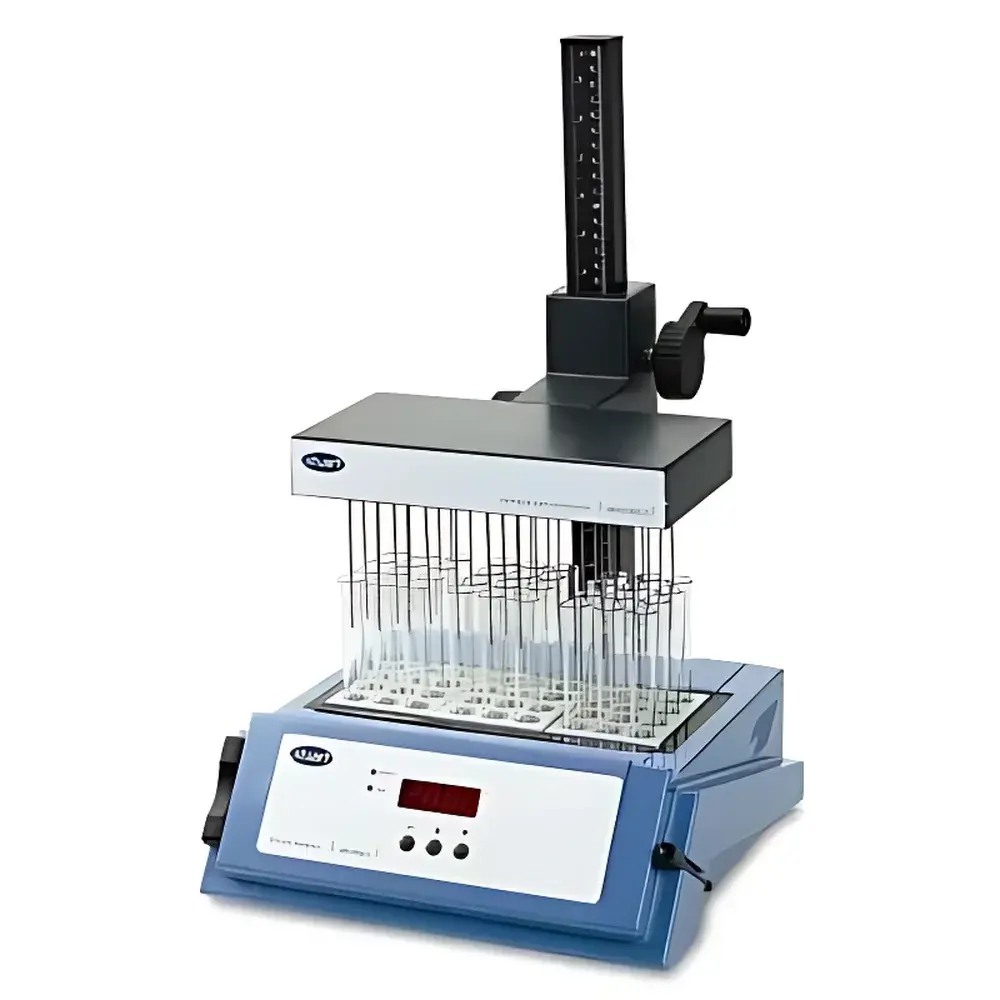
Stuart SBHCONC/1 Nitrogen Evaporator (Sample Concentrator)
| Origin | UK |
|---|---|
| Manufacturer Type | Authorized Distributor |
| Origin Category | Imported |
| Model | SBHCONC/1 |
| Pricing | Available Upon Request |
Overview
The Stuart SBHCONC/1 Nitrogen Evaporator is a precision-engineered sample concentration system designed for reproducible, gentle solvent removal from multiple samples under controlled inert gas flow and regulated thermal conditions. Operating on the principle of nitrogen-assisted evaporation—where a stream of dry, temperature-stabilized nitrogen gas is directed vertically onto the liquid surface of each sample—the instrument accelerates solvent volatilization while minimizing analyte degradation, oxidation, or cross-contamination. Unlike vacuum-based concentrators, the SBHCONC/1 maintains atmospheric pressure throughout the process, eliminating foaming or bumping risks common with volatile or viscous matrices. It is purpose-built for integration exclusively with Stuart’s three-position dry block heaters (SBH130D/3 and SBH200D/3), ensuring thermal uniformity across all sample positions and eliminating thermal drift during extended concentration cycles. The system supports standard centrifuge tube formats—including 13 mm, 15 mm, and 16 mm outer diameters—without requiring custom adapters, enabling seamless workflow continuity in analytical laboratories performing LC-MS, GC-MS, environmental residue analysis, clinical toxicology, and pharmaceutical stability testing.
Key Features
- Modular design engineered for compatibility only with Stuart SBH130D/3 and SBH200D/3 dry block heaters—ensuring mechanical alignment, thermal coupling, and operational safety.
- Adjustable stainless-steel gas delivery needles (76 mm and 127 mm options) with micrometer-height positioning for precise gas jet targeting above each sample meniscus.
- Needle height and lateral position independently adjustable per channel to accommodate varying tube lengths and fill volumes without compromising laminar gas flow.
- PTFE-coated needle variants (FSC4NCS and FSC4NCL) available for use with aggressive solvents (e.g., concentrated acids, halogenated organics) or alkaline extracts, preventing corrosion and metal leaching.
- Gas distribution manifold constructed from electropolished 316 stainless steel with integrated flow restrictors—delivering consistent, low-turbulence nitrogen flow across all 12 channels (standard configuration).
- No internal electronics or digital controls: operation relies entirely on external nitrogen supply pressure regulation (recommended 10–30 psi) and heater-set temperature—enhancing long-term reliability and simplifying validation.
Sample Compatibility & Compliance
The SBHCONC/1 accommodates common laboratory tubes up to 100 mm in height and 16 mm OD, including polypropylene and glass centrifuge tubes (e.g., Eppendorf 5424/5430, Thermo Scientific 179420, Corning 430776). Its open architecture allows direct visual monitoring of sample volume reduction and facilitates rapid tube exchange without system shutdown. From a regulatory standpoint, the device supports GLP and GMP environments by virtue of its passive, non-programmable design—eliminating software validation requirements under FDA 21 CFR Part 11. When used with calibrated dry block heaters traceable to NIST standards and documented nitrogen source specifications (e.g., ISO 8573-1 Class 2 purity), the complete setup meets method requirements outlined in EPA Method 525.3, ASTM D7066, and USP residual solvent analysis protocols.
Software & Data Management
The SBHCONC/1 operates without embedded firmware, displays, or data logging capabilities. All operational parameters—including gas pressure, heater setpoint, and exposure time—are recorded manually or via external environmental monitoring systems. This analog architecture ensures full auditability, eliminates cybersecurity vulnerabilities, and simplifies IQ/OQ/PQ execution in regulated labs. Users are advised to pair the unit with validated temperature mapping reports for the associated dry block heater and maintain logs of nitrogen supply quality certifications (moisture, oil, particulate content) as part of routine equipment qualification.
Applications
- Routine concentration of pesticide extracts prior to GC-ECD or GC-MS/MS analysis (AOAC 2007.01, EN 15662).
- Preparative cleanup of plasma, urine, or tissue homogenates in forensic toxicology workflows.
- Final solvent exchange steps in oligonucleotide synthesis and peptide purification.
- Reducing large-volume SPE eluates to microvial-ready volumes while preserving thermolabile metabolites.
- Parallel processing of up to 12 samples with identical evaporation kinetics—critical for inter-sample comparability in quantitative bioanalysis.
FAQ
Is the SBHCONC/1 compatible with heating blocks from manufacturers other than Stuart?
No. Mechanical interface tolerances, heater well geometry, and gas manifold alignment are specific to Stuart SBH130D/3 and SBH200D/3 units. Use with third-party blocks may result in misalignment, uneven heating, or gas leakage.
What nitrogen purity and pressure range is recommended?
Instrument performance is optimized with nitrogen meeting ISO 8573-1 Class 2 specifications (≤0.1 µm particles, ≤0.1 ppm oil, ≤−40 °C dew point). Supply pressure should be regulated between 10–30 psi at the inlet port.
Can the SBHCONC/1 be used under a fume hood?
Yes. The unit contains no moving parts or electrical components in the gas path and is fully compatible with standard laboratory fume hood ventilation when handling volatile or hazardous solvents.
Are replacement needles supplied sterile or individually wrapped?
Needles are supplied non-sterile in bulk packaging (100 per pack) and must be cleaned and autoclaved or chemically sterilized by the end user according to institutional biosafety protocols.
Does Stuart provide calibration certificates for the SBHCONC/1?
As a passive accessory, the SBHCONC/1 does not require calibration. However, Stuart provides dimensional verification reports and material certifications (316 SS, PTFE) upon request for IQ documentation purposes.



