
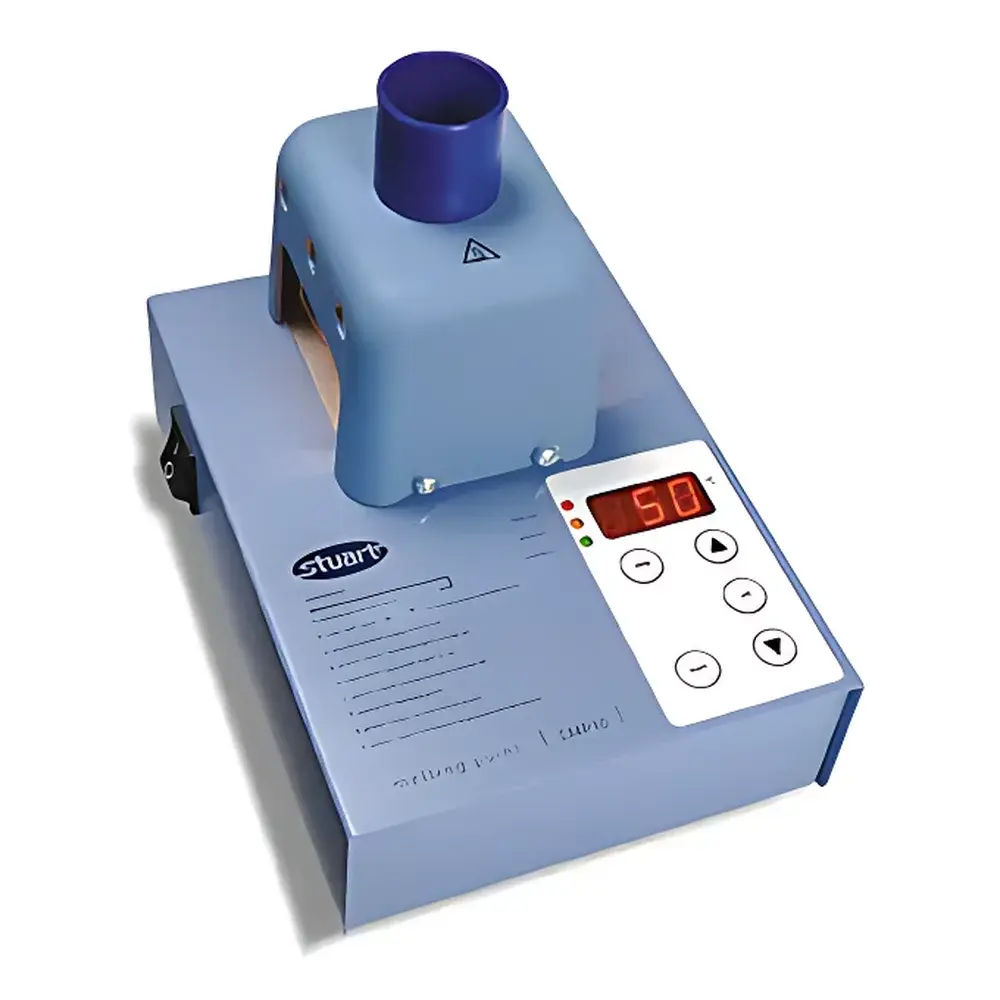
Stuart SMP10 Digital Melting Point Apparatus
| Brand | Stuart |
|---|---|
| Origin | UK |
| Model | SMP10 |
| Temperature Range | Ambient to 300 °C |
| Temperature Resolution | 1 °C |
| Accuracy | ±1.0 °C at 20 °C, ±2.5 °C at 300 °C |
| Heating Rate | 20 °C/min (pre-heat), 2 °C/min (melting determination) |
| Display | 3-digit LED |
| Sensor | PT100 platinum resistance thermometer |
| Sample Capacity | 2 capillaries simultaneously |
| Dimensions (W×D×H) | 160 × 220 × 170 mm |
| Net Weight | 1.8 kg |
| Power Supply | 230 V / 50 Hz, 75 W |
| Includes | 100 sealed-end capillary tubes (SMP10 kit) |
Overview
The Stuart SMP10 Digital Melting Point Apparatus is a benchtop thermal analysis instrument engineered for precision and repeatability in solid-state phase transition characterization. It operates on the principle of controlled-rate heating combined with direct visual observation of sample melting under magnification — a classical yet rigorously validated method aligned with pharmacopoeial standards including USP <741>, EP 2.2.14, and JP 2.60. Designed explicitly for academic laboratories, quality control units, and early-stage R&D environments, the SMP10 delivers traceable, operator-independent results without reliance on analog thermometers or subjective endpoint interpretation. Its dual-capillary configuration enables comparative analysis or replicate measurement within a single thermal cycle, supporting statistical validation per ISO/IEC 17025 requirements for calibration and testing laboratories.
Key Features
- Dual independent sample stations allow side-by-side comparison or sequential analysis of two specimens without resetting thermal parameters.
- PT100 platinum resistance thermometer ensures stable, NIST-traceable temperature sensing across the full 20–300 °C operating range.
- Programmable two-stage heating profile: rapid pre-heating (20 °C/min) to near expected melt onset, followed by precise low-rate ramping (2 °C/min) during actual melting observation — minimizing thermal lag and improving endpoint resolution.
- Ergonomic optical system featuring an extendable eyepiece tube and integrated LED illumination enhances visual clarity of crystal lattice collapse, particularly critical for polymorphic or eutectic systems.
- Three-digit LED display provides real-time, unambiguous temperature readout with 1 °C resolution — eliminating parallax error and interpolation uncertainty inherent in mercury or alcohol thermometers.
- Compact footprint (160 × 220 × 170 mm) and low power consumption (75 W) make it suitable for shared instrumentation labs and mobile teaching setups.
Sample Compatibility & Compliance
The SMP10 accepts standard 1.0 mm OD glass capillary tubes (supplied sealed at one end), compatible with ASTM E324–19 and ISO 11357-3 methodologies for melting point determination. Capillaries are manually loaded and inserted into precisely machined aluminum heating blocks ensuring uniform thermal contact. The instrument’s accuracy specification (±1.0 °C at 20 °C, ±2.5 °C at 300 °C) meets the tolerance thresholds required for educational verification, raw material identity testing, and intermediate purity screening. All components—including the heating block, lens housing, and sample stage—are fully accessible for cleaning and decontamination, supporting GLP-aligned maintenance protocols. A factory-issued calibration certificate is provided with each unit, documenting as-delivered performance against certified reference standards.
Software & Data Management
The SMP10 is a standalone, microprocessor-controlled instrument with no embedded software or data logging capability — a deliberate design choice to maximize operational simplicity, reduce qualification burden, and ensure long-term reliability in resource-constrained settings. Temperature setpoints and status indicators are managed exclusively via front-panel pushbuttons and LED feedback. While not compliant with FDA 21 CFR Part 11 out-of-the-box, its deterministic behavior, mechanical reset function, and absence of configurable user accounts or audit trails simplify IQ/OQ documentation for regulated academic or contract research facilities. Users requiring electronic record retention may integrate external digital thermographic recording via optional USB microscope attachments or third-party video capture systems synchronized with manual timestamp annotation.
Applications
- Verification of compound identity and batch-to-batch consistency in synthetic organic chemistry laboratories.
- Teaching fundamental thermal behavior concepts — polymorphism, racemate formation, and eutectic depression — in undergraduate physical chemistry and pharmaceutical sciences curricula.
- Routine QC screening of excipients, active pharmaceutical ingredients (APIs), and polymer resins prior to formulation development.
- Stability-indicating assessment of degradation onset in accelerated storage studies (e.g., ICH Q1A).
- Supporting monograph compliance for pharmacopoeial submissions where visual melting point remains a primary specification parameter.
FAQ
What capillary tube dimensions are compatible with the SMP10?
Standard 1.0 mm outer diameter × 100 mm length capillaries with one sealed end — supplied as part of the SMP10 kit (100 tubes) or available separately as SMP10/1.
Is the SMP10 suitable for measuring decomposition points?
No. The SMP10 is optimized for sharp, reversible solid–liquid transitions. Decomposition, charring, or sublimation events require differential thermal analysis (DTA) or thermogravimetric (TGA) instrumentation.
Can the heating rate be adjusted beyond the preset 2 °C/min during melting observation?
No. The dual-rate architecture is fixed: 20 °C/min for initial ramp and 2 °C/min for final melting detection. This ensures reproducibility across operators and aligns with pharmacopoeial guidance on controlled heating rates.
Does the SMP10 require annual recalibration?
Yes. While inherently stable, periodic verification using certified reference materials (e.g., pure caffeine, indium, or phenacetin) is recommended annually or after any mechanical impact or extended non-use period, per ISO/IEC 17025 Clause 6.6.
Is the instrument compatible with 115 V / 60 Hz power supplies?
No. The SMP10 is configured for 230 V / 50 Hz operation only. Use with alternative mains requires an appropriately rated isolation transformer meeting IEC 61558-2-6 safety standards.



