
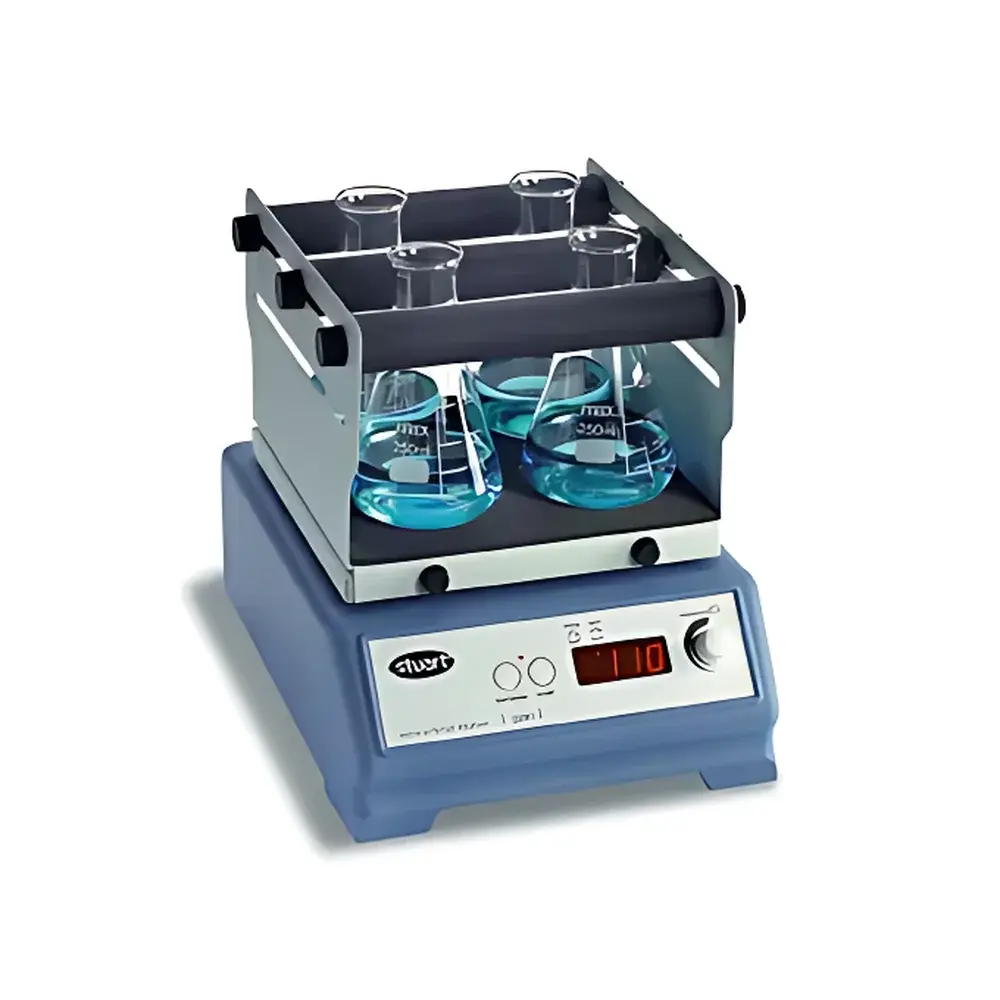
Stuart SSM1 Compact Orbital Shaker
| Brand | Stuart |
|---|---|
| Origin | United Kingdom |
| Model | SSM1 |
| Platform Dimensions (W×L) | 220 × 220 mm |
| Orbit Diameter | 16 mm |
| Speed Range | 30–300 rpm |
| Max Load Capacity | 3 kg |
| Operating Temperature Range | Ambient +4 °C to 40 °C |
| Relative Humidity Limit | ≤80% RH |
| External Dimensions (W×D×H) | 240 × 300 × 140 mm |
| Net Weight | 5 kg |
| Power Supply | 230 V / 50 Hz, 50 W |
| Timer Range | 1–999 min (with continuous mode) |
| Compliance | CE-marked, RoHS-compliant, designed for ISO 13485-aligned lab environments |
Overview
The Stuart SSM1 Compact Orbital Shaker is an engineered solution for precise, low-profile orbital agitation in controlled laboratory environments—including incubators, environmental chambers, and biosafety cabinets. Utilizing a robust eccentric drive mechanism, the SSM1 delivers smooth, uniform circular motion with a fixed 16 mm orbit diameter—optimized for consistent mixing of small-volume samples across multiwell plates, diagnostic cards, Petri dishes, and shallow culture vessels (0.5–5 mL per well). Its compact footprint (240 × 300 × 140 mm) and low thermal signature (50 W power draw) enable stable integration into temperature- and humidity-controlled enclosures up to 40 °C and 80% RH without compromising chamber integrity or sample stability. The shaker operates on a precision-machined aluminum platform with integrated anti-slip silicone matting—designed specifically to retain standard 96-well, 384-well, and microfluidic diagnostic plates during extended agitation cycles.
Key Features
- Digitally controlled speed regulation from 30 to 300 rpm, with high-resolution LED display and ±2 rpm repeatability under load
- Integrated digital timer with programmable duration (1–999 minutes) and continuous operation mode for unattended protocols
- Stainless steel-reinforced base and vibration-damped housing for long-term mechanical stability and minimal cross-unit interference
- CE-marked and RoHS-compliant construction; designed to meet general requirements for GLP-compliant instrumentation in regulated life science labs
- Modular accessory architecture supporting three optional configurations: SSM1/1 (universal bottle/balloon clamp kit), SSM1/2 (expanded 220 × 440 mm platform for dual 4×96-well plate arrays), and SSM1/3 (transparent acrylic polycarbonate enclosure for aerosol containment and visual monitoring)
Sample Compatibility & Compliance
The SSM1 accommodates a wide range of vessel formats without adapter modification: standard SBS-format microplates (96-/384-well), PCR plates, ELISA strips, diagnostic assay cards, and sterile Petri dishes (up to 100 mm diameter). With the SSM1/1 accessory kit, it supports conical flasks (4 × 250 mL, 2 × 500 mL, or 1 × 1000 mL), Erlenmeyer flasks, glass bottles, and beakers via four adjustable rubber-tipped clamping rods—each independently tensioned to ensure secure fixation across varying neck geometries and wall thicknesses. All accessories are autoclavable (121 °C, 20 min) and chemically resistant to common laboratory solvents and disinfectants. The unit complies with IEC 61010-1:2010 for electrical safety and is validated for use in Class II biological safety cabinets per NSF/ANSI 49 standards.
Software & Data Management
While the SSM1 operates as a stand-alone analog/digital hybrid instrument (no proprietary software required), its control interface supports audit-ready operational logging when integrated with external Lab Information Management Systems (LIMS) via RS-232 serial output (optional interface module available). All speed and timer settings are retained through power cycling, and the system includes non-volatile memory for up to 10 user-defined protocols. For facilities requiring 21 CFR Part 11 compliance, the SSM1/3 enclosure variant may be deployed alongside third-party electronic lab notebook (ELN) platforms to document environmental parameters, operator ID, and run timestamps—supporting traceability in QC/QA workflows aligned with ISO/IEC 17025 and FDA GMP Annex 11 expectations.
Applications
- Cell-based assays requiring gentle yet thorough reagent homogenization (e.g., cytokine ELISAs, cell viability staining)
- Immunoassay plate washing and incubation steps in clinical diagnostics laboratories
- Microbial suspension preparation for colony-forming unit (CFU) enumeration and antimicrobial susceptibility testing
- Hybridization kinetics optimization in nucleic acid probe-based detection systems
- Pre-incubation mixing of enzymatic reaction mixtures prior to thermal cycling or spectrophotometric analysis
- Long-duration kinetic studies under controlled temperature/humidity where mechanical consistency supersedes high-speed agitation
FAQ
Can the SSM1 be operated inside a CO₂ incubator?
Yes—the unit is rated for continuous operation at up to 40 °C and 80% RH, and its sealed electronics and low heat dissipation make it compatible with standard humidified CO₂ incubators. Ensure adequate airflow clearance (≥5 cm on all sides) for thermal management.
Is the anti-slip mat replaceable?
Yes—Stuart supplies replacement silicone mats (Part No. SSM1-MAT) with identical surface texture and dimensional tolerance to maintain consistent plate retention across extended use cycles.
Does the SSM1 support external triggering or remote start/stop?
Not natively; however, the optional RS-232 interface module enables TTL-level trigger input and ASCII command control for integration into automated workflow sequences.
What is the maximum allowable imbalance tolerance?
The platform is balanced to ISO 1940 Grade G6.3 at 300 rpm. Load asymmetry exceeding 150 g between quadrants may induce perceptible vibration—users are advised to distribute mass evenly across the 220 × 220 mm surface.
Are calibration certificates available?
Factory calibration reports (speed and timer accuracy) are provided with each unit. UKAS-accredited calibration services are available through Stuart’s authorized service partners upon request.




