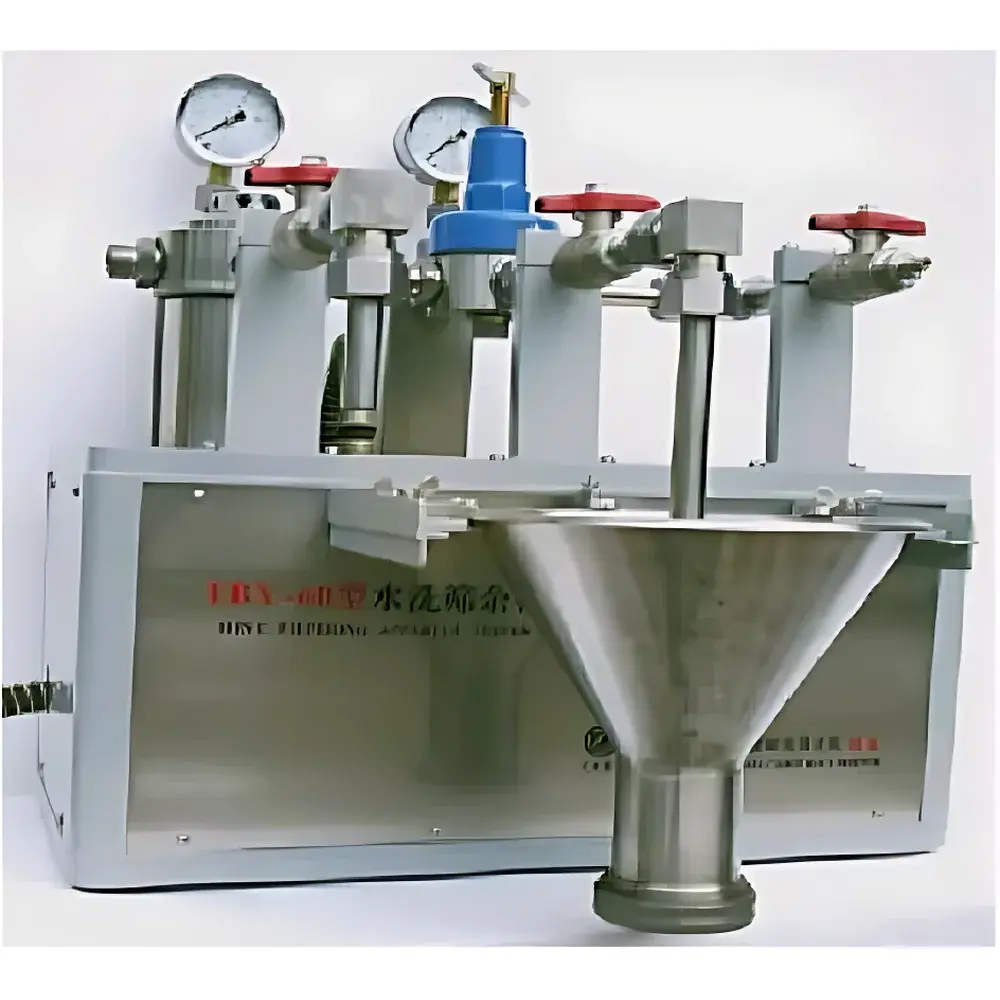
SUERC TBY-60 Carbon Black Dispersion & Wash Sieve Residue Analyzer
| Brand | SUERC |
|---|---|
| Origin | Beijing, China |
| Model | TBY-60 |
| Operating Pressure Range | 0.1–0.5 MPa ±0.05 MPa |
| Max Operating Temperature | ≤75 °C |
| Standard Sieve Mesh Sizes | 35 mesh (500 µm), 100 mesh (150 µm), 325 mesh (45 µm) |
| Power Supply | AC 220 V, 50 Hz, 300 VA |
| Dimensions | 440 × 450 × 480 mm |
| Weight | 25 kg |
| Compliance | ASTM D1514–80 (referenced design equivalence) |
Overview
The SUERC TBY-60 Carbon Black Dispersion & Wash Sieve Residue Analyzer is a precision-engineered benchtop instrument designed for quantitative assessment of coarse particle contamination in carbon black, precipitated silica (white carbon black), and other fine industrial powders. It operates on the principle of pressurized aqueous suspension followed by controlled filtration through standardized stainless-steel sieve plates—directly aligned with the methodology outlined in ASTM D1514–80 for sieve residue determination in carbon black. Unlike conventional gravity-fed or manual wash systems, the TBY-60 integrates a self-regulating hydraulic pressure delivery system, enabling consistent, repeatable wash flow rates across multiple sieve sizes without operator-dependent variables. Its compact footprint (25% of the reference ASTM apparatus volume) and factory-calibrated configuration reduce installation overhead and eliminate on-site commissioning delays. The device is purpose-built for rubber and plastics compounders, quality control laboratories, and raw material suppliers requiring traceable, reproducible quantification of oversize particles that impact dispersion homogeneity, vulcanization kinetics, and final product mechanical performance.
Key Features
- Integrated self-contained hydraulic system featuring a stainless-steel water filter assembly with three-stage filtration (coarse/medium/fine), including an integrated drain port for automatic removal of particulate > coarse mesh size
- Spring-loaded, direct-acting pressure regulator delivering stable 0.1–0.5 MPa output with ±0.05 MPa accuracy—ensuring uniform wash force across all test cycles
- Internally mounted helical-flow spray nozzles positioned within the feed line to generate turbulent, non-obstructive rinse patterns directly onto the sieve surface
- Modular, reinforced composite sieve plate holder accommodating interchangeable 35 mesh (500 µm), 100 mesh (150 µm), and 325 mesh (45 µm) stainless-steel woven wire meshes—designed to maintain dimensional stability under repeated thermal and hydraulic stress
- Full electrical safety compliance: CE-marked power module (AC 220 V, 50 Hz, 300 VA), IP20 enclosure rating, and redundant fuse protection (4× spare fuses supplied)
- Pre-assembled and functionally validated at factory; requires only connection to potable water supply and standard mains power for immediate operation
Sample Compatibility & Compliance
The TBY-60 is validated for use with carbon black grades (N110–N990 series), precipitated hydrated silica (e.g., Ultrasil®, Zeosil®), and general-purpose inorganic and organic pigment powders. It supports ASTM D1514–80-compliant testing protocols and aligns with ISO 4618 (pigments and extenders — determination of residue on sieve) for comparative analysis. While not a GLP/GMP-certified instrument per se, its deterministic pressure regulation, fixed geometry, and documented calibration traceability support audit-ready documentation when used within controlled QC environments. The unit’s construction—stainless-steel wetted parts, non-reactive polymer housing, and sealed electronics—ensures compatibility with water-based suspensions and eliminates cross-contamination risks between sample batches. All sieve plates conform to ISO 3310-1:2016 tolerances for woven metal wire cloth.
Software & Data Management
The TBY-60 is a hardware-only analytical platform with no embedded firmware or digital interface. All operational parameters—including pressure setpoint, wash duration, and sieve selection—are manually configured and recorded externally. This architecture ensures long-term reliability, immunity to software obsolescence, and full compliance with facilities operating under strict validation regimes where uncontrolled code changes are prohibited. Users are expected to log test conditions, sieve mass before/after washing, and calculated residue percentages using laboratory notebooks or LIMS-integrated spreadsheets. For laboratories subject to FDA 21 CFR Part 11 requirements, external documentation workflows must incorporate electronic signature controls, audit trails, and version-controlled SOPs—none of which reside within the instrument itself.
Applications
- Quantitative evaluation of carbon black agglomerate content prior to masterbatch production
- Batch release testing of precipitated silica for tire tread compounds, where >45 µm particles impair rolling resistance and wear performance
- Raw material acceptance testing for pigment dispersions in rubber compounding, especially where coarse fractions induce scorch sensitivity or surface defects
- Process troubleshooting in high-shear mixing lines—correlating sieve residue trends with mill rotor speed, temperature profiles, or residence time
- Technical service support for OEMs validating supplier-grade carbon black against internal specifications (e.g., ≤0.05% residue on 325 mesh)
- Method transfer studies between R&D labs and contract manufacturing sites requiring identical physical separation mechanics
FAQ
Does the TBY-60 require calibration certification or annual recalibration?
No formal calibration certificate is issued, as the instrument relies on mechanical pressure regulation and standardized sieve geometry rather than sensor-based measurement. Users should verify pressure gauge accuracy annually using a traceable deadweight tester and inspect sieve plates for deformation or blinding before each use.
Can custom sieve meshes be installed beyond the standard 35/100/325 options?
Yes—any ISO 3310-1 compliant stainless-steel woven mesh up to 400 mm diameter may be fitted, provided the mounting flange dimensions match the TBY-60’s 120 mm clamping interface.
Is the unit suitable for organic solvents or acidic wash media?
No. The TBY-60 is engineered exclusively for aqueous suspensions. Exposure to solvents, acids, or caustics will compromise seal integrity and stainless-steel filter components.
What maintenance intervals are recommended for the water filtration system?
The three-stage filter cartridges should be inspected after every 20 test cycles and replaced if visible particulate accumulation exceeds 30% of the coarse screen area—or immediately following any pressure drop exceeding 0.08 MPa across the filter assembly.
How does the TBY-60 compare to vacuum-assisted sieve analyzers?
Unlike vacuum-driven systems, the TBY-60 applies positive pressure to drive suspension through the sieve—minimizing particle re-agglomeration and ensuring representative retention of fragile agglomerates that might disintegrate under suction. This yields higher fidelity for dispersion quality assessment in elastomer applications.