
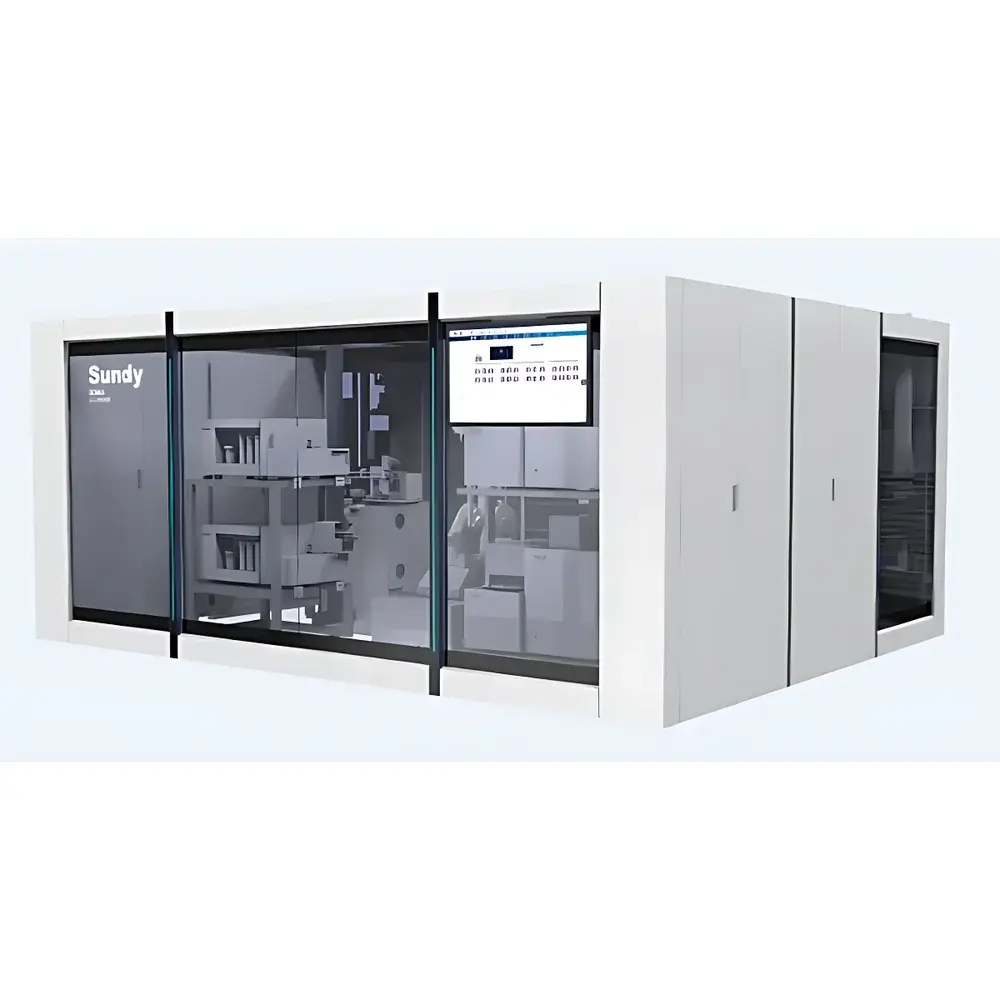
Sundhy SDIAS Series Fully Automated Coal Analysis System
| Brand | Sundhy |
|---|---|
| Origin | Hunan, China |
| Manufacturer Type | Authorized Distributor |
| Origin Category | Domestic |
| Model | SDIAS |
| Pricing | Available Upon Request |
Overview
The Sundhy SDIAS Series Fully Automated Coal Analysis System is an integrated, robotics-driven laboratory platform engineered for end-to-end unattended coal quality testing in high-throughput industrial and regulatory environments. Based on standardized gravimetric, calorimetric, thermogravimetric, and combustion-based elemental analysis principles, the system executes sequential ASTM D5865 (gross calorific value), ASTM D3176 (ultimate analysis), ASTM D3172 (proximate analysis), and ISO 1928, ISO 562, ISO 331, ISO 1171, and ISO 10153–compliant methodologies—fully aligned with GB/T 212, GB/T 213, GB/T 214, GB/T 30733, GB/T 483, and GB/T 3715. The system integrates robotic sample handling, precision microbalance weighing, automated crucible conditioning (cleaning, drying, ashing), controlled combustion modules (oxygen/nitrogen/helium/air gas management), and synchronized data acquisition—all orchestrated via a deterministic real-time control architecture. Designed for continuous 24/7 operation in power plants, coal trading centers, metallurgical QA labs, and third-party certification facilities, SDIAS eliminates manual intervention while maintaining metrological traceability to national standards.
Key Features
- Fully autonomous workflow: Sample bottle agitation → lid opening → robotic weighing → crucible loading → thermal conditioning → combustion analysis → post-run crucible cleaning/ashing → data validation and reporting
- Dual-arm collaborative robot with ISO 12642–compliant repeatability (±0.05 mm) and payload capacity (≥5 kg), operating within a Class 10,000 clean enclosure with localized fume extraction per module
- Modular instrumentation architecture: Interchangeable, hot-swappable analyzers—including oxygen bomb calorimeters, proximate analyzers (TGA-based), and CHN/O/S elemental analyzers—each certified to relevant ISO/GB performance specifications
- Redundant subsystem design: Independent pneumatic, gas, and power domains ensure continued operation of unaffected modules during single-point failure (e.g., robotic arm downtime does not halt calorimeter throughput)
- Real-time visual monitoring: Integrated HD machine vision system with timestamped video logging synchronized to analytical events; all operations visible via secure web interface with role-based access control
- Comprehensive safety interlocks: Light curtain perimeter protection, emergency stop cascading across all motion axes, collision detection with <5 ms response latency, and automatic shutdown upon unauthorized entry into robotic workcell
Sample Compatibility & Compliance
SDIAS accepts standard coal sample bottles (Φ40 × 80 mm) containing 0.5–1.5 g pulverized coal (≤200 mesh, air-dried basis). The system complies with GLP and GMP-aligned operational protocols, supporting full audit trails per FDA 21 CFR Part 11 requirements—including electronic signatures, immutable result history, and change-controlled software versioning. All analytical outputs meet statutory reporting thresholds for commercial coal settlement under Chinese National Energy Administration (NEA) directives and international trade contracts (e.g., FOB/CIF coal quality clauses). Gas supply compliance includes verified O2 (≥99.99%, 6 L/min @ 3.0 ± 0.1 MPa), N2 (≥99.9%, 8 L/min @ 0.3 ± 0.01 MPa), He (≥99.999%, 0.3 ± 0.01 MPa), and oil-free, desiccated compressed air (≥120 L/min @ ≥0.6 MPa).
Software & Data Management
The SDIAS Control Suite is a Windows-based SCADA-grade application built on Microsoft .NET Framework with SQL Server backend. It provides configurable test sequences, dynamic calibration scheduling, instrument health diagnostics, and automated report generation in PDF/XLSX formats compliant with ISO/IEC 17025 Annex A.5. Raw sensor data (mass, temperature, pressure, gas flow) are logged at ≥10 Hz resolution with hardware-timestamped metadata. Data export supports OPC UA, MQTT, and RESTful API interfaces for seamless integration into LIMS (e.g., Thermo Fisher SampleManager, LabVantage), ERP (SAP S/4HANA), and digital twin platforms. Audit logs record every user action, instrument state transition, and calibration event with cryptographic hashing for forensic integrity verification.
Applications
- Coal quality arbitration in power generation and cement manufacturing
- Automated QA/QC for coal blending optimization in coking plants
- Regulatory compliance testing for environmental reporting (SOx, NOx precursor quantification)
- Research-grade coal characterization in university energy laboratories
- Third-party verification for international coal trade (ASTM/ISO cross-referenced certificates)
- Integration with automated sampling (ISO 13909) and sample preparation systems (ISO 18283) to enable full “mine-to-report” digital chain traceability
FAQ
What is the maximum sample throughput under standard configuration?
Up to 80 coal samples per 8-hour shift for full proximate + ultimate + calorific analysis, assuming dual-calorimeter + triple-proximate + dual-element analyzer configuration.
Can SDIAS operate without climate-controlled laboratory infrastructure?
Yes—the system requires only ambient temperature stability within 20–24 °C (±0.5 °C/h drift) and 30–75 %RH; no dedicated HVAC is mandated beyond standard industrial lab conditions.
Is manual override supported during robotic malfunction?
Yes—each analytical module (calorimeter, proximate analyzer, element analyzer) retains independent local HMI and manual loading capability, ensuring continuity of certified testing even during robotic subsystem downtime.
How is data integrity ensured for commercial settlement use?
All results include embedded digital signatures, NIST-traceable calibration certificate references, raw sensor time-series archives, and immutable audit logs meeting NEA Document No. 2022-17 and ISO/IEC 17025:2017 clause 7.11 requirements.
Does SDIAS support remote diagnostics and preventive maintenance scheduling?
Yes—embedded Telematics Agent enables encrypted remote monitoring, predictive failure modeling using vibration/thermal trend analytics, and automated spare-part provisioning alerts based on component lifecycle counters.





