
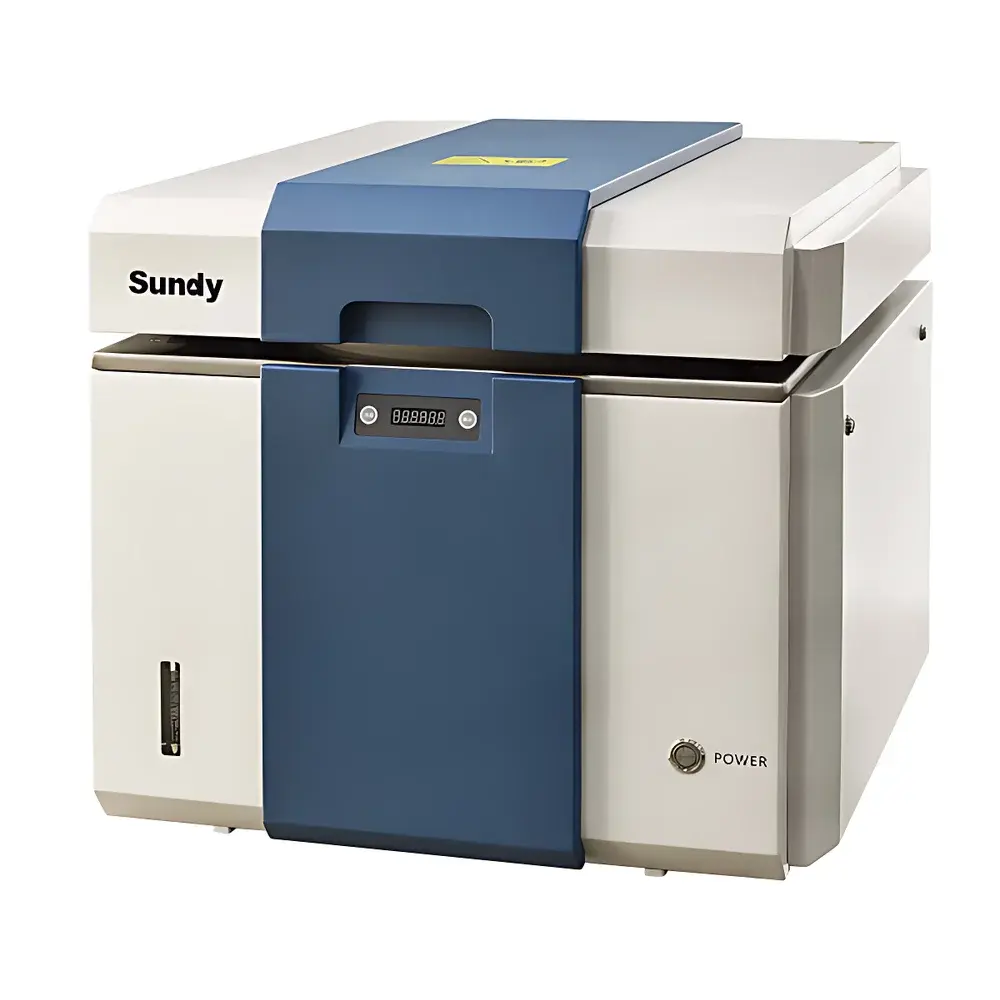
Sundhy SDLOI2000 Thermogravimetric Loss-on-Ignition Analyzer
| Brand | Sundhy |
|---|---|
| Origin | Hunan, China |
| Model | SDLOI2000 |
| Sample Capacity | 20 positions |
| Sample Mass Range | 0.1–10 g (user-definable) |
| Temperature Range | Ambient to 1050 °C |
| Temperature Control Accuracy | ±2 °C |
| Balance Resolution | 0.0001 g |
| Maximum Power Consumption | 4 kW |
| Dimensions (L×W×H) | 550 × 590 × 530 mm |
| Net Weight | ~70 kg |
| Power Supply | AC 220 V ±10 %, 50 Hz ±1 Hz |
Overview
The Sundhy SDLOI2000 Thermogravimetric Loss-on-Ignition Analyzer is an automated, high-precision instrument engineered for standardized determination of mass loss upon controlled thermal treatment—commonly referred to as loss on ignition (LOI) or thermogravimetric灼减 analysis. It operates on the fundamental principle of sequential gravimetric measurement before and after programmed heating in a muffle furnace environment, enabling quantification of volatile components, moisture, carbonates, hydroxides, organic matter, and other thermally labile species. Designed specifically for routine quality control and compositional analysis in metallurgical, cementitious, and mineral processing laboratories, the SDLOI2000 integrates precision microbalance technology with programmable furnace control and automated handling to deliver repeatable, traceable, and standards-compliant results without manual intervention during the thermal cycle.
Key Features
- Fully automated operation: motorized lid actuation, auto-taring, and sequential sample weighing before and after thermal treatment—eliminating operator-induced variability.
- 20-position sample carousel enables unattended batch processing; users load all samples at once and define individual thermal profiles per position.
- Programmable temperature ramping and isothermal hold stages support multi-step thermal protocols—including moisture drying (e.g., 105 °C), carbonate decomposition (e.g., 950 °C), and high-temperature ashing (up to 1050 °C).
- Dual-display interface: integrated external balance display mounted on the front panel provides real-time mass readout during weighing; main touchscreen displays furnace status, time-temperature profile, and live weight curve.
- Intelligent thermogravimetric decision logic: dynamically monitors mass change rate (dm/dt) during heating to determine endpoint stability, reducing unnecessary dwell time while ensuring full decomposition compliance.
- Active cooling assistance: automatic lid opening post-analysis accelerates heat dissipation, minimizing turnaround time between batches without compromising furnace longevity.
Sample Compatibility & Compliance
The SDLOI2000 is validated for quantitative LOI analysis across diverse inorganic matrices, including alumina (Al₂O₃), cryolite (Na₃AlF₆), aluminum fluoride (AlF₃), iron ores, lateritic nickel ores, Portland cements, limestone (CaCO₃), and dolomite (CaMg(CO₃)₂). Its operational methodology aligns strictly with internationally recognized standard test methods: GB/T 6609.2–2022 (alumina, 300 °C and 1000 °C mass loss), GB/T 6730.68–2009 (iron ore, gravimetric LOI), GB/T 176–2017 (cement LOI), YS/T 820.26–2012 (lateritic nickel ore), and GB/T 3286.8–2014 (limestone/dolomite). While not certified to ISO/IEC 17025 or GLP out-of-the-box, the system supports audit-ready data logging—including timestamped weight values, temperature setpoints, actual furnace temperatures, and user-defined method IDs—facilitating internal validation and regulatory alignment under ISO 9001 or GMP-aligned QA frameworks.
Software & Data Management
The embedded firmware provides intuitive method creation via touchscreen interface, supporting up to 99 customizable thermal programs with independent ramp rates, target temperatures, hold durations, and stabilization criteria. All raw and processed data—including initial mass, final mass, calculated LOI (%), and intermediate weight readings—are stored locally in CSV format with UTC timestamps. Export is supported via USB port; no cloud connectivity or proprietary software installation is required. Audit trail functionality records user login events, method modifications, and result exports—enabling partial compliance with FDA 21 CFR Part 11 requirements when paired with institutional electronic signature policies and access controls.
Applications
- Quality assurance of alumina feedstock in aluminum smelting: monitoring residual fluorides and hydrates affecting electrolytic cell efficiency.
- Metallurgical grade iron ore evaluation: quantifying LOI as proxy for gangue content, moisture, and carbonate impurities prior to sintering or pelletizing.
- Cement clinker and blended cement certification: verifying conformity to ASTM C114 or GB/T 176–2017 specifications for burnability and fineness-related reactivity.
- Lime production control: determining calcination completeness in limestone and dolomite processing lines.
- Environmental solid waste characterization: estimating organic carbon content in fly ash, sludge, or incinerator residues per EPA Method 9081 or equivalent.
FAQ
What standards does the SDLOI2000 directly support?
It implements the procedural logic and reporting structure of GB/T 6609.2–2022, GB/T 6730.68–2009, GB/T 176–2017, YS/T 820.26–2012, and GB/T 3286.8–2014—including automatic calculation of LOI percentage and pass/fail flags based on user-input specification limits.
Can the instrument perform non-standard thermal profiling?
Yes—users may define custom temperature ramps, multi-stage holds, and dynamic endpoint detection thresholds beyond those specified in published standards.
Is calibration traceability provided?
The integrated analytical balance is factory-calibrated using NIST-traceable weights; users are responsible for periodic verification and adjustment per internal SOPs or ISO/IEC 17025 requirements.
What maintenance is required for long-term reliability?
Recommended practices include quarterly cleaning of furnace chamber and crucible holder, annual verification of thermocouple accuracy against reference standards, and biannual inspection of lid actuator mechanism and balance draft shield integrity.
Does the system support LIMS integration?
Raw data export in CSV format allows manual import into most LIMS platforms; direct API or HL7 connectivity is not available in the base configuration.





