
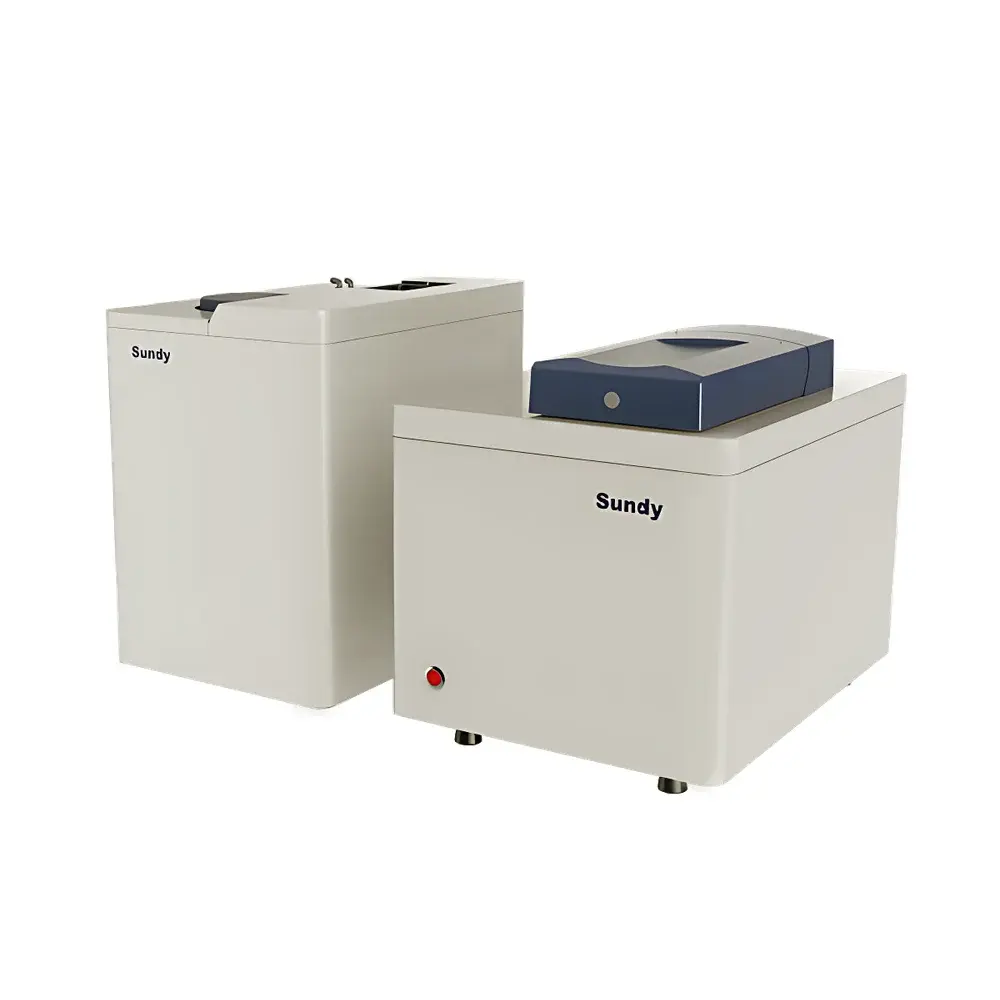
Sundy SDACM3200 Isoperibolic Oxygen Bomb Calorimeter
| Brand | Sundy |
|---|---|
| Origin | Hunan, China |
| Model | SDACM3200 |
| Measurement Mode | Isoperibolic Calorimetry |
| Instrument Type | Oxygen Bomb Calorimeter |
| Temperature Resolution | 0.0001 °C |
| Thermal Capacity Stability | ≤0.25% over 3 months |
| Thermal Capacity Precision | ≤0.15% RSD |
| Single Test Duration | ≤15 min |
| External Jacket Temperature Drift | <0.1 °C per test |
| Max Power Consumption | 0.15 kW |
| Supply Voltage | AC 220 V ±10%, 50 Hz ±1 Hz |
| Dimensions (Main Unit) | 500 × 600 × 425 mm |
| Weight (Main Unit) | ~65 kg |
| Water Jacket Dimensions | 550 × 356 × 520 mm |
| Water Jacket Weight | ~17.5 kg |
| Compliance | GB/T 213–2008, GB/T 384–1981, GB/T 30727–2014, ASTM D5865–2007, ISO 1928–2009, JC/T 1005–2006 |
Overview
The Sundy SDACM3200 Isoperibolic Oxygen Bomb Calorimeter is a precision-engineered instrument designed for accurate and reproducible determination of gross calorific value (GCV) in solid and liquid combustible materials. Based on the principle of isoperibolic calorimetry—where the outer water jacket temperature remains nearly constant during combustion—the system measures heat release via high-resolution temperature tracking of the inner water bath surrounding the oxygen bomb. This architecture ensures minimal thermal lag and enhanced baseline stability, critical for compliance with international standard methods requiring strict control of jacket temperature drift (<0.1 °C per test). The SDACM3200 meets the thermodynamic and procedural requirements of major regulatory frameworks including ASTM D5865–2007, ISO 1928–2009, and GB/T 213–2008, making it suitable for accredited laboratories operating under GLP or ISO/IEC 17025 quality systems.
Key Features
- Isoperibolic thermal design with large-volume water jacket (≥20 L), ensuring external temperature variation remains below 0.1 °C per test—exceeding minimum requirements specified in ISO 1928 and GB/T 213.
- Automated water handling: integrated temperature adjustment, volumetric water dosing, and total mass verification prior to ignition—eliminating manual calibration errors and operator dependency.
- High-stability thermistor-based temperature sensing with 0.0001 °C resolution, enabling precise integration of the temperature-time curve for calorimetric calculation.
- Self-diagnostic firmware with real-time fault detection, automatic safety shutdown, and condition-based error logging—supporting traceable instrument health monitoring.
- Hardware-based data acquisition: all thermal and timing parameters are acquired directly from calibrated sensors; no post-acquisition software correction or algorithmic compensation is applied to raw test results.
- Modular mechanical configuration: supports both benchtop and upright installation layouts, accommodating space-constrained labs or high-throughput workflows without structural modification.
Sample Compatibility & Compliance
The SDACM3200 is validated for use with heterogeneous, high-ash, and high-moisture samples common in energy and environmental testing—including bituminous coal, coke, petroleum products, solid biomass fuels (e.g., wood pellets, agricultural residues), cement raw meal (black feed), and selected solid hazardous wastes. Its robust oxygen bomb assembly (rated to 30 MPa) and corrosion-resistant inner vessel ensure long-term reliability when analyzing sulfur- or chlorine-rich matrices. Regulatory alignment includes full method equivalence with ASTM D5865 (coal and coke), ISO 1928 (solid mineral fuels), GB/T 30727 (biomass), and JC/T 1005 (cement black feed). All calibration and verification procedures adhere to documented SOPs compatible with FDA 21 CFR Part 11 audit trails when paired with compliant LIMS integration.
Software & Data Management
The embedded control software provides real-time graphical display of temperature rise, combustion profile, and thermal equilibrium detection. Data export supports CSV, XML, and PDF formats with embedded metadata (operator ID, sample ID, calibration certificate number, ambient conditions). Audit-ready features include electronic signatures, immutable test logs, and version-controlled method templates. Optional Ethernet interface enables direct connection to laboratory balances (RS-232/USB) and enterprise-level LIMS platforms. Raw sensor outputs—including thermistor resistance values, stirrer RPM, and pressure transducer readings—are retained alongside final GCV calculations to support technical review and uncertainty budgeting per GUM (JCGM 100:2008).
Applications
- Quality assurance of commercial coal and coke shipments in power generation and metallurgical facilities.
- Energy content certification of ASTM-compliant biofuels for renewable portfolio standards (RPS) reporting.
- Raw material evaluation in cement manufacturing, particularly for alternative fuel substitution programs.
- Regulatory submission testing for EPA Method 28, EU Directive 2009/28/EC, and China’s GB 17167–2006 energy metering standards.
- Research applications in thermochemical conversion kinetics, where repeatable GCV serves as boundary condition input for pyrolysis and gasification modeling.
FAQ
What standards does the SDACM3200 fully support for coal analysis?
It complies with GB/T 213–2008, ASTM D5865–2007, and ISO 1928–2009 for gross calorific value determination, including corrections for nitric acid and sulfuric acid formation.
Can the instrument operate unattended for batch testing?
Yes—automated water management, ignition sequencing, and thermal equilibration detection enable walk-away operation for up to 12 consecutive tests with preloaded sample IDs.
Is thermal capacity recalibration required between tests?
No. The system maintains thermal capacity stability within ±0.25% over three months; routine verification using benzoic acid reference material is recommended per ISO 1928 Annex B.
Does the software meet 21 CFR Part 11 requirements?
When deployed with optional audit trail module and role-based access control, the system satisfies electronic record and signature requirements for regulated environments.
What maintenance intervals are recommended for the oxygen bomb?
Hydrostatic testing every 2 years and visual inspection of gasket integrity before each use—consistent with ASTM E1710 and manufacturer-recommended service protocols.
Related Products



