
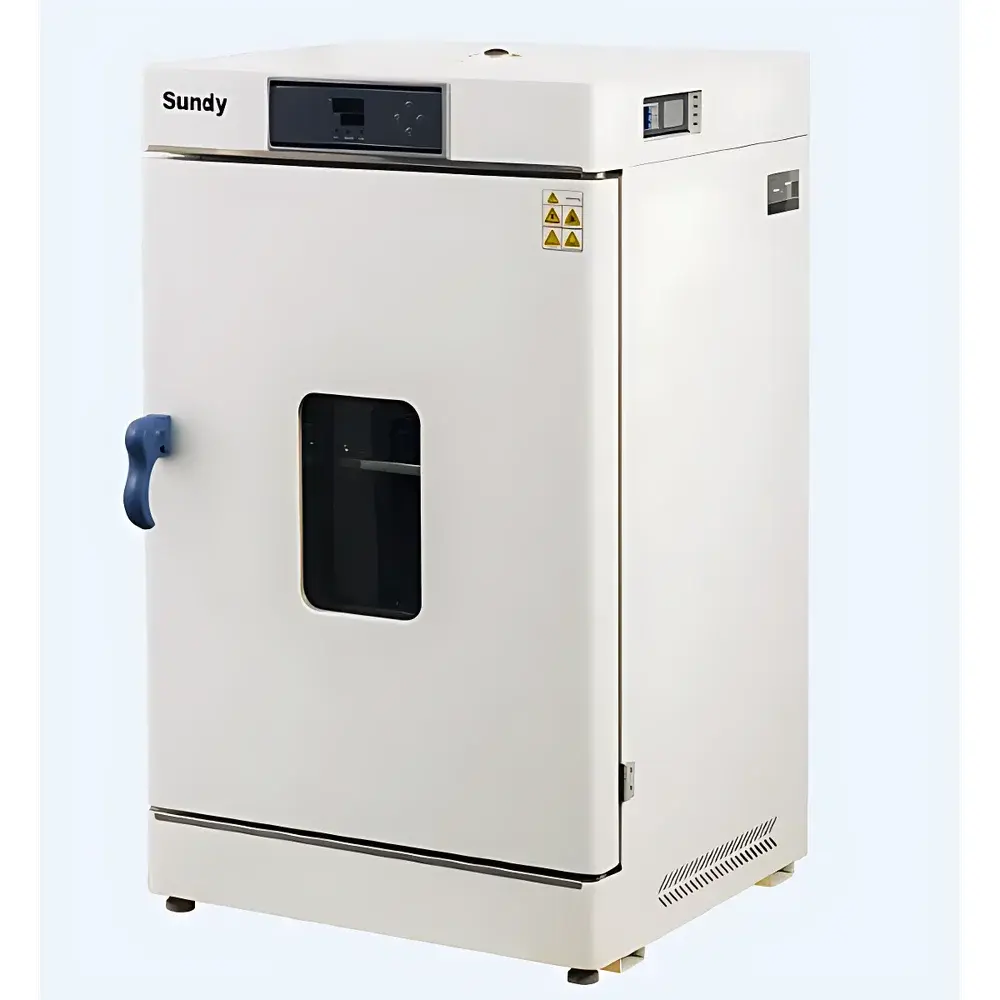
Sundy SDDH323 / SDDH313 / SDDH306 Forced-Air Drying Oven
| Brand | Sundy |
|---|---|
| Origin | Hunan, China |
| Model | SDDH323 / SDDH313 / SDDH306 Forced-Air Drying Oven |
| Temperature Range | Ambient to 300 °C |
| Temperature Uniformity | ±1 °C |
| Internal Chamber Dimensions (SDDH306) | 400 mm × 360 mm × 450 mm |
| Internal Chamber Material | Mirror-Finish Stainless Steel (AISI 304) |
| Heating Method | Bottom-Mounted Heaters with Vertical Dual-Air-Channel Forced Convection |
| Power Consumption | SDDH306: 1.6 kW |
| SDDH313 | 2.3 kW |
| SDDH323 | 3.0 kW |
| Control Resolution | 0.1 °C |
| Power Supply | AC 220 V ±10%, 50 Hz ±1 Hz |
| Compliance | GB/T 212–2008, GB/T 211–2017, JB/T 5520–1991 |
Overview
The Sundy SDDH323, SDDH313, and SDDH306 series forced-air drying ovens are precision-engineered laboratory instruments designed for consistent thermal processing in quality control, materials testing, and routine analytical workflows. These ovens operate on the principle of controlled convective heat transfer—utilizing bottom-mounted heating elements combined with a high-efficiency centrifugal blower and vertically oriented dual air channels—to ensure uniform temperature distribution across the entire working chamber. Unlike natural convection ovens, this forced-air architecture minimizes thermal gradients and accelerates drying kinetics, making the series particularly suitable for applications requiring reproducible moisture loss, ash determination, or pre-conditioning of solid samples prior to gravimetric or calorimetric analysis.
Key Features
- Robust structural design: Outer casing fabricated from cold-rolled steel with electrostatic epoxy powder coating for corrosion resistance and long-term dimensional stability.
- Optimized airflow system: Proprietary turbine-style impeller and vertical dual-channel air circulation path deliver ≥90% temperature uniformity (measured per JB/T 5520–1991 at 100 °C and 200 °C).
- High-integrity chamber: Interior constructed from mirror-finish AISI 304 stainless steel with radiused corners and electropolished surface finish to prevent residue accumulation and facilitate GLP-compliant cleaning.
- Precision digital control: PID-based microprocessor controller with 0.1 °C resolution, programmable timer (up to 9999 minutes), over-temperature cut-off protection, and real-time deviation alarm output.
- Ergonomic access and maintenance: Quick-release side baffle panels and detachable bottom heater shroud enable tool-free chamber inspection and decontamination; adjustable stainless steel shelving supports flexible sample loading configurations.
- Thermal containment: Double-glazed tempered observation window with high-temperature silicone gasket and cam-action door latch ensures minimal heat leakage (<1.2 °C external surface rise at 200 °C operating point).
Sample Compatibility & Compliance
These ovens accommodate a broad range of solid, granular, and powdered specimens—including coal, coke, biomass fuels, pharmaceutical excipients, polymer pellets, and ceramic precursors—without risk of cross-contamination or thermal degradation. Their performance is validated against internationally referenced test methods: GB/T 211–2017 (total moisture in coal), GB/T 212–2008 (proximate analysis), and JB/T 5520–1991 (industrial drying oven specifications). While not certified to ISO/IEC 17025 or ASTM E145, the units meet essential functional criteria for routine QC environments operating under GLP-aligned internal procedures. All models comply with CE-marked electrical safety requirements for Class I equipment (IEC 61010-1) and include grounding continuity verification per factory calibration records.
Software & Data Management
The integrated controller supports manual operation only—no external PC interface, USB port, or data logging capability is provided. However, the PID algorithm maintains stable setpoint tracking with <±0.5 °C steady-state deviation under load (per internal validation using calibrated PT100 probes). For laboratories requiring audit-trail functionality, third-party standalone temperature data loggers (e.g., compliant with FDA 21 CFR Part 11 when paired with appropriate software) may be deployed inside the chamber via the observation window or optional external probe port (not included). Calibration certificates traceable to NIM (National Institute of Metrology, China) are available upon request for IQ/OQ documentation packages.
Applications
- Determination of total moisture content in coal and solid biofuels per GB/T 211–2017.
- Proximate analysis (moisture, volatile matter, fixed carbon, ash) per GB/T 212–2008.
- Drying of filter papers, crucibles, and weighing dishes prior to gravimetric assays.
- Pre-heating and conditioning of catalysts, adsorbents, and battery electrode materials.
- Baking of coatings, curing of adhesives, and thermal stabilization of composite substrates.
- Low-temperature sterilization of non-critical labware where steam autoclaving is unsuitable.
FAQ
What is the maximum recommended operating temperature for continuous use?
The ovens are rated for continuous operation up to 300 °C; however, sustained use above 250 °C may reduce heater lifespan and increase thermal stress on door seals. For optimal longevity, 200–250 °C is advised for daily routine work.
Are replacement shelves and trays available as spare parts?
Yes—standard perforated stainless steel shelves (304 grade) and solid trays are stocked as consumables; custom dimensions can be fabricated upon order with lead time confirmation.
Does the unit support ramp-and-soak programming?
No. The controller supports only single-setpoint operation with timer-based shutdown; multi-step thermal profiles require external programmable controllers.
Can these ovens be used for inert-atmosphere drying?
Not natively. The chamber lacks gas inlet/outlet ports or pressure-rated seals; modification for nitrogen purging is possible but voids warranty and requires engineering review.
Is there a validation package available for GMP environments?
Factory IQ/OQ documentation templates are provided; full PQ must be conducted on-site by the user’s qualified personnel using calibrated reference standards and protocol aligned with ISO 14644 or EU Annex 15 guidelines.



